

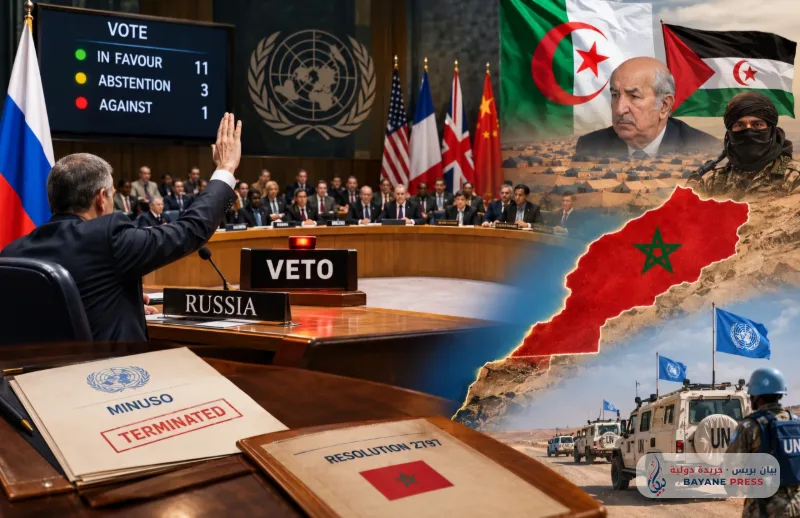
The southern provinces of the Kingdom of Morocco, and with them the entire Maghreb region, stand at a decisive historical and operational turning point following the diplomatic earthquake witnessed in the UN Security Council in late October 2026. This led—after the Russian "veto" against the American draft and the resounding defeat of the parallel Russian draft—to the expiration of the "MINURSO" mission mandate and its non-renewal. This new legal and political situation, which was immediately translated into the decisive statement of the Royal Moroccan Cabinet announcing the turning of a page lasting thirty-five years and ending the presence of the UN mission with its personnel, vehicles, equipment, and symbols in the coming days, poses a fundamental question on the strategic analysis table concerning the future of the military situation on the ground and the secrets behind international backstage maneuvers. Will the "Polisario" front, backed by its host Algeria, adhere to the truce requirements, or will the absence of international observers tempt the separatist camp to slide into a military adventure and an open war?
A reading of what transpired behind the scenes in New York reveals first that Moscow's wielding of the "veto" weapon was neither out of love for the "Polisario" front nor conviction in its thesis, but rather the result of a complex geopolitical bargain. Its goals were, on the one hand, to respond to Washington, which had single-handedly drafted the text and ignored Russian amendments, and on the other hand, to offer a political price to Algeria to ensure it does not obstruct Russia's military influence—represented by the "Africa Corps" in Sahel countries like Niger and Mali—and to preserve major arms deals with it.
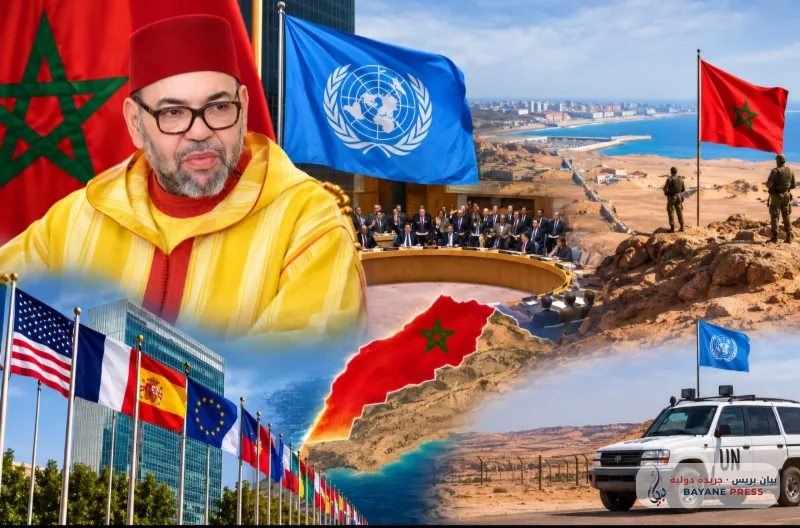
Despite Russian diplomacy's attempt to strike a balance by justifying its objection through "UN procedures" without challenging Morocco's sovereignty, the decisive Moroccan royal stance cut off any gray-zone maneuver, turning the Russian veto into a knockout blow that ended the annual "October blackmail" forever. Throughout thirty-five years, the only legal reason forcing the Security Council to hold annual sessions on the Sahara every autumn was the expiration of MINURSO's mandate and the need to renew it. Today, this "time counter" used to blackmail Morocco has fallen, and the file has practically dropped off the Council's periodic agenda. Consequently, UN Resolution 2797—which supports the autonomy initiative under Moroccan sovereignty—remains the final and indefinitely valid legal text without the need for renewal.
The hidden strategic losses of the separatist camp did not stop there, but extended to the final burial of the "human rights monitoring" card that Algeria and the "Polisario" constantly raised at each annual renewal to demand expanded powers for the mission. With the end of MINURSO's presence altogether, there is no longer any field-level UN mechanism whose powers opponents could demand to expand. Concurrently, the mission of the UN Secretary-General's Personal Envoy, Staffan de Mistura, has entered a state of clinical paralysis. Logistically and politically, the UN envoy relied in his movements, tours, and reports on the mission's infrastructure, aircraft, and field reports. With its departure, he has been stripped of his executive tools in the southern provinces, and his mission has turned into a protocol function in New York and Geneva holding no authority for field movement except with pure Moroccan sovereign permission and strictly within the ceiling of autonomy. Furthermore, despite the Russian veto formally dropping the American draft, the approval of eleven countries within the Council—foremost among them western donor powers (the United States, France, and Britain)—on clauses obligating the census of Tindouf camp residents and monitoring humanitarian aid, provided these countries with a collective political umbrella to implement this requirement outside the Security Council umbrella. This was achieved by linking their bilateral funding to the World Food Programme and the UN Refugee Agency to the condition of census and strict monitoring without the need for Russian approval.
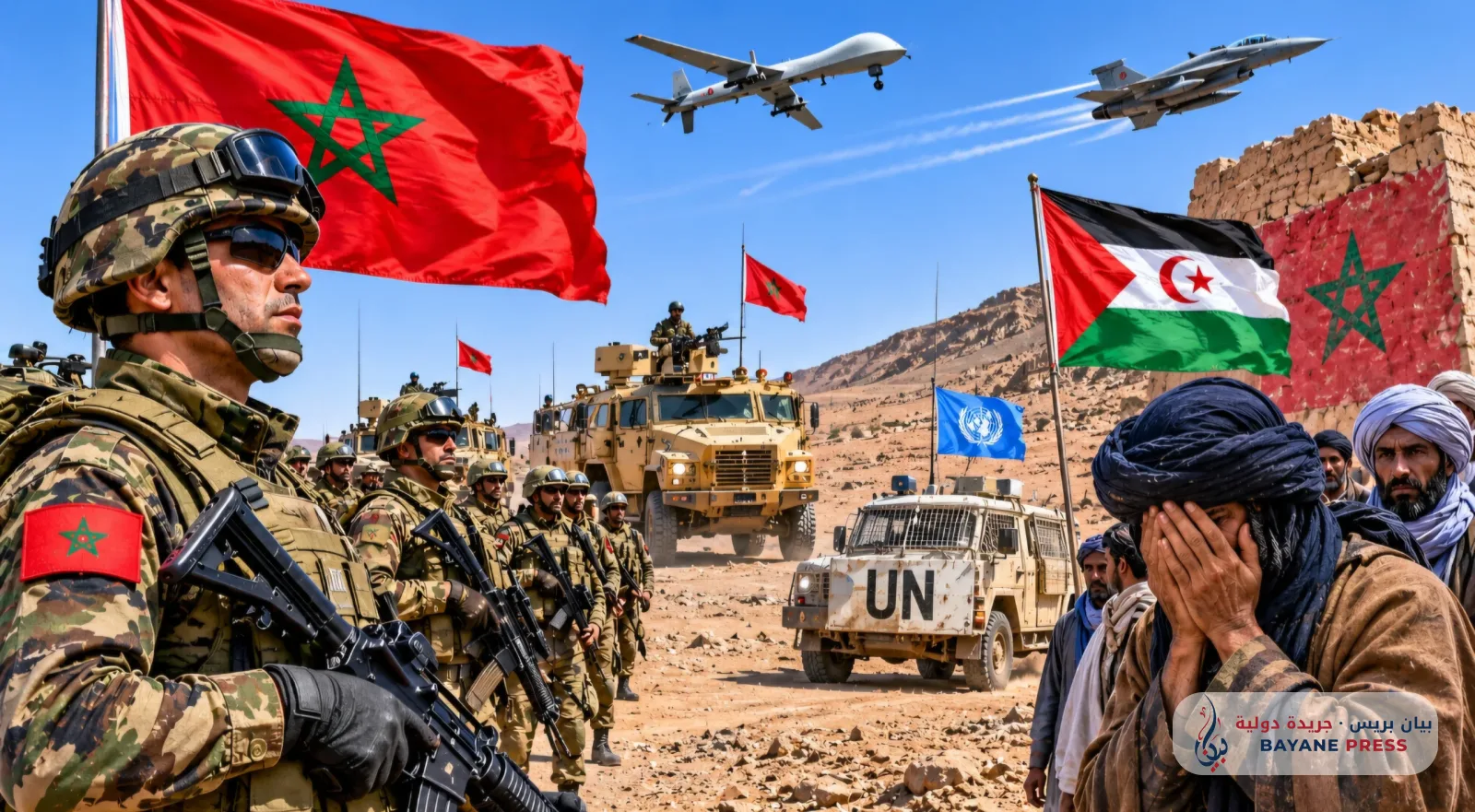
When projecting these legal and political shifts onto the military hypothesis on the ground, a constant historical and field fact emerges: the "Polisario" front had previously unilaterally declared its disavowal of the ceasefire agreement signed in 1991, in the wake of the peaceful and decisive intervention of the Royal Armed Forces to secure the Guerguerat border crossing in November 2020. Since that date, the separatist leadership has tried to market the illusion of a "resumed war" by issuing daily military statements that find no echo on the ground. All its attempts at provocation or infiltration have collided with an airtight Moroccan defense system led by the security sand berm equipped with the latest electronic monitoring and space reconnaissance technologies, alongside the overwhelming air superiority of drones and precision artillery. This has turned any hostile movement into a monitored and exposed suicide mission even before it begins.
Contrary to what opponents of the Kingdom's territorial integrity might imagine, the exit of the MINURSO mission from the field equation does not grant the separatist front any margin for military maneuver. Instead, it strips it of the last procedural umbrella it sought shelter under and leads to the "legal evaporation" of the concept of the buffer zone east of the sand berm. The areas including Tifariti, Bir Lahlou, and Agouinit were not left open by Morocco in 1991 except to enable MINURSO teams to carry out UN monitoring patrols. With the turning of the page of the mission and its departure, the concept of the "buffer zone subject to international monitoring" loses its legal and practical justification. This radical transformation—coupled with the liberation of the Moroccan army from complex UN reporting and coordination protocols that sometimes restricted the speed of response—grants the Royal Armed Forces, anchored by the Royal Cabinet statement affirming adherence to the ceasefire agreement provided there is absolute respect for the Kingdom's territorial integrity, unity, and national security, full sovereign legitimacy and operational flexibility to change rules of engagement, respond immediately and overwhelmingly to any threat, and redraw the field map either by completely closing passages or by annexing strategic parts and establishing advanced security belts directly on the international border line.
Alongside this overwhelming Moroccan field superiority, the ruling establishment in Algeria, acting as the actual financier and director of the "Polisario" front, realizes that pushing toward an all-out regional war or conventional military confrontation is a losing gamble fraught with a destructive geopolitical and economic cost it cannot bear. The suffocating diplomatic isolation—manifested in the Russian-Algerian axis's failure to gather more than three votes for its draft in the Security Council, compared to the alignment of eleven countries, three permanent veto-holding major powers, and more than two-thirds of the United Nations members behind Moroccan sovereignty and the autonomy initiative—means that any explicit military aggression will place Algeria and its militias in direct confrontation with international will and Morocco's strategic allies. This will push the conflict out of the realm of proxy skirmishes into an international crisis threatening the stability of the Algerian regime itself.
Based on these intertwined factors, the most likely scenario in the post-MINURSO era rules out the region sliding into an all-out war, given the lack of military parity and the absence of strategic depth for the "Polisario", coupled with Algeria's fear of the repercussions of a direct clash. However, this inability to wage a major war does not rule out the possibility that separatist militias might resort to staging desperate and limited skirmishes along the borders in a propaganda attempt to absorb tension and anger inside the Tindouf camps following the approach of the guillotine of the international census, and to cover up the dual diplomatic defeat caused by the Russian veto. These are provocations that will not change the field equation in the slightest; rather, they will be met by the Royal Armed Forces with utmost vigilance and decisive resolution, cementing a new reality whose title is absolute Moroccan sovereignty both on the ground and diplomatically, and the fading of separatist illusions forever.
Comments (0)
No comments yet. Be the first to react!