

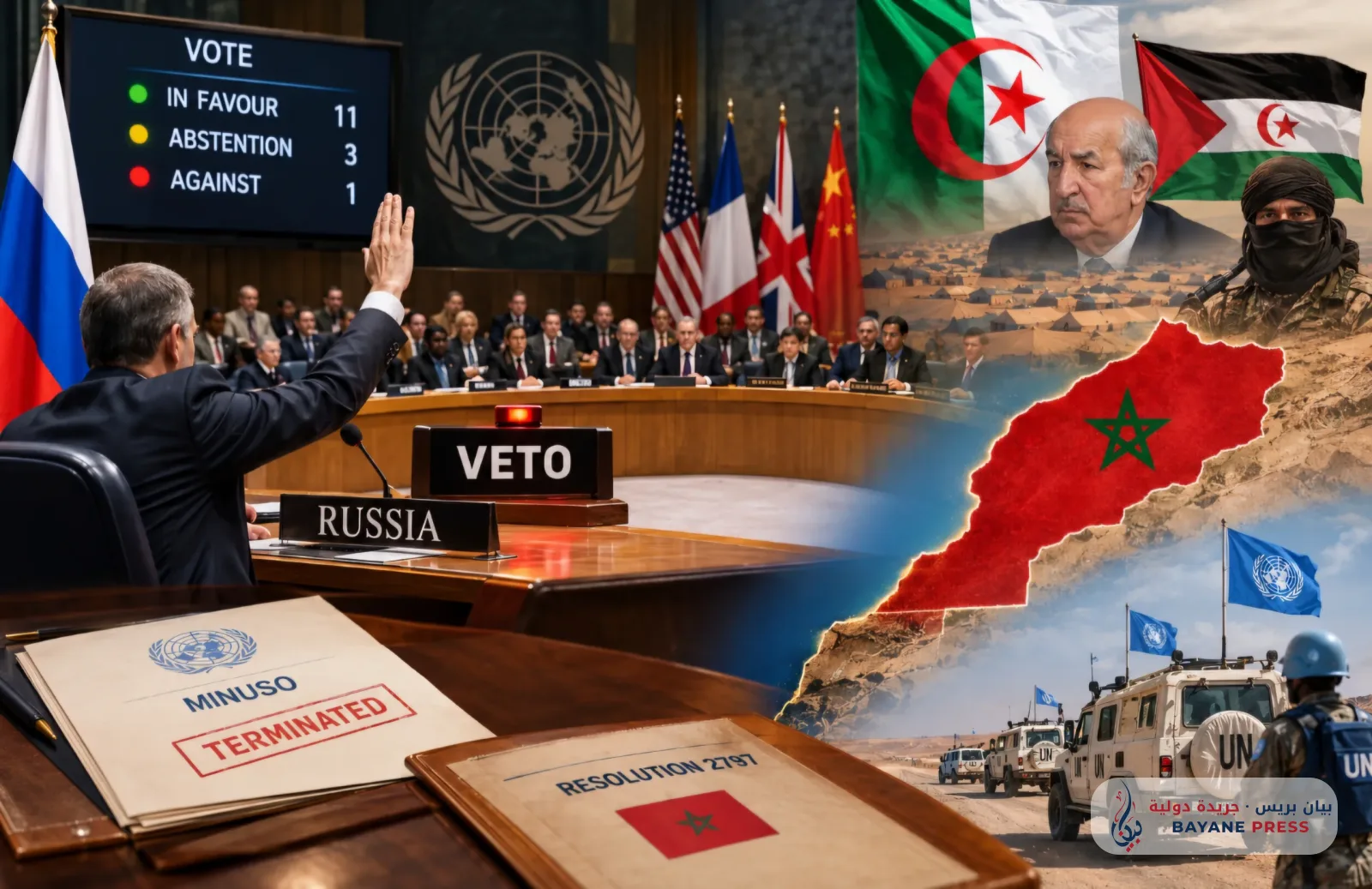
The United Nations Security Council witnessed an unprecedented geopolitical and legal shift in the course of the artificial regional conflict over the Moroccan Sahara, following the Russian Federation's decision to use its veto power to defeat a draft resolution drafted by the United States as the "penholder." The American text had garnered overwhelming support of eleven members out of fifteen within the Council, with three countries abstaining—China, Pakistan, and Somalia—before colliding with individual Russian opposition. This American draft was not merely a routine technical text to renew the mandate of the UN mission; rather, it served as a decisive document aimed at building upon the gains of UN Resolution 2797 of October 31, 2025, and transitioning the international approach from mere support for negotiations to enshrining the autonomy initiative under Moroccan sovereignty as the sole and exclusive basis for negotiation and the most viable solution on the ground.
The American draft resolution included strategic clauses sufficient to bring about a definitive break with separatist theses, expressly stipulating a change in the official name of the UN mission from "MINURSO" to "MINUSO"—a fundamental amendment entailing the final and official deletion of the word and concept of "referendum" from the United Nations dictionary and structures thirty-five years after the mission's establishment in 1991. The project also included a comprehensive restructuring of the mission's tasks and field structure, by demanding that the UN Secretary-General submit practical proposals to reduce the military element, reorganize the mission's deployment locations, and limit its tasks to monitoring the ceasefire and demining. On the humanitarian and human rights fronts, the American text included a strict provision obliging a comprehensive and accurate census of the detainees in the Tindouf camps on Algerian territory, under the supervision of relevant international agencies within a maximum period of six months, in order to control the number of beneficiaries of humanitarian aid and strengthen international monitoring mechanisms to put an end to irregularities and manipulations associated with its management.
As for the motives underlying Moscow's transition from an abstention stance—as it did with Resolution 2797 last year—to wielding the direct "veto" weapon, they are closely linked to international polarization calculations and open geopolitical confrontation with Washington within UN corridors, alongside its quest to align with its ally Algeria, whose diplomacy was mobilized to prevent the passage of the American amendments. Russia justified its objection by rejecting what it termed "pre-determining the outcome of negotiations" by imposing autonomy as the sole framework, clinging to outdated classical formulas referring to "self-determination" and rejecting the change of the mission's name and tasks. In an attempt to save the presence of the MINURSO mission and avoid a legal vacuum, Moscow rushed in the final hours to put forward an alternative and competing draft resolution providing for the extension of the mission's mandate until October 31, 2027, under its old name and tasks while excluding exclusive autonomy. However, this Russian-Algerian maneuver met with a resounding and twofold failure; the Russian proposal secured only three orphan votes against eleven abstentions, and the United States voted against it with a counter-veto, leading to its immediate abortion due to its glaring failure to achieve the required legal majority.
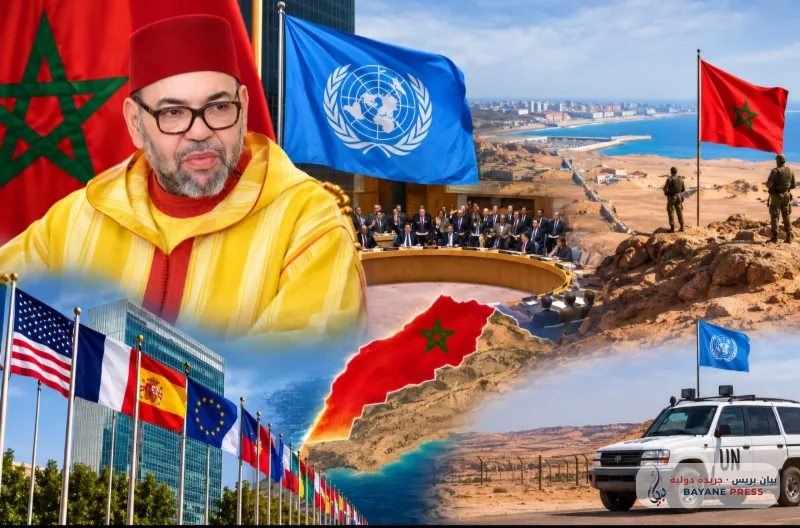
Reflecting on the implications of this event for the Kingdom of Morocco, the legitimacy of the autonomy initiative, and Resolution 2797, it is clear that the Russian "veto" did not detract an iota from Morocco's historical gains; instead, thanks to Moroccan diplomatic acumen and strategic vigilance, it transformed into an unprecedented historical achievement. The downfall of both draft resolutions (American and Russian) upon the expiration of the mission's mandate on October 31, 2026, legally and practically resulted in the expiration of the MINURSO mission's mandate and its non-renewal. Furthermore, the absence of a new resolution keeps UN Resolution 2797—which triumphed over the Moroccan autonomy initiative—as the latest and active UN reference, bolstered by overwhelming international support representing more than two-thirds of United Nations member states, eleven members within the UN Security Council, and three permanent major powers (the United States, France, and Britain), which reiterated following the voting session their firm attachment to Morocco's sovereignty and the autonomy initiative as the sole, irreplaceable solution.
In a careful reading of the question whether this "veto" serves the interests of the "Polisario" front and its host Algeria, field and political results reveal that the separatist camp has fallen into a fatal strategic trap. Instead of the Russian veto succeeding in maintaining MINURSO in its old format as Algeria planned, this objection caused the execution of the legal basis for the mission's very presence across the Kingdom's southern provinces. The Moroccan sovereign response was decisive and immediate through a historic press release by the Royal Cabinet, announcing that the Security Council's failure to renew MINURSO's mission turns a thirty-five-year-old page and constitutes a major, pivotal step toward the final closure of the Moroccan Sahara file and its removal from UN corridors, stressing that the presence of the mission with its personnel, vehicles, equipment, and symbols should end in the coming days, while the Kingdom remains committed to the ceasefire agreement provided there is full respect for its territorial integrity, unity, and national security. Thus, Algeria and Polisario's bet on Russian obstruction ended in stifling international isolation embodied in their project's failure to garner more than three votes, and in terminating the umbrella of the UN mission that was exploited to prolong the conflict, enshrining Morocco's full and absolute sovereignty over its Sahara as an irreversible historical and field reality.
Comments (0)
No comments yet. Be the first to react!