


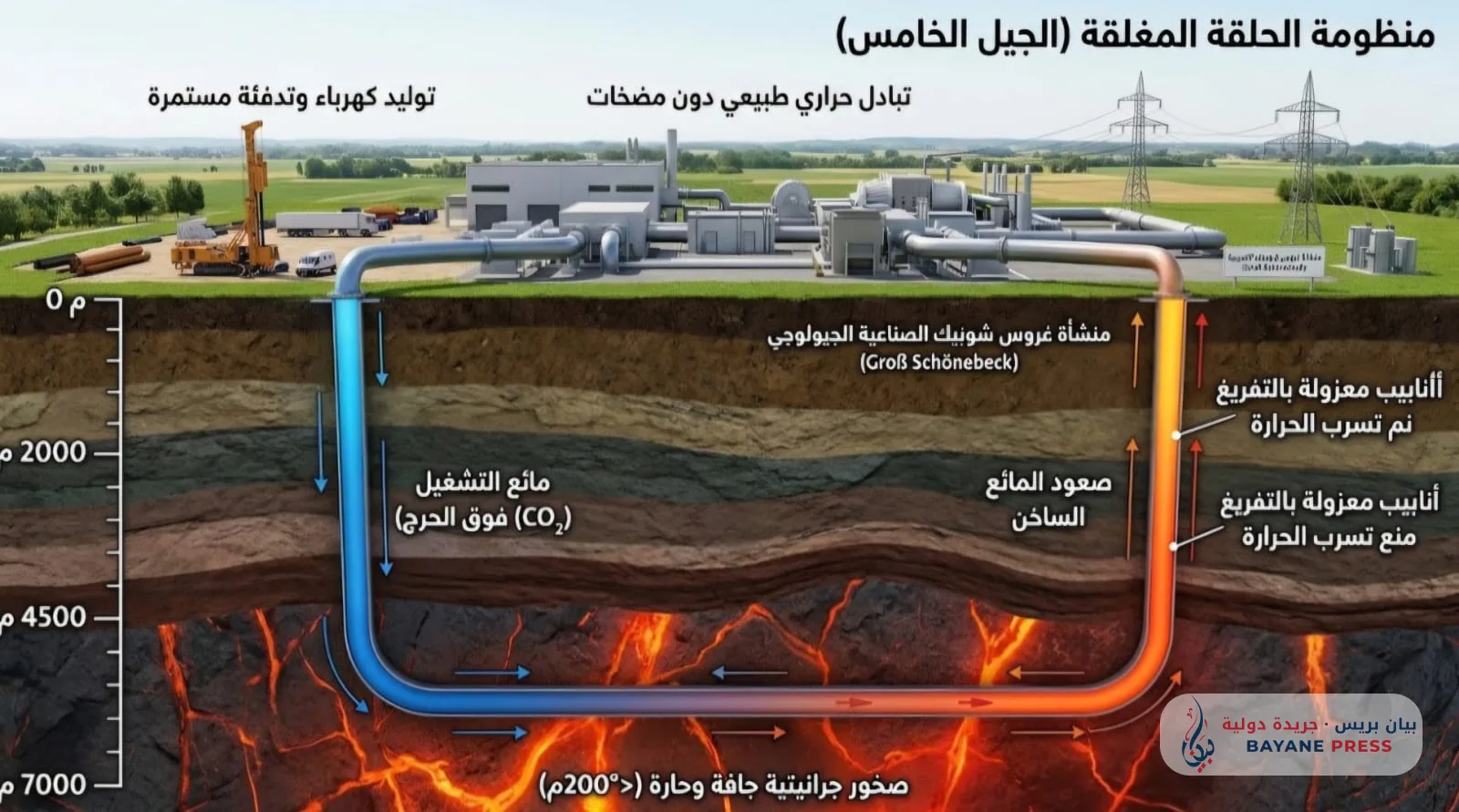
The Geothermal Energy Conference and Exhibition held on October 20, 2026, alongside a comprehensive technical study published in the engineering journal First Break, witnessed the announcement of the successful operational results of the first expanded fifth-generation closed-loop geothermal energy pilot system at the Groß Schönebeck facilities of the Potsdam GeoForschungsZentrum.
The system provided conclusive engineering proof regarding the feasibility of extracting electricity and heat from dry underground rock without the need for natural groundwater reservoirs or resorting to hydraulic fracturing, which raises environmental concerns.
The technology relies on drilling a network of deep wells reaching depths of between 4,500 and 7,000 meters using guided directional drilling techniques, lining the trajectories with vacuum-insulated pipes to prevent heat loss during the fluid's ascent.
Additionally, an advanced working fluid, such as supercritical carbon dioxide, is circulated within a completely closed loop that absorbs heat from deep granitic rocks, whose temperatures exceed 200 degrees Celsius, subsequently flowing to the surface driven by the natural thermosiphon effect due to density differences, without the need for electric circulation pumps.
Assessments by energy research firm Rystad Energy demonstrated that the system delivers stable clean electricity production with an operational rate exceeding 95 percent year-round, and at a cost ranging between 55 and 65 dollars per megawatt-hour, making it possible to generate baseload energy and district heating in any geographic region without being limited to fault zones and volcanic springs.



Comments (0)
No comments yet. Be the first to react!