


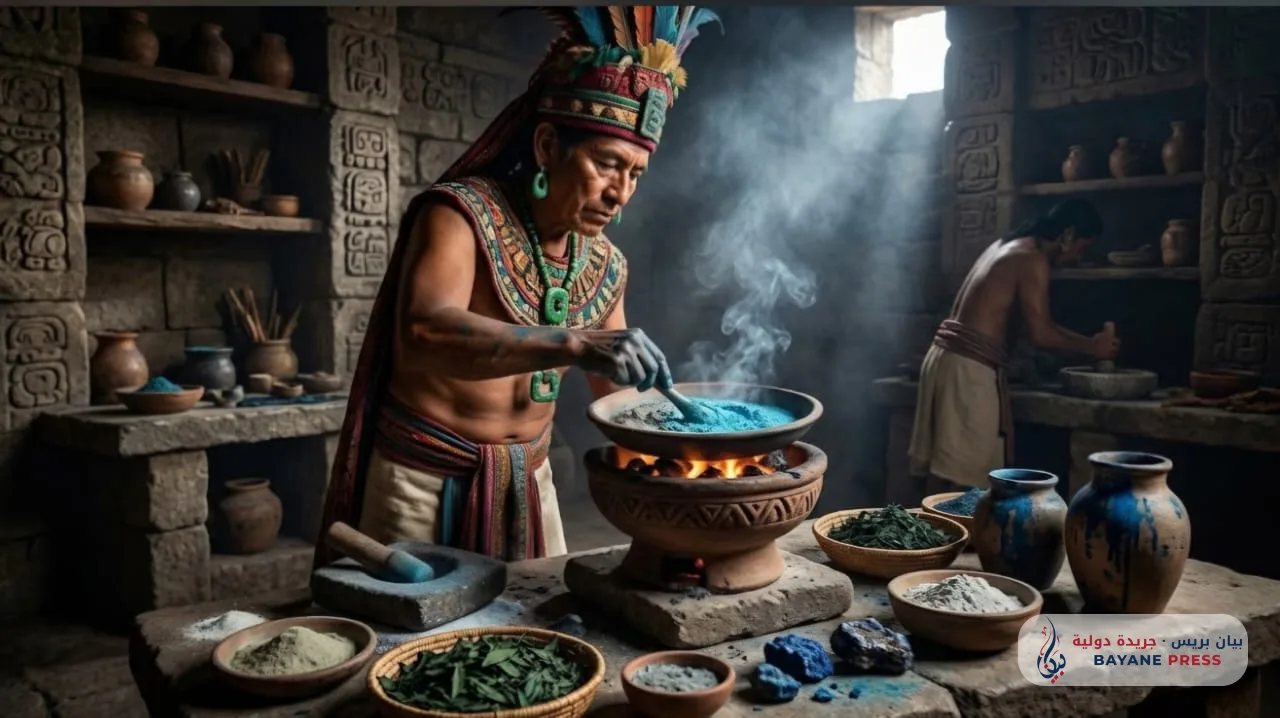
The color "Mayan blue" represents one of the greatest technical mysteries in the chemistry of synthetic materials created by Mesoamerican peoples during the Classic period of the Mayan civilization, which spans between 250 and 900 AD, as evidenced in the famous murals of the Temple of Bonampak, the texts of the Madrid Codex, and the offering deposits of the "Sacred Cenote" in the city of Chichen Itza. This color was not a simple ordinary paint, but a super-resistant hybrid material combining organic and mineral components, endowed with an exceptional capacity to resist corrosion due to extreme tropical humidity, acids, chemical solvents, and high temperatures, maintaining its brilliant turquoise shine on walls, sculptures, and human offerings for more than 15 centuries.
This chemically proven Mayan recipe is based on two main elements of disparate nature; the first is an organic vegetable blue dye extracted from the leaves of the wild indigo plant, belonging to the legume family and scientifically known as "Indigofera suffruticosa", and the second is a rare type of mineral clay with a fine fibrous crystal structure known as palygorskite or attapulgite, a whitish-gray clay that the Maya carefully extracted from rocky cavities and sacred caves in the Yucatán Peninsula called "sak kab", in addition to the use of copal incense resin during thermal fusion to bond the components together.
The manufacturing process begins by harvesting the leaves of the indigo plant and fermenting them in water ponds until they release their blue juice, then filtering the liquid and drying it under sunlight to produce solid blocks of pure blue indigo powder. After this, the dry palygorskite is taken and ground with the indigo powder in a precise weight ratio of approximately one part indigo dye to every 10 or 15 parts clay, rubbing both components together in dry circular movements until the blue powder penetrates the pores of the clay and its dark color disappears, transforming into a pale gray mixture seemingly devoid of any shine or color radiation.
Next comes the crucial and secret chemical step documented by archaeologists and modern spectroscopic analysis: subjecting this mixture to a controlled thermal treatment ranging between 100 and 150 degrees Celsius over ritual censers filled with burning blocks of copal gum. The continuous heating expels the water molecules trapped inside the structural channels of the clay ore, allowing the fine indigo dye molecules to slip inside the nanoscale channels of the attapulgite and chemically bond with the internal silica walls. At that moment, the pale earthy mixture miraculously transforms into a luminous sky-blue color that neither fades nor dissolves in water, and with which the Mayan priests painted the bodies of warriors and sacrificial victims, as well as ritual vessels offered to the rain god "Chaac" in search of fertility and water.
Comments (0)
No comments yet. Be the first to react!