


Ancient Egyptian medical and cosmetic papyri—primarily the Ebers Papyrus and the Kahun Papyrus, dating back approximately to 1550 BC—along with precise chemical analyses conducted by researchers from the Louvre Museum and the French National Center for Scientific Research (CNRS) on samples taken from cosmetic applicators and vessels preserved in pharaonic tombs, document that eye kohl formerly known as "mesmet" was not merely an aesthetic dye to adorn the eyes, but a highly complex medical and preventive drug prepared with rigorously measured proportions to protect vision from the abrasive desert sun, dust and sandstorms, and swarms of flies transmitting bacterial infections along the banks of the Nile River.
This pharaonic recipe is based on the combination of two main components of natural minerals extracted from the depths of the earth: the first is galena mineral, a dark silver-gray lead sulfide extracted from the lead mountain mines near the Red Sea and the Aswan mines; the second is green malachite, a basic copper carbonate extracted from the Sinai desert, in addition to frankincense gum powder, burned almond shells, and charred olive pits. However, the most prominent scientific discovery in this recipe lay in the fact that pharaonic chemists synthesized two chemical compounds not found naturally in raw minerals, laurionite and phosgenite, through a wet manufacturing process that included dissolving lead oxide in saltwater and filtering it repeatedly for weeks, with the aim of reducing lead toxicity and increasing its capacity to stimulate the local immune system.
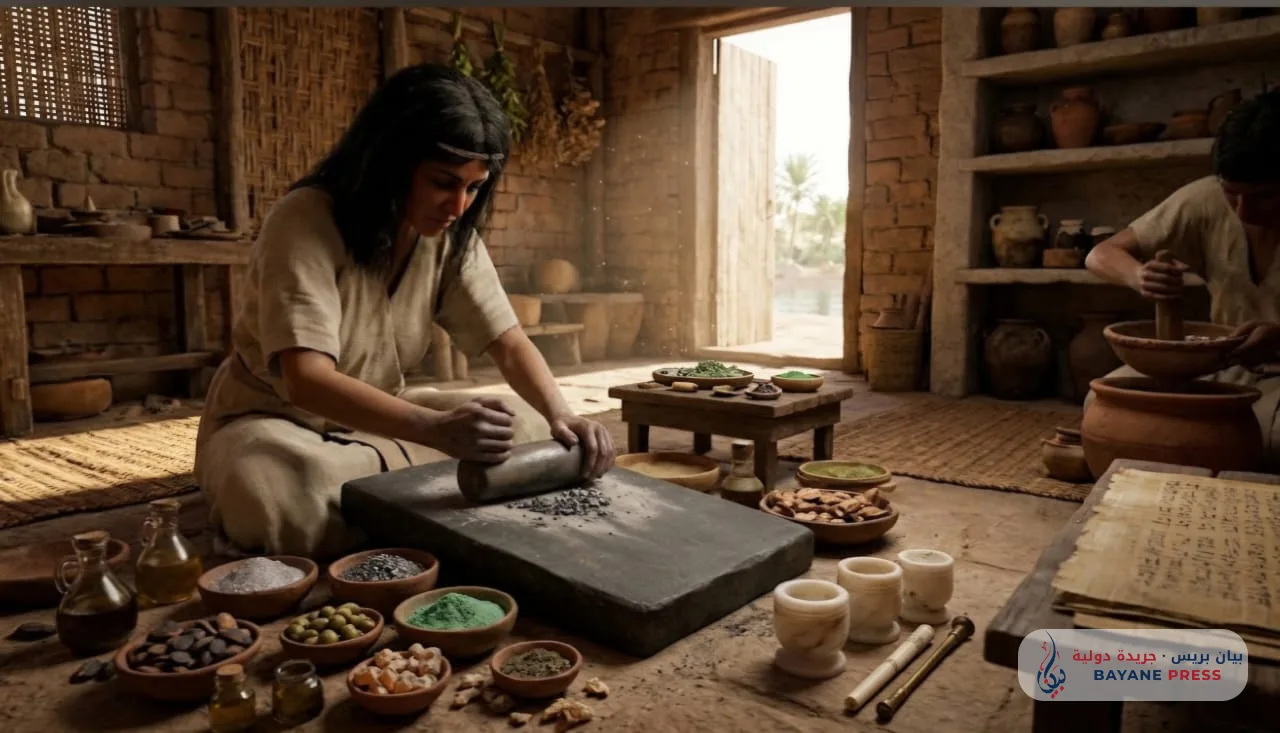
The practical preparation stages begin by crushing galena rock crystals with extreme precision on hard schist or basalt stone slabs, using a polished stone mortar until the coarse grains turn into an extremely fine powder that does not cause the slightest scratch on the cornea of the eye. This lead powder is mixed with charred almond shells that impart a deep carbon black, to which frankincense resin powder is added, acting as a sterilizing agent and fixative for the preparation. To obtain a consistency suitable for drawing and application, the dry mixture is kneaded gradually by adding purified cattle fat, warm goose fat, or cold-pressed castor oil, beating constantly until forming a smooth, homogeneous paste similar to a thick ointment.
Modern microscopic analyses have shown that this compound releases lead ions in extremely minute concentrations as soon as it comes into contact with the delicate tear film, stimulating the keratinocyte cells of the eyelid to produce nitric oxide in quantities exceeding the normal rate by 240%, this being the biological gas responsible for activating the immune system and destroying the bacteria causing conjunctivitis and trachoma before they infiltrate the eye. This kohl was kept inside cylindrical vessels carved from white alabaster or decorated wood, and was applied using a thin ivory or bronze applicator passed between the eyelids each morning and evening to protect the sight of peasants and kings alike.



Comments (0)
No comments yet. Be the first to react!