


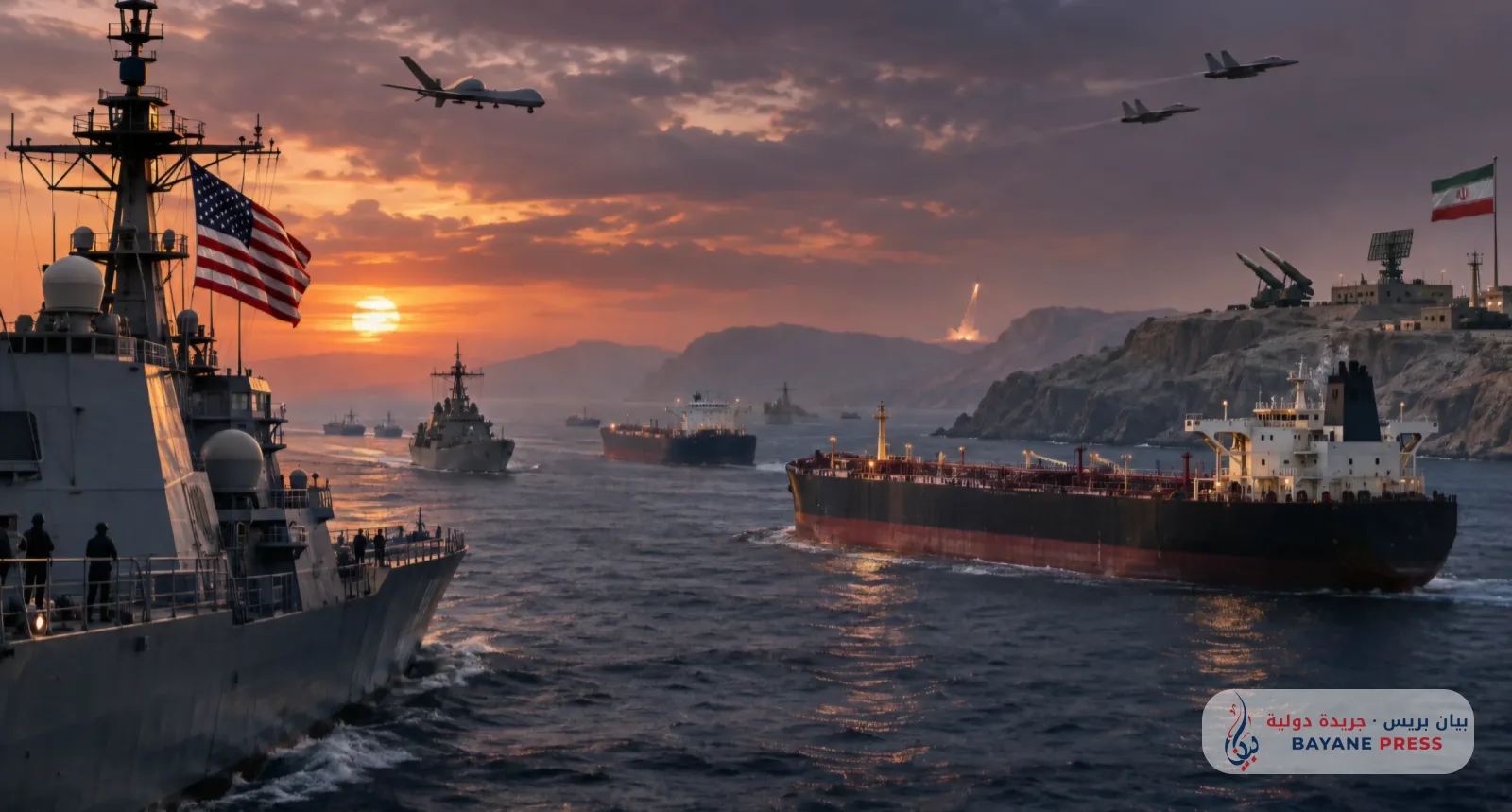
The US-Iranian confrontation is no longer just a military conflict whose results are measured by the number of missiles, aircraft, and airstrikes, but has turned into a complex geopolitical battle in which the calculations of nuclear deterrence, control of maritime corridors, economic attrition, and the redrawing of power balances in the Middle East are intertwined. While Washington seeks to translate its military superiority into political gains, Tehran is betting on its ability to endure and raise the cost of the confrontation to prove that possessing firepower does not necessarily mean the ability to impose peace terms. Thus, both parties find themselves facing a highly complex equation, in which the chances of a swift military resolution are receding, while political settlement falters in the face of conflicting strategic demands.
In the developments of Tuesday, November 10, 2026, a notable discrepancy emerged between American rhetoric and military preparations on the ground, after President Donald Trump indicated on Monday, November 9, that he was in no rush to resume large-scale strikes against Iran, following discussions with the Qatari Prime Minister and contacts regarding regional de-escalation efforts. However, this approach was not accompanied by a relaxation of the US naval blockade on Iranian ports, or the abandonment of the military intervention option, which reveals an American attempt to manage the conflict through continuous pressure without rushing into a comprehensive confrontation whose repercussions could extend beyond Iranian territory to Gulf security and global energy markets.
This trend was reinforced by statements from US Secretary of State Marco Rubio, who, as reported by Reuters citing diplomats during the G7 meetings in Paris, confirmed Washington's determination to continue imposing harsh economic costs on Iran. He considered that the United States possesses options that go beyond the binary choice of resuming a large-scale war or accepting Iranian conditions. This position reflects a shift in the management of American pressure, based on employing sanctions, the blockade, and ready military capabilities to improve Washington's negotiating position, rather than relying exclusively on airstrikes to achieve political objectives.
However, the Iranian vision stems from different calculations. Mohsen Rezaei, Secretary of the Supreme National Security Council of Iran, confirmed that there are no ongoing negotiations with Washington, noting that Tehran is awaiting a clear American response to its seven conditions linked to last June's understandings, which it considers the basis for reopening the Strait of Hormuz and resuming talks. Foreign Minister Abbas Araghchi also denied reports regarding an upcoming meeting between Rezaei and US Vice President J.D. Vance, emphasizing that ending the confrontation cannot be achieved by military force or tightening sanctions alone.
These positions gain their importance from the fact that both parties had previously signed a memorandum of understanding in June 2026, aimed at establishing a framework to end the war that broke out in February, without that step succeeding in producing a final, enforceable settlement. Hence, one of the central knots of the conflict emerges; Washington wants security and nuclear guarantees before making substantial concessions, while Tehran insists on lifting the blockade, easing sanctions, and responding to its demands as a necessary entry point for any agreement. This equation shows that the obstacle is no longer limited to opening communication channels, but includes arranging obligations and determining which party must take the first step.
In parallel with this diplomatic stalemate, Iran unveiled a new underground missile facility, as announced by the Revolutionary Guard and reported by Tasnim agency, in the presence of the Chief of Staff of the Iranian Armed Forces, Major General Ali Abdollahi, and the Commander of the Aerospace Force of the Revolutionary Guard, Brigadier General Majid Mousavi. The footage released by Iranian media showed ballistic and cruise missiles and launch systems inside underground facilities, in a military message aimed at demonstrating the continuity of Iranian deterrence capabilities despite the strikes the country has been subjected to.
Mousavi went on to warn that his country could target the capabilities of its adversaries inside and outside the region if necessary. Iranian officials also spoke of moving some missile and drone production lines to fortified underground facilities, with the aim of reducing their vulnerability to airstrikes. However, these statements remain part of the Iranian military narrative, and the published footage alone does not allow for independent verification of the size of the missile stockpile, the actual production capacity, or the extent of the facilities' ability to continue operating during intensive bombardment operations.
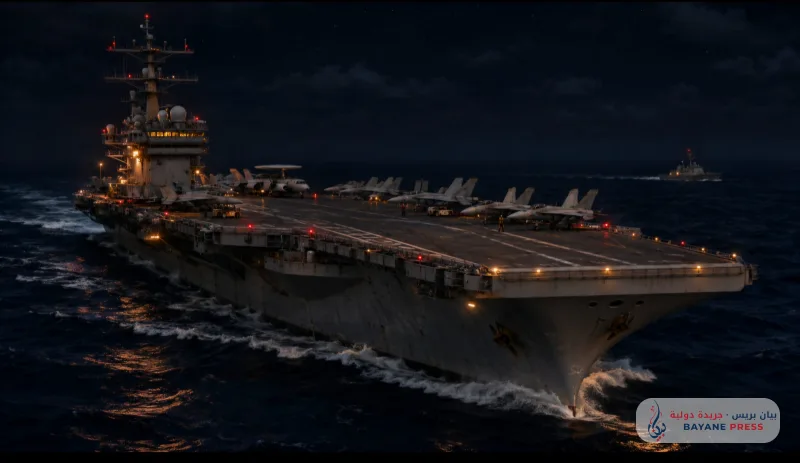
On the other side, US Secretary of Defense Pete Hegseth confirmed that US forces maintain their ability to monitor Iranian nuclear facilities and act against activities they consider a threat. He went on to describe the naval blockade as tight, stressing the continued readiness to resume strikes. These statements reflect the Pentagon's desire to emphasize that political hesitation does not mean military retreat, and that Washington seeks to maintain a wide margin of freedom of movement and pressure.
But the most dangerous test of this strategy remains in the Strait of Hormuz, which has turned from a vital maritime corridor into a confrontation arena where mines, missile threats, interception operations, and naval blockades overlap. The Iranian Revolutionary Guard announced on Tuesday that two oil tankers were subjected to explosions and fires while attempting to cross paths it described as unauthorized, noting that one of them collided with a naval mine, and claimed that the second was moving under the protection of US military aircraft. Although this narrative was conveyed via Tasnim agency and international media, the identity of the two tankers and the operational details of the incident were not all independently confirmed, especially with similar Iranian announcements about maritime incidents during the previous days.
Documented figures reveal that the maritime danger goes beyond a single incident. According to data from the Washington Institute for Near East Policy, cited by Reuters in a report published on November 10, 37 ships were subjected to attacks during last October, the highest monthly number since the outbreak of the war. The International Maritime Organization also recorded 130 maritime incidents in the region since late February, resulting in the death of at least 25 sailors. This toll gives a clearer dimension to the nature of the confrontation, where commercial navigation is no longer just an economic activity affected by the war, but has become one of its most sensitive arenas.
The danger of Hormuz does not lie in the number of targeted ships alone, but in its position within the global energy system. Before the war broke out, about a fifth of global oil and liquefied natural gas trade passed through the strait, which makes the disruption of navigation in it a factor capable of affecting shipping and insurance costs, energy supplies, and international prices. From this standpoint, Iran is trying to use its geographical location and military capabilities to expand the scope of pressure on Washington, while the United States seeks to reduce Iranian economic resources by blockading ports and preventing the circumvention of imposed restrictions.
However, this equation carries mutual risks; the continued disruption of navigation may harm the global economy and increase political pressure on the American administration, but it also exposes Iran to cumulative economic and military losses, and threatens to expand the circle of confrontation with affected countries. Therefore, the ability to disrupt maritime corridors does not necessarily equate to the ability to control the final outcomes of the conflict.
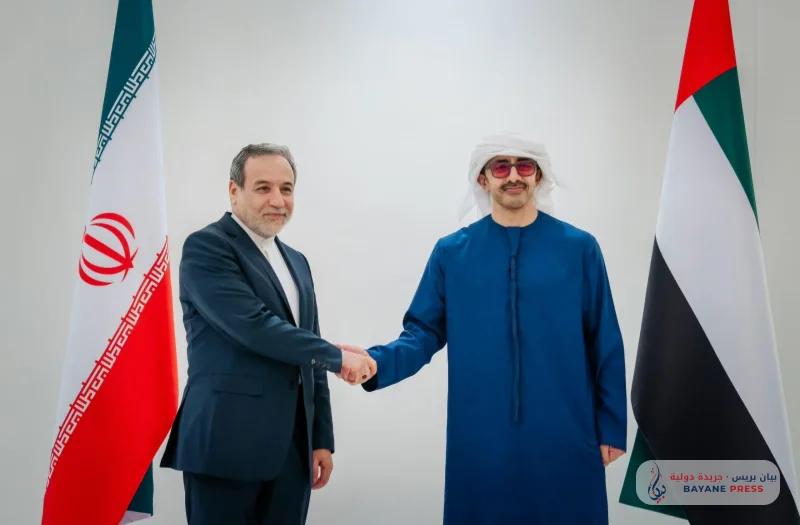
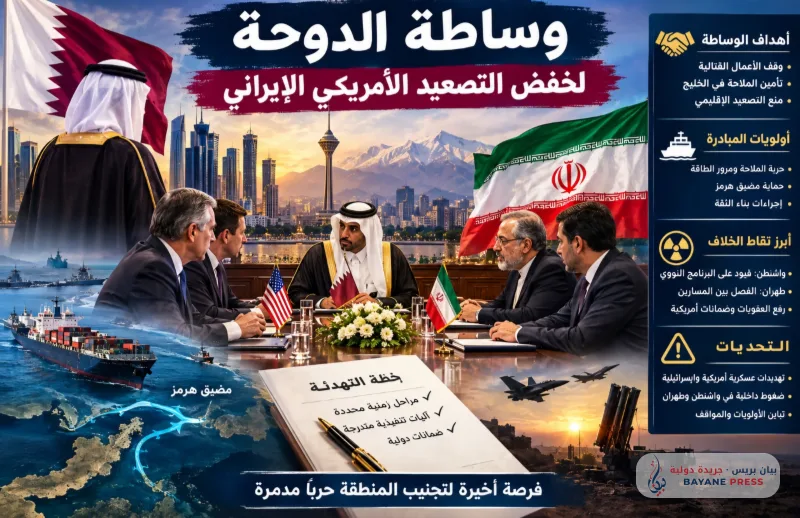
Gulf states emerge at the heart of these calculations, as they are the most exposed to the direct repercussions of any new escalation. Qatari moves aimed at bridging the positions between Washington and Tehran reflect a regional realization that the continuation of the confrontation not only threatens the security of oil facilities and ports, but may put the economic and investment stability of the entire region to a long test. Israeli security calculations also remain present in the background of the scene, especially regarding the Iranian nuclear program, missile capabilities, and regional influence networks, which increases the difficulty of reaching arrangements that guarantee the interests of all parties.
Inside the United States, the continuation of the war faces a growing political challenge. A poll conducted by Reuters in cooperation with Ipsos, which included 1,705 American adults, showed that 71 percent of participants support the passage of legislation by Congress to end the war with Iran, including 93 percent of Democrats and 51 percent of Republicans. These numbers do not necessarily mean there is a consensus on all details of US foreign policy, but they reflect the breadth of popular support for legislative action that puts an end to the conflict, in light of concerns about the rising cost of living and energy prices.
The poll results gain additional importance after the midterm elections that gave the Democrats a majority in both houses of Congress, with the new Congress assuming its powers in January 2027. This shift may add new political and legislative constraints on the Trump administration, and make the continuation of military operations and the spending associated with them a more prominent subject in the internal American debate, even if the ability of Congress to change the course of the war will remain linked to complex constitutional and political balances.
From a broader geopolitical perspective, the confrontation reveals the limits of using military superiority to achieve long-term political goals. The United States can inflict extensive damage on Iranian military and economic infrastructure, but it cannot assume that this damage will automatically lead to Tehran accepting its conditions. Conversely, Iran can employ missiles, maritime corridors, and asymmetric deterrence tools to prolong the crisis, but it has no guarantee that attrition will lead to extracting American concessions without heavy internal and regional costs.
Here lies the most important strategic paradox: each party is trying to turn its ability to inflict damage on its adversary into political leverage at the negotiating table, but continuing this approach may lead to a war of attrition in which the chances of settlement recede as losses accumulate and the conditions for ending the confrontation grow.
The next phase seems linked to three decisive issues: the future of the US naval blockade, guarantees related to the Iranian nuclear program, and the conditions for ending military operations and sanctions. Any agreement that does not address these files in an interconnected manner may turn into a fragile truce, capable of collapsing with the first maritime incident, military strike, or disagreement over the implementation of obligations.
In conclusion, the most important question is no longer who possesses the strongest weapon, but who can turn their elements of power into a stable settlement without long attrition or expanding the scope of the war. Washington faces the test of translating its military superiority into a political result, and Tehran faces the test of maintaining its capabilities and negotiating position under continuous economic and military pressure, while the Middle East stands before two open possibilities: a settlement that requires mutual concessions, or the continuation of a confrontation that is limited in its direct scope, but broad in its economic and strategic effects.
Between the American blockade, Iranian deterrence, and the fears of Gulf capitals, a geopolitical reality is crystallizing that is difficult to ignore: military force may succeed in changing the balances on the ground, but it alone does not guarantee changing the political calculations of the adversary. Therefore, the greatest challenge facing Washington and Tehran is no longer proving the ability to continue the war, but finding a way out of it before the cost of its continuation becomes higher than the gains each party seeks to achieve.
Comments (0)
No comments yet. Be the first to react!