


Forward-looking analysis — Saturday November 7, 2026
Starting today, the US-Iranian confrontation enters days of heightened anticipation, with intersecting military preparations, the approaching new moon, and continued Qatari mediation, coinciding with the movement of the aircraft carrier "Theodore Roosevelt" toward the Middle East. These data points allow for a discussion of the possibility of a new escalation in the coming days, but they do not confirm a date for an attack. This is an analysis of potential paths based on published information, not a disclosure of a decided operation; as no US decision for a new, large-scale campaign has been announced, according to the sources relied upon here.
The midterm elections have already concluded, and their results have become part of the White House's calculations. According to an NBC report cited by "Iran International," some of President Donald Trump's advisors urged the resumption of major military operations before the Democrat-controlled Congress takes office in January 2027, fearing that investigations and funding restrictions might hinder any subsequent move. The report stated that Defense Secretary Pete Hegseth is pushing for renewed strikes, while others warn against undermining the diplomatic path, with the decision remaining unresolved at the time of publication.
The near-term timing gains its importance from reports that linked military options to the new moon, when the side of the moon facing Earth is almost entirely unlit and the moon is close to the direction of the sun in the sky, making it generally invisible.
The US Naval Observatory identifies the new moon on Monday, November 9, at 07:02 UTC. "The Times of Israel" quoted Fox News as saying that officials considered the accompanying darkness a favorable condition for operations. This places the days surrounding this date among the possibilities, without making the period from November 7 to 11 a confirmed execution window.
As for the nature of a potential campaign, some estimates are based on previously discussed options. Coverage cited a New York Times report published on October 8 regarding the preparation of a plan for about three days of intensive strikes, focusing on missile and drone capabilities, which could include energy facilities and Revolutionary Guard command centers. The report noted that Trump had rejected previous proposals. This confirms that military options have been discussed, but whether the October plan is being adopted today, or whether its duration is linked to the new moon nights, remains unconfirmed.
In this climate, a post by American journalist Tucker Carlson on the "X" platform sparked controversy regarding the potential use of a nuclear weapon against the Iranian "Jabal al-Fas" facility. According to the coverage that relayed his remarks, he claimed that Netanyahu is pushing for this option and that Trump might make his decision by November 7, without providing independent public evidence. This does not equate to saying that Washington will carry out a nuclear strike today. Coverage also noted the White House's skepticism regarding his claims and pointed out that Trump had previously ruled out the use of nuclear weapons against Iran. Therefore, the post remains an unverified claim and is not relied upon as an indicator to favor a nuclear attack.
The clearest military indicator is the continuation of limited operations. In coverage published today, Reuters relayed Trump's statements regarding new strikes targeting Iranian air defenses, coinciding with reports of explosions in the Suza area on Qeshm Island. These developments reveal the continued use of force during negotiations, while the question remains open: will the strikes remain limited or expand into a larger campaign? Considering them a confirmed prelude to a wide-scale operation goes beyond what the available information proves.
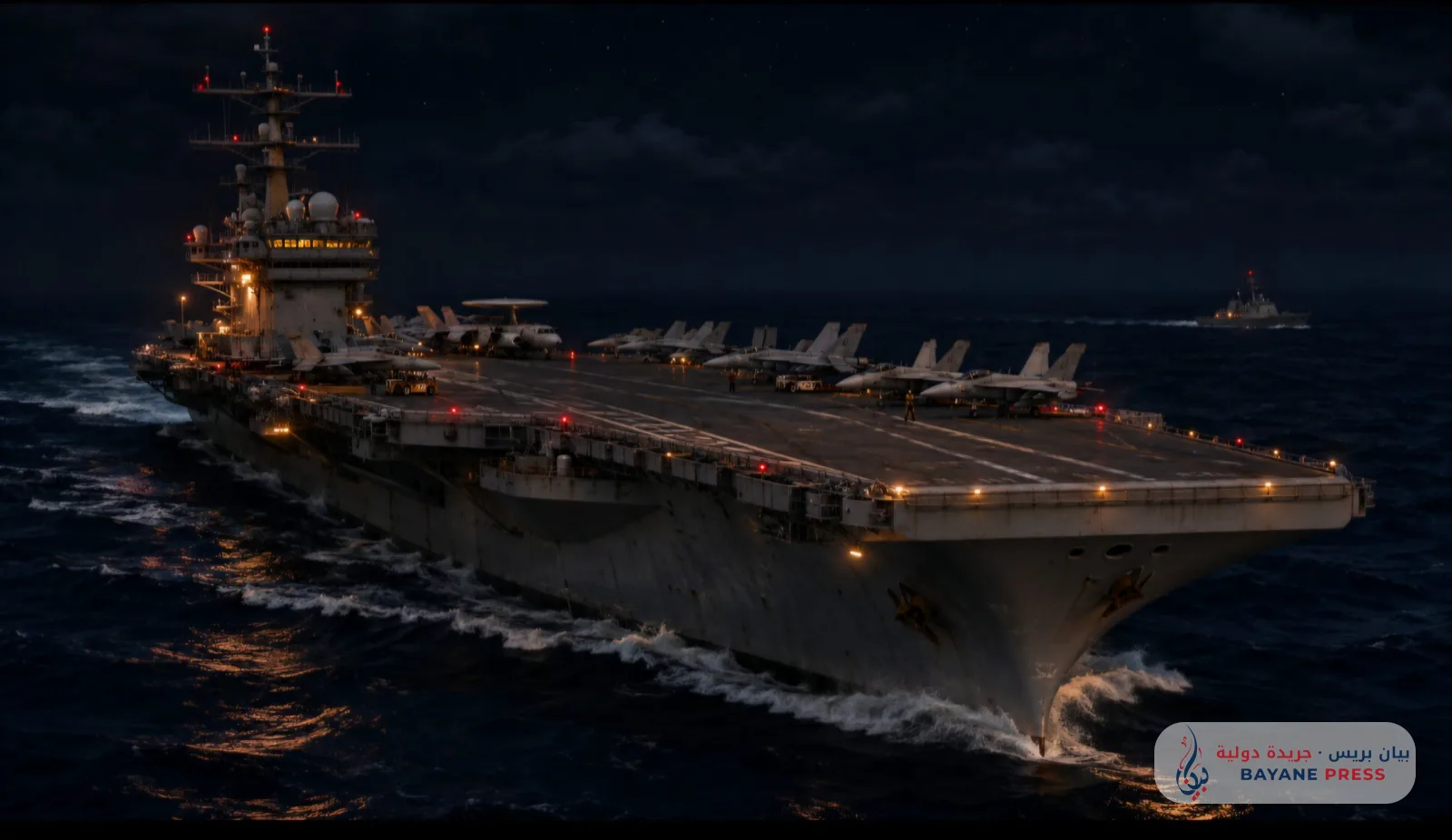
The "Theodore Roosevelt" adds another dimension to the picture. It arrived in Singapore on Friday, November 6, local time, before its expected transit to the Middle East. According to the US Naval Institute, it is likely to replace the carrier "George Washington," with it being unclear whether Washington will keep three carriers in the region together. If their simultaneous presence continues, the available military options might expand; if it is limited to troop rotation, its arrival alone does not prove readiness for a prolonged war.
In Israel, government formation negotiations add an element of political uncertainty. President Isaac Herzog announced that Gadi Eisenkot had received recommendations from blocs representing 67 deputies, compared to 46 for Netanyahu, with his intention to assign the mandate on Sunday.
However, recommendations do not mean the formation of a government coalition, and the mandate does not equal an immediate transfer of power. Therefore, it is difficult to consider November 8 as the date for Netanyahu's departure, or to conclude a direct impact of this development on the timing of the American decision.
This coincides with Trump's announcement that annual funding for Israel will stop after the end of the year, while arms sales to it will continue. However, Reuters noted the absence of implementation details, in light of an existing aid memorandum until 2028. The announcement might reshape support arrangements without necessarily meaning a political rupture or a retreat in military coordination between the two countries.
Conversely, diplomacy remains a factor capable of changing the course. Bloomberg spoke about the possibility of achieving a negotiating breakthrough, with Iran's readiness to discuss issues related to its nuclear program. The Qatari Prime Minister confirmed the continuation of mediation and progress, calling for a good agreement instead of waiting for a perfect one. These signals keep the possibility of an understanding alive and prevent treating the military buildup as an inevitable path to war.
Based on this, one can imagine a path that begins with expanding strikes with existing forces, then maintaining or increasing pressure with the arrival of the Roosevelt. But it is not the only path; limited operations might continue in parallel with negotiations, or progress in mediation might contain the escalation. Furthermore, it is impossible to guarantee that any short campaign will remain within its assumed duration, especially with the Iranian threat to respond to American and Israeli targets in neighboring countries, which could expand the confrontation and reshape its calculations.
From today, the most likely reading in light of the presented information is the continued combination of military pressure and negotiation, with the possibility of a wider campaign remaining if mediation falters and an execution order is issued. The new moon nights, the carrier's movement, and the advisors' pressures explain the heightened anticipation, but they do not prove that a date for an attack has been chosen. As for talk of a nuclear strike, it is not supported by available evidence.



Comments (0)
No comments yet. Be the first to react!