


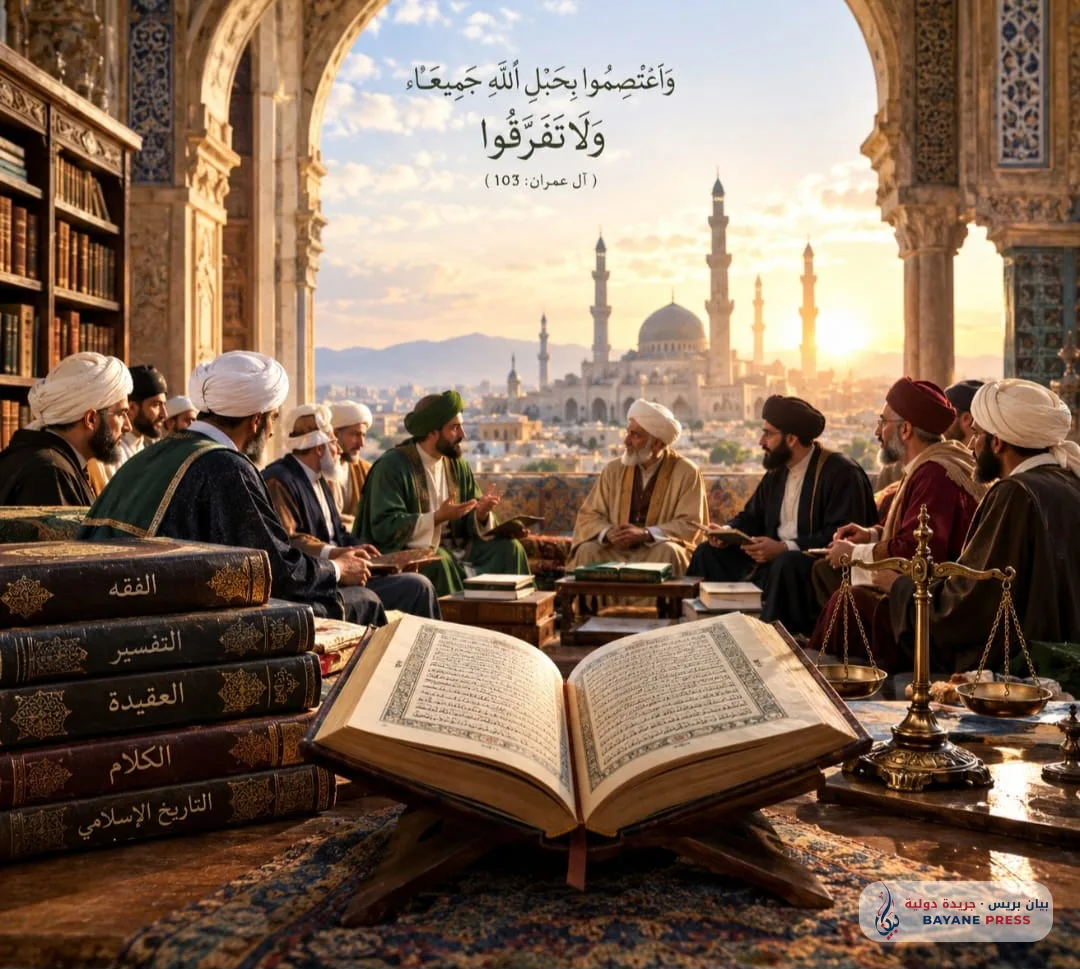
Islamic doctrine emerged in its dawn pure and clear like the dawn, relying on the innate nature of pure monotheism and addressing the human intellect in the direct language of revelation, uniting scattered hearts under a single banner. However, the expansion of the Islamic State after the prophetic era, the mingling of Arabs with other nations bearing philosophical heritages and ancestral cultures, in addition to the major political events that shook the first century of the Hijra, generated theological and doctrinal questions that were not raised in the time of revelation. From the bosom of this interaction between the sacred text, the reflective mind, and historical reality, Islamic theological schools and sects crystallized: Sunnis with their three schools (Ash'aris, Maturidis, and People of Hadith), Shiites with their branches (Twelver Imamis and Zaidis), Ibadis, Mu'tazilis, Murji'is, and other factions recorded by scholars in compendiums of doctrines and sects, starting with Abu al-Hasan al-Ash'ari in his work «Maqalat al-Islamiyyin wa Ikhtilaf al-Musallin», where he pointed out the essence of the phenomenon by stating that people differed after their prophet in matters concerning which some declared others astray despite Islam uniting them, up to Al-Shahrastani in «Al-Milal wa al-Nihal», Ibn Hazm in «Al-Fisal», Al-Ghazali in «Faisal al-Tafriqa», Sheikh Al-Mufid in «Awail al-Maqalat», and Nur al-Din al-Salimi in «Mashariq Anwar al-Uquq».
When investigating the original sources of all these major Islamic sects and schools, it becomes clearly evident that the circle of what is agreed upon represents the definitive categorical principle and solid foundation upon which everyone concurs without exception, at the forefront of which is the principle of pure monotheism; all Muslims, Sunnis, Shiites, and Ibadis, agree on the oneness of Almighty God in His essence, Lordship, and divinity, and that He is the eternal Creator, self-sufficient, who
«There is nothing like unto Him, and He is the Hearing, the Seeing» (Ash-Shura: 11)
, exempt from any partner, equal, offspring, or temporality. Likewise, they concur with a categorical consensus free from any doubt on the principle of prophecy and message, and faith in all of God's prophets and messengers, and that Muhammad bin Abdullah, may God bless him and his family and grant them peace, is the seal of the prophets and the master of the messengers, with no prophet after him nor any legislation abrogating his, in accordance with the Almighty's word:
«Muhammad is not the father of [any] one of your men, but [he is] the Messenger of God and last of the prophets» (Al-Ahzab: 40)
.
This narrow doctrinal consensus extends to include faith in the authority of the Holy Quran found between the two covers of the Mushaf, and that it is the word of God revealed and preserved by His protection from addition, omission, and alteration, fulfilling the truthful divine promise:
«Indeed, it is We who sent down the message and indeed, We will be its guardian» (Al-Hijr: 9)
; this is what all the Sunni imams stipulated as in «Aqidah Tahawiyyah», and what Imami researchers such as Sheikh Al-Saduq in his work «Al-I'tiqadat», Al-Sharif al-Murtada, and Sheikh Al-Tusi in the introduction of his exegesis «Al-Tibyan» agreed upon, as well as the Zaidi and Ibadi imams without relevant discrepancy among investigating scholars. To this is added total agreement on the metaphysical pillars of faith: belief in the angels, the heavenly books, the Day of Judgment and what it comprises of bodily and spiritual resurrection, judgment, the scale, Paradise and Hell, in addition to the five practical pillars: the establishment of prayer, the payment of zakat, fasting Ramadan, and pilgrimage to the House for whoever is able to find a way. All of this is crowned by the convergence of all on the essence of the rank of Ihsan (spiritual excellence), purification of the soul, and beautification of the inner self with noble moral virtues as a cross-cutting spiritual bridge among the schools; these are the universal elements that shaped the concept of «Ahl al-Qibla» (the people of the Qibla) as an integrative framework preserving the doctrinal, legislative, and spiritual unity of the nation.
As for the circle of what is disputed among Islamic sects, this did not arise from the denial of categorical texts, but rather was engendered by divergence in perspectives when interpreting ambiguous and allegorical texts, and by disparity in methodologies for reconciling traditional transmission and intellect. At the forefront of these historical and doctrinal disputes is the question of the Imamate and the Caliphate, to the extent that Al-Shahrastani uttered his famous phrase:
«No sword was drawn in Islam for a religious basis like the Imamate in every era»
; thus, while Sunnis, along with Mu'tazilis and Ibadis, consider that the appointment of the imam or caliph belongs to the branches of religion and the global interests of the legal community, which are decided through consultation (shura) and the election by those competent to bind and loose in order to preserve religion and manage worldly affairs, Imami Shiism maintains that the Imamate is one of the five fundamentals of religion and an extension of the prophetic function to preserve and explain legislation, and thus it is not left to human choice, but is determined by explicit divine designation and prophetic testament in twelve imams of the Household of the Prophet (Ahl al-Bayt), from whom infallibility (isma) is required. For its part, Zaidism adopts an intermediate path that recognizes the superiority of Ahl al-Bayt and their right to the imamete through rebellion against tyranny, without requiring explicit designation or infallibility, validating the caliphate of the first two caliphs Abu Bakr and Umar (may God be pleased with them) under the principle of «the lawfulness of the imamate of the less virtuous while the more virtuous exists» for the sake of preserving the interest of Islam.
In the realm of theology and eschatological matters, subtle theological disputes arose regarding divine attributes and transcendence (tanzih); the school of the people of hadith (Atharis) opted to affirm the traditional, essential, and active attributes that God affirmed for Himself in the Book and the Sunnah as befits His majesty, without modal specification (takyif), assimilation (tamthil), nullification (ta'til), or allegorical interpretation (ta'wil), based on the rule of Imam Malik:
«The establishment (istiwa) is known, the modality is unknown, and believing in it is obligatory»
, whereas the Ash'ari and Maturidi schools leaned towards affirming the seven or eight intellectual attributes of meaning, resorting to metaphorical interpretation or delegation (tafwid) in texts whose apparent sense suggests anthropomorphism; a method that approaches in its transcendent end the path of Imami Shiism, Zaidism, Ibadiism, and the Mu'tazilis of Basra and Baghdad, who exaggerated in rational transcendence to the point of denying attributes added to the essence for fear of the multiplicity of eternal entities, affirming that God is omniscient by His essence, omnipotent by His essence, and living by His essence. This divergence in transcendence extended to the question of the speech of Almighty God: the people of hadith maintained that it is an eternal uncreated speech, with its letters and sounds; Ash'aris and Maturidis distinguished between the eternal psychic speech inherent to the essence and the recited expressions; while Mu'tazilis, Shiites, and Ibadis maintained that it is created and contingent, in the sense that God brought it into existence in the Preserved Tablet or through the tongue of the angel Gabriel (peace be upon him), as an exemption of the divine essence from contingent events. From this principle also branched their disagreement concerning the vision of Almighty God in the Hereafter; the Sunnis of its three schools affirmed it for believers in Paradise without encompassing or modalizing it, based on the word of the Almighty:
«That Day, faces will be radiant * Looking at their Lord» (Al-Qiyamah: 22-23)
and on the hadiths regarding the vision reported mutawatir in the two Sahihs, whereas Shiites, Ibadis, and Mu'tazilis denied it and interpreted the verse as waiting for reward, clinging to the word of the Almighty:
«Vision perceives Him not, but He perceives [all] vision; and He is the Subtle, the Acquainted» (Al-An'am: 103)
.
Linked to this doctrinal dialogue is the dossier of divine decree (qadar and qada) and the actions of servants, where opinions were distributed among those who exaggerated in affirming divine capacity to the point of stripping human beings of their free will, being the Jabaris (fatalists); those who exaggerated in affirming human free will to exalt divine justice to the extent of making the servant the creator of their own acts independently, being the Qadaris, Mu'tazilis, and those who agreed with them on the principle of justice; and the moderate stance formulated by Ash'aris in the theory of «acquisition» (kasb) and by Maturidis in distinguishing between God's creation of the act and the servant's choice thereof. This deeply intersects with the golden phrase attributed to Imam Ja'far al-Sadiq in Imami sources:
«There is neither determinism nor absolute free will, but a matter between two extremes»
; and similarly is the case in the question of faith, the status of the perpetrator of a major sin, and intercession; the Khawarij were distinguished anciently by declaring the perpetrator of a major sin an infidel, the Ibadis called him a «disbeliever in ingratitude (kafir ni'ma)» and not an infidel by abandoning the religious community, subject to punishment in the Hereafter if he does not repent; the Mu'tazilis invented the theory of the «intermediate position between the two positions»; while the great mass of the Sunni community, Imami Shiites, and Zaidis agreed that the perpetrator of a major sin is a believer with diminished faith or a transgressive Muslim who does not abandon the religious community, and his affair is entrusted to God on the Day of Judgment according to His will, by virtue of the word of the Almighty:
«Indeed, God does not forgive association with Him, but He forgives what is less than that for whom He wills» (An-Nisa: 48)
, and that he is included in the intercession of the noble Prophet, may God bless him and grant him peace, which has been proven in Sunni Sahihs and Shia compilations alike.
These intellectual developments and sectarian divisions were not absent from sacred prophetic insight; on the contrary, the noble Messenger Muhammad, may God bless him and grant him peace, anticipated them by inspiration from God before they occurred, and addressed them with a preventive vision combining early warning, diagnosis of the disease, and the establishment of guidelines protecting against falling into the abyss of armed conflict and mutual accusation of apostasy (takfir). Thus, he informed, may God bless him and grant him peace, of the inevitability of divergence occurring as a cosmic and social law that affected previous nations, as stated in the famous hadith narrated by Abu Dawud, Al-Tirmidhi, and Ibn Majah from Al-Irbad bin Sariyah, may God be pleased with him, who said: The Messenger of God, may God bless him and grant him peace, gave us an eloquent sermon at which hearts trembled and eyes shed tears, in which he said:
«For whoever among you lives after me will see great divergence; so adhere to my Sunnah and the Sunnah of the rightly guided, righteous caliphs; hold fast to it and bite onto it with your molar teeth, and beware of newly invented matters!»
, and in parallel established safeguard in the hadith of the two weighty things (al-thaqalayn) transmitted by Muslim in his Sahih and Ahmad in his Musnad, whose routes multiplied via mutawatir paths in the sources of both sides with slight variations in their expressions:
«Indeed, I am leaving among you two weighty things: the first of them is the Book of God, in it is guidance and light; so take the Book of God and hold fast to it»
and then advised concerning his household and his Sunnah, to show that the way out in case of conflict consists in returning to infallible foundations and not to mere passions and pure opinions.
The analytical depth of the prophetic vision manifests in the hadith of division narrated by the authors of the Sunan, Ahmad, and Al-Hakim from Abu Hurayrah, Abdullah bin Amr, and Muawiyah, may God be pleased with them, that the Prophet, may God bless him and grant him peace, said:
«The Jews divided into seventy-one sects, the Christians divided into seventy-two sects, and this community will divide into seventy-three sects»
; despite critical revisions raised by major scholars like Ibn Hazm in «Al-Fisal», Al-Shawkani, and Al-San'ani regarding the addition «all of them in the Fire except one» both in terms of chain of transmission (isnad) and text (matn), researchers who accepted the hadith —such as Imam Al-Khattabi, Al-Ghazali in «Faisal al-Tafriqa», Ibn Taymiyyah in «Majmu' al-Fatawa», and Al-Shatibi in «Al-I'tisam»— extracted from it a truth of great precision: that the Prophet, may God bless him and grant him peace, collectively granted the seventy-three sects the name «my community» and, in another narration, «this religious community», which textually demonstrates that these sects remain within the circle of Islam and the community of response (ummat al-ijaba), and that their error in theological interpretations and doctrinal ijtihad (deductions) does not expel them from the religious community nor permit declaring their apostasy, and that what is meant by the saved sect is the integrative body that holds fast to the foundation of what the Prophet, his companions, and his household were upon in major categorical matters, without falling into destructive deviation that nullifies the foundation of monotheism and the message.
And so that the noble Prophet, may God bless him and grant him peace, might close the door to any sectarian instrumentalization of doctrinal divergence, he erected a steel fence protecting the blood, honor, and sanctity of Muslims, making belonging to Islam depend on the manifest apparent rather than probing consciences and subtle theological discussions; thus, in Sahih al-Bukhari, from Anas bin Malik, may God be pleased with him, the Messenger of God, may God bless him and grant him peace, said:
«Whoever prays our prayer, faces our qibla, and eats our slaughtered sacrifice, that is the Muslim who has the protection of God and the protection of His messenger; so do not betray God in His protection»
, and when Usamah bin Zaid, may God be pleased with him, killed a man in combat after he had uttered the Shahada, believing he had said it only out of fear of the sword, the Prophet, may God bless him and grant him peace, became extremely angry and said to him in the agreed-upon hadith:
«Did you kill him after he said "There is no deity but God"? Did you not split open his heart to know whether he said it or not?»
, just as he warned in the two Sahihs categorically against the plague of mutual takfir by saying:
«Any man who says to his brother, "O disbeliever!", the burden falls upon one of the two: if it is as he said, otherwise it returns to him»
.
The Prophet, may God bless him and grant him peace, diagnosed in the Farewell Sermon the consequences of division when it transforms from an intellectual effort into a bloody conflict, crying out to the crowds with a warning:
«Do not return after me as disbelievers, striking the necks of one another»
, placing the community before its historical responsibility of distinguishing between categorical foundations that no Muslim can ignore or contravene, and interpretative and ijtihadi matters that the bosom of legislation can accommodate and in which the mistaken person who interpreted seeking to exalt the Almighty Creator or venerate His prophet, his household, and his companions is excused. Through this enlightened prophetic methodology—which contemporary legal academies and Islamic pacts such as the «Amman Message» and the «Mecca Document» drew inspiration from by recognizing the eight Islamic schools and criminalizing takfir among the people of the Qibla—and through an integrative and fair reading of all Islamic sources, it becomes evident that the common doctrinal substrate among the sects of the community represents the firm trunk of the blessed Islamic tree, and what arose among its theological schools of divergence in branches and interpretations is nothing more than human intellectual dynamism measured on the scale of knowledge and proof, under the shelter of the eternal Quranic verse:
«And hold firmly to the rope of God all together and do not become divided» (Ali 'Imran: 103)
.

Comments (0)
No comments yet. Be the first to react!