


In the tenth year of the prophetic mission, specifically in the aftermath of the "Year of Sorrow" during which the Prophet Muhammad ﷺ lost his uncle Abu Talib and his wife Khadijah bint Khuwaylid, may Allah be pleased with her, the moral and material blockade imposed by Quraysh on the Islamic call in Mecca intensified. The noble Messenger set out on foot toward the city of Taif, seeking support and protection from the Thaqif tribe. However, the chieftains of Thaqif met him with harsh rejection and incited their foolish youth and slaves to pelt him with stones until pure blood flowed from his noble heels. He was forced to seek refuge in an orchard belonging to Utbah and Shaybah, the two sons of Rabi'ah, raising his hands to the sky in his famous humble supplication in which he declared his soul's richness in Allah above every earthly helper:
«O Allah, to You I complain of my weakness, the lack of my resourcefulness, and my insignificance before people. O Most Merciful of the merciful, You are the Lord of the oppressed and You are my Lord. To whom do You entrust me? To a distant stranger who looks at me with hostility, or to an enemy to whom You have given control over my affair? If You are not angry with me, then I do not care»
. At that decisive moment when the polytheists thought the call had been cornered in the ravines of the Hijaz and that the doors of the earth were closed in the face of the bearer of the message, the highest heavens and the unseen worlds were witnessing a massive cosmic upheaval paving the way for an unprecedented conquest transcending human boundaries into the world of the jinn.
Prior to this historical transformation, the rebellious jinn and devils used to take seats in the lowest heaven to eavesdrop and catch fragments of angelic unseen news to cast them to fortune-tellers and diviners. However, with the emanation of the Muhammadan light and the descent of revelation with the Holy Quran, the world of the jinn was surprised by a change in the laws of cosmic space; the sky turned into an impregnable fortress guarded by angels and burning meteors tracking down every eavesdropper. The two Imams Al-Bukhari (no. 4921) and Muslim (no. 449) documented this cosmic event in their Sahihs from the narration of the scholar of the nation Abdullah ibn Abbas, may Allah be pleased with them both, when he stated that the jinn were barred from heavenly news, and meteors were sent upon them. They returned to their people asking in astonishment and fear about the secret of this sudden blockage, whereupon their elders and leaders told them:
«Nothing has come between you and the news of the sky except something that has happened. So scour the east and the west of the earth, and see what this is that has come between you and the news of the sky»
, which the Holy Quran depicted in the very words of the jinn in Surah Al-Jinn (verses 8-9): ﴿And that we touched the heaven and found it filled with stern guards and burning flames. And that we used to sit therein in positions for hearing, but whoever listens now finds a burning flame lying in wait for him﴾.
The reconnaissance squads of the jinn set off roaming the regions of the earth in search of the secret of the celestial transformation. Among those delegations was a group of noble jinn from the region of "Nusaybin" (numbering seven or nine according to differing accounts in books of biography and exegesis such as Ibn Kathir's *Al-Bidayah wa an-Nihayah* and Al-Qurtubi's *Al-Jami' li Ahkam al-Quran*). They headed toward Tihamah and the Hijaz. On the Prophet's ﷺ return journey from Taif to Mecca, he encamped at "Batn Nakhlah" —a valley located between Mecca and Tajf— and stood in the depth of the night or in the Fajr prayer, praying with his companions and reciting the Holy Quran in his humble, awe-inspiring voice. No sooner had the delegation of the jinn of Nusaybin passed by that valley than the prophetic recitation captivated them. They approached in reverence and awe, and some of them advised others to remain completely silent to ponder this speech the likes of which had never reached their ears before. Then they said to one another with absolute certainty, as authenticated in Sahih Al-Bukhari:
«This, by Allah, is what has come between you and the news of the sky!»
.
On that blessed night in the valley of Nakhlah, the Prophet ﷺ was not initially aware of their presence and listening until Allah the Almighty informed him through revelation, as Ibn Abbas, may Allah be pleased with them both, affirmed. Clear verses from Surah Al-Ahqaf (verses 29-31) were revealed to immortalize that majestic scene: ﴿And [mention, O Muhammad], when We directed toward you a few of the jinn, listening to the Quran. And when they attended it, they said, "Listen quietly." And when it was concluded, they went back to their people as warners. They said, "O our people, indeed we have heard a Book revealed after Moses confirming what was before it, guiding to the truth and to a straight path. O our people, respond to the Caller of Allah and believe in Him; He will forgive you for your sins and protect you from a painful punishment"﴾, while the opening of Surah Al-Jinn (verses 1-2) was revealed revealing the depth of their rhetorical and doctrinal realization: ﴿Say, "It has been revealed to me that a group of the jinn listened and said, 'Indeed, we have heard an amazing Quran. It guides to the right course, and we have believed in it. And we will never associate anyone with our Lord'"﴾. Thus, at the very moment when the chieftains of Quraysh were describing the Quran as "fables of the ancients" or "effective magic," the wise among the jinn realized through their innate disposition that it was the clear truth. They believed in it immediately, transforming overnight from confused scouts into callers and warners to their people.
The story did not stop at the limits of the Nusaybin delegation listening in the valley of Nakhlah; rather, it was followed by even more astonishing and awe-inspiring chapters when the jinn callers returned to their people and clans. Their call met hearts thirsty for guidance, and they thronged in major delegations toward Mecca to pledge direct allegiance to the Prophet ﷺ and receive the laws and rulings of Islam. Here emerges the great historical and prophetic hadith account known in Islamic sources as the "Night of the Jinn," whose sole human witness was the noble Companion Abdullah ibn Mas'ud, may Allah be pleased with him, as recorded by Imam Muslim in his Sahih (no. 450), Al-Tirmidhi in his Sunan (no. 2861), Imam Ahmad in his Musnad, and whose contexts were detailed by Imam Al-Bayhaqi in *Dala'il an-Nubuwwah* and Al-Hafiz Ibn Hajar al-Asqalani in *Fath al-Bari*.
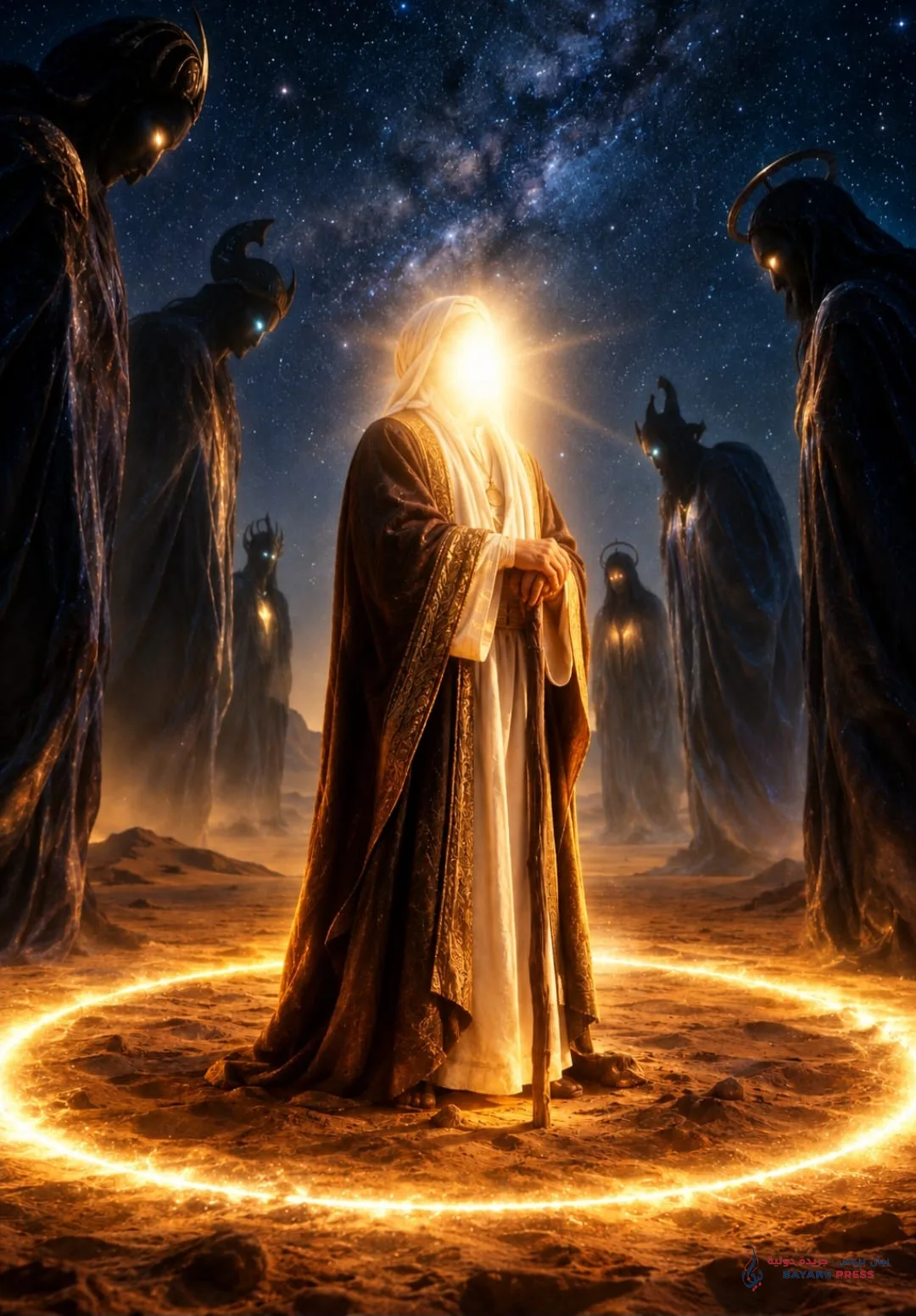
Alqamah and Amir al-Sha'bi narrate that Abdullah ibn Mas'ud, may Allah be pleased with him, was asked: Did any of you witness the Night of the Jinn with the Messenger of Allah ﷺ? He replied: None of us witnessed it except me. The Prophet ﷺ was missed one night in Mecca, so the companions went out searching for him in the valleys and mountain passes, fearing that he might have been snatched away or assassinated by Quraysh in the darkness. They spent the worst night any people could spend. In the narration of Al-Tirmidhi and Musnad Ahmad, which clarifies the detail of their departure to meet another delegation of jinn at the upper part of Mecca near the "Al-Hujun" area, the Prophet ﷺ took Abdullah ibn Mas'ud alone in the dark pitch of night and walked with him through the silent mountain ravines until they reached a desolate spot. The Messenger of Allah ﷺ stood and drew a circle on the ground around Ibn Mas'ud with his hand or his staff, saying to him with a decisive prophetic command:
«Do not leave your circle, for they will not reach you. If you step out of it, you will perish or you will not see me until the Day of Judgment»
.
Ibn Mas'ud sat inside that dirt circle which, by the blessing of the prophetic command, turned into an invisible fortress. The Prophet ﷺ walked a few paces into the depth of the valley and commenced the recitation of the Quran. Moments later, the unseen scene began to unfold before the Companion's eyes. Ibn Mas'ud describes what he saw, stating that huge black creatures with massive bodies began descending from the mountaintops and ravines like "the men of Zutt" (a tall, dark-skinned people from India), or like patches of dark night and eagles of the wilderness, walking all at once without interruption. They had tambourines or sounds like the buzzing of bees and the murmuring of pilgrims, until they overwhelmed the Messenger of Allah ﷺ and surrounded him like a bracelet around a wrist, piling up around him in layers until their vast numbers prevented Ibn Mas'ud from seeing the Prophet ﷺ or hearing his noble voice. They began rising into the sky like pieces of clouds.
Amidst that heart-wrenching terror, Ibn Mas'ud narrates that he felt extreme fear for the Messenger of Allah ﷺ and was about to step out of the circle, drawing his sword to defend him. However, he remembered the decisive prophetic instruction not to leave the circle, so he stood firm in his place, watching the scene with a trembling heart until the pillar of dawn broke. Throughout those nightly hours, the Prophet ﷺ was teaching them the laws of Islam and reciting the Quran to them. Imam Al-Tirmidhi in his Jami' (no. 3291) and Al-Hakim in *Al-Mustadrak* (authenticating it upon the conditions of the two Shaykhs) narrated from the noble Companion Jabir ibn Abdullah, may Allah be pleased with them both, that the Messenger of Allah ﷺ came out to his companions and recited Surah Ar-Rahman from beginning to end to them, and they remained silent. Then the Prophet ﷺ said to them:
«I recited it to the jinn on the Night of the Jinn, and they were a better response than you! Whenever I came to the verse: ﴿Then which of the favors of your Lord will you deny?﴾ they would say: "We do not deny any of Your favors, our Lord. To You belongs all praise"»
.
That night was not limited to recitation and pledging allegiance alone; rather, it witnessed prophetic rulings and legislation organizing the livelihood relationship between the worlds of humans and jinn. In Sahih Muslim, on the authority of Al-Sha'bi from Ibn Mas'ud, may Allah be pleased with him, the delegation of the jinn asked the Messenger of Allah ﷺ for provisions and food for themselves and their mounts. The Prophet ﷺ said to them:
«You have every bone over which the name of Allah has been mentioned; it will fall into your hands with more meat on it than ever. And every dropping is fodder for your mounts»
, and then the Prophet ﷺ turned to his human nation, forbidding them from performing istinja' (cleaning after relieving oneself) with bones and dung, saying:
«Do not use them for istinja', for they are the food of your brothers among the jinn»
. The jurisprudential reviews during those nights also included exposing the conflict between the jinn of the Arabian Peninsula and the jinn of Nusaybin, and establishing the rules of protection for a Muslim by mentioning the name of Allah when entering homes and consuming food, lest the devilish jinn share their overnight stay or sustenance, which authentic hadiths in Sahih Muslim detailed from the narration of Jabir ibn Abdullah (
«When a man enters his home and mentions Allah upon entering and upon eating, the Satan says: There is no overnight stay for you here and no dinner»
).
With the break of dawn, the throng of jinn began to gradually dissipate just as fog clears from the peaks of Al-Hujun. The Prophet ﷺ returned to Abdullah ibn Mas'ud, looking severely exhausted from the prolonged standing and addressing those massive crowds, to the point that he said to Ibn Mas'ud:
«I have been feverish (meaning fatigued and tired) due to what the jinn invited me to tonight»
, and then he placed his noble head in Ibn Mas'ud's lap to take a brief rest before standing up for the morning prayer. Ibn Mas'ud was asked whether he had water for ablution, and he replied: I do not have water, but I have nabidh (water in which dates were soaked to sweeten it before fermenting) in a water skin. The Messenger of Allah ﷺ said:
«A good date and a purifying water»
, so he performed ablution with it. When he was about to leave, a group of late-arriving jinn caught up with him to ask him questions. When the sun rose, Ibn Mas'ud and his companions saw the traces of their fires, their ash, and their sitting places in the depth of the valley as a tangible physical witness to the events of that immortal night.
While the believing jinn delegations willingly and lovingly submitted to the majesty of prophethood, the prophetic biography preserved for us the other side of the Prophet's ﷺ overwhelming authority over the rebellious jinn and demons who tried to plot against him with direct aggression after his migration to the city of Medina. Imam Al-Bukhari (no. 461) and Imam Muslim (no. 541) narrated from Abu Hurairah, may Allah be pleased with him, that the Prophet ﷺ said after finishing his prayer:
«An ifrit from among the jinn broke loose upon me last night to interrupt my prayer, but Allah enabled me to overpower him and I seized him. I wanted to tie him to one of the pillars of the mosque so that you could all wake up in the morning and look at him, but then I remembered the supplication of my brother Solomon: ﴿My Lord, forgive me and grant me a kingdom such as will not belong to anyone after me﴾ [Sad: 35], so I sent him back humiliated»
. In the narration of Abu al-Darda', may Allah be pleased with him, in Sahih Muslim (no. 542) and Abu Sa'id al-Khudri, that ifrit came with a fireball of fire to place it in the face of the Messenger of Allah ﷺ, so the Prophet sought refuge in Allah from him and cursed him three times. Then he seized him with his noble hand, choked him, and shoved him (meaning pushed him forcefully in his throat) until he found the coolness of the ifrit's tongue and saliva on his noble hand between his thumb and the finger next to it. Had it not been for his lofty moral adherence to the supplication of his brother, the Prophet of Allah Solomon, peace be upon him, that rebellious jinn would have remained tied with the ropes of the Prophet's Mosque, played with by the children of the people of Medina in the morning.
These integrated events —from the valley of Nakhlah and the mountain passes of Al-Hujun in Mecca to the sanctuary of the Prophet's Mosque in Medina— vividly embody the reality of the final Muhammadan message, which was neither restricted to the human race nor to the geography of the Arabian Peninsula. Rather, its legislative and spiritual dominance extended to encompass both "weights" (the realms of humans and jinn) alike. When the earth became straitened for the Prophet ﷺ in Taif and human leaders closed their doors in his face, Allah opened for him the doors of the unseen and drove the chieftains of the jinn to pledge allegiance to him under the cover of darkness. Thus, that line drawn by the Greatest Messenger around Ibn Mas'ud in the sands of Mecca remains an eternal witness to the moment when the visible world met the unseen world under the banner of monotheism and the Quran.




Comments (0)
No comments yet. Be the first to react!