


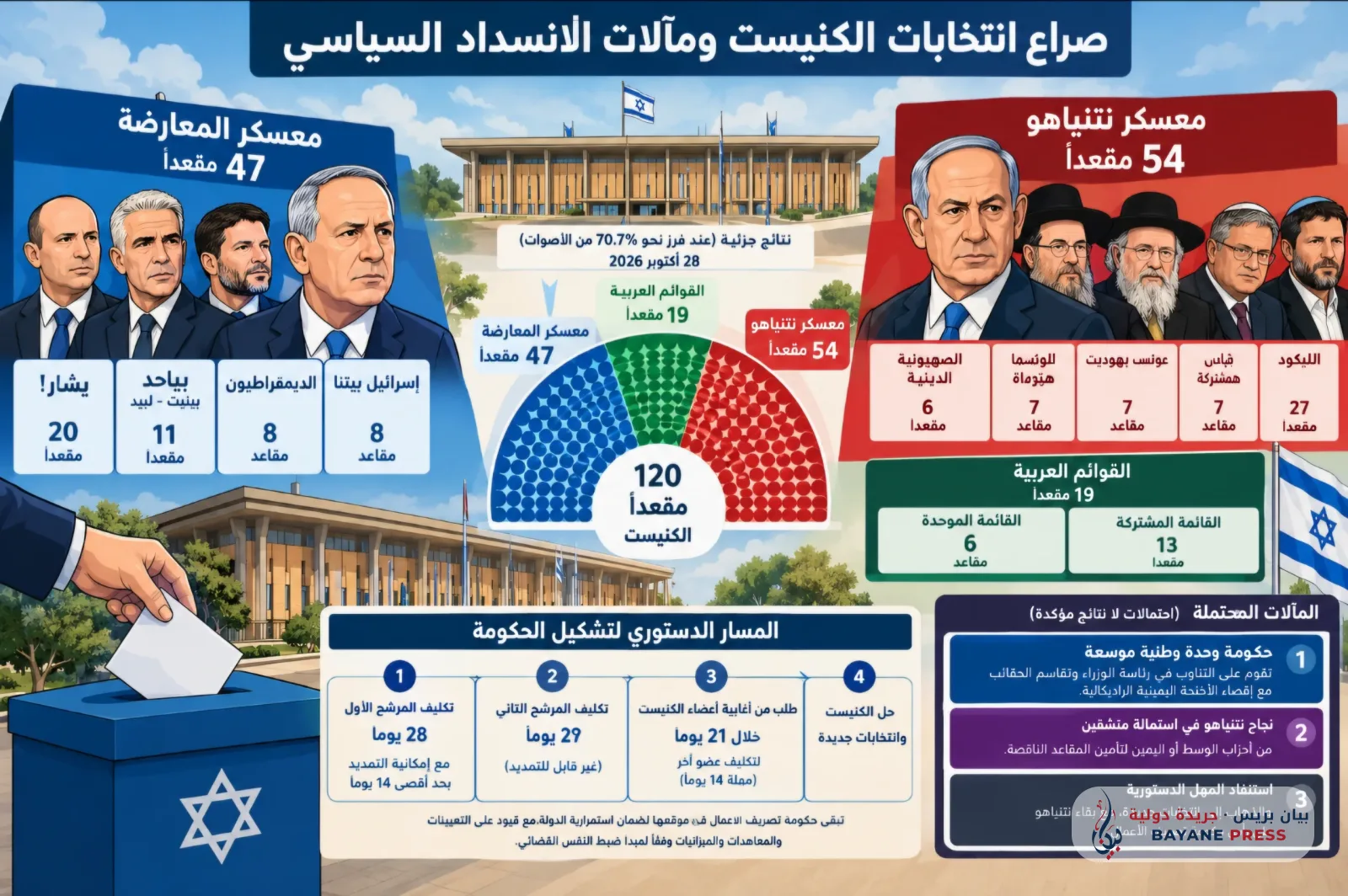
Never in Israel's parliamentary and political history since the founding of the Knesset has any single party managed to secure the 61-seat majority required to form a government. The system of absolute proportional representation has always made complex party coalitions an absolute necessity to secure a quorum. This historical rule is clearly embodied in the latest vote tallying data for the 26th Knesset elections, which witnessed a high voter turnout of 77.7%. With the counting of regular votes reaching approximately 77%, a deep state of division has been entrenched, leaving major camps unable to cross the 61-seat threshold.
The Likud party, led by Prime Minister Benjamin Netanyahu, topped the results by securing 20.6% of the vote, giving it 27 parliamentary seats as the largest political force. Netanyahu relies on a right-wing and religious alliance that includes the Ashkenazi Haredi party "United Torah Judaism" (7 seats), the Sephardic Haredi party "Shas" (7 seats), the far-right nationalist list "Otzma Yehudit" led by Itamar Ben-Gvir (7 seats), and the "Religious Zionism" party led by Bezalel Smotrich (6 seats), bringing Netanyahu's camp to a total of 54 seats.
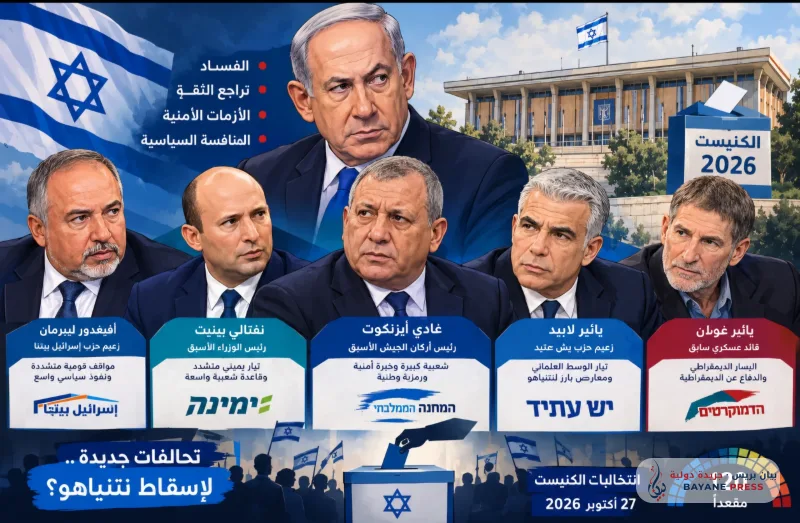
In contrast, the "Yashar!" party, headed by former Chief of Staff Gadi Eizenkot, emerged as the second major force in the Knesset and the leader of the opposition camp, capturing 20 parliamentary seats with 15.9% of the vote (around 640,000 votes). It outpaced its partners in the change camp: the "Bayachad" joint list of Naftali Bennett and Yair Lapid (11 seats), the "Democrats" party led by Yair Golan (8 seats), and the "Yisrael Beiteinu" party led by Avigdor Lieberman (8 seats), settling the total Zionist opposition camp at 47 seats. The map is completed by the qualitative weight of the Arab parties, totaling 19 seats—represented by 13 seats for the "Joint List" and 6 seats for the "United Arab List" headed by Mansour Abbas. Meanwhile, the political arena awaits the counting of "double envelopes" belonging to army soldiers and diplomats, which may cause slight shifts among electoral surpluses without breaking the current zero-sum equation.
This mathematical deficit pushes the scene directly toward the constitutional constraints stipulated in the "Basic Law: The Government". This process begins with the President of the State holding binding consultations with the blocs to mandate the candidate with the highest chance with a first period of 28 days, renewable for an additional 14 days. In case of failure, it moves to a second candidate with a non-renewable 28-day period, and then to the collective Knesset period of 21 days, during which any lawmaker who gathers 61 signatures can form a government, before resorting forcibly to dissolving parliament and calling for new elections.
Throughout these complex pathways, the executive branch remains in the hands of a temporary caretaker government to ensure state continuity and address security emergencies. However, it is subject to strict judicial restrictions established by the Supreme Court and the Attorney General under the "principle of restraint." It is prohibited from making any strategic or permanent appointments for senior military, intelligence, police, or judicial leaders, and is stripped of the authority to conclude sovereign international treaties, pass long-term public budgets, or provide sectoral financial allocations that could be politically exploited to influence voters.
As for the ultimate fate of this race, who will win, or what will realistically happen, the numerical and symbolic victory goes to Benjamin Netanyahu as the leader of the largest party (27 seats) and the most cohesive parliamentary bloc closest to a majority (54 seats). This makes him the political favorite to receive the presidential mandate first. Meanwhile, the opposition led by Eizenkot finds itself unable to translate its presence into a ruling coalition due to a strict right-wing veto within its own ranks (from Lieberman and Bennett) against any governmental partnership with the Arab lists.
Based on these realities, practical outcomes are confined to three inevitable paths:
- The First Path: Parties yielding under pressure from isolation and the security establishment to form an "expanded national unity government" based on a rotation in the premiership and portfolio sharing between Likud and the blocs of Eizenkot and Bennett, while sidelining radical right-wing wings as a condition for settlement.
- The Second Path: Netanyahu succeeding through backroom negotiations in luring defectors from centrist or opposing right-wing parties to secure the seven missing seats for his side.
- The Third and Most Likely Path: In the event of stubborn mutual concessions, exhausting the full constitutional deadlines, automatically leading to the dissolution of the Knesset and heading to a new round of early elections, with Netanyahu remaining at the head of the caretaker government holding the reins of executive power until further notice.
Comments (0)
No comments yet. Be the first to react!