


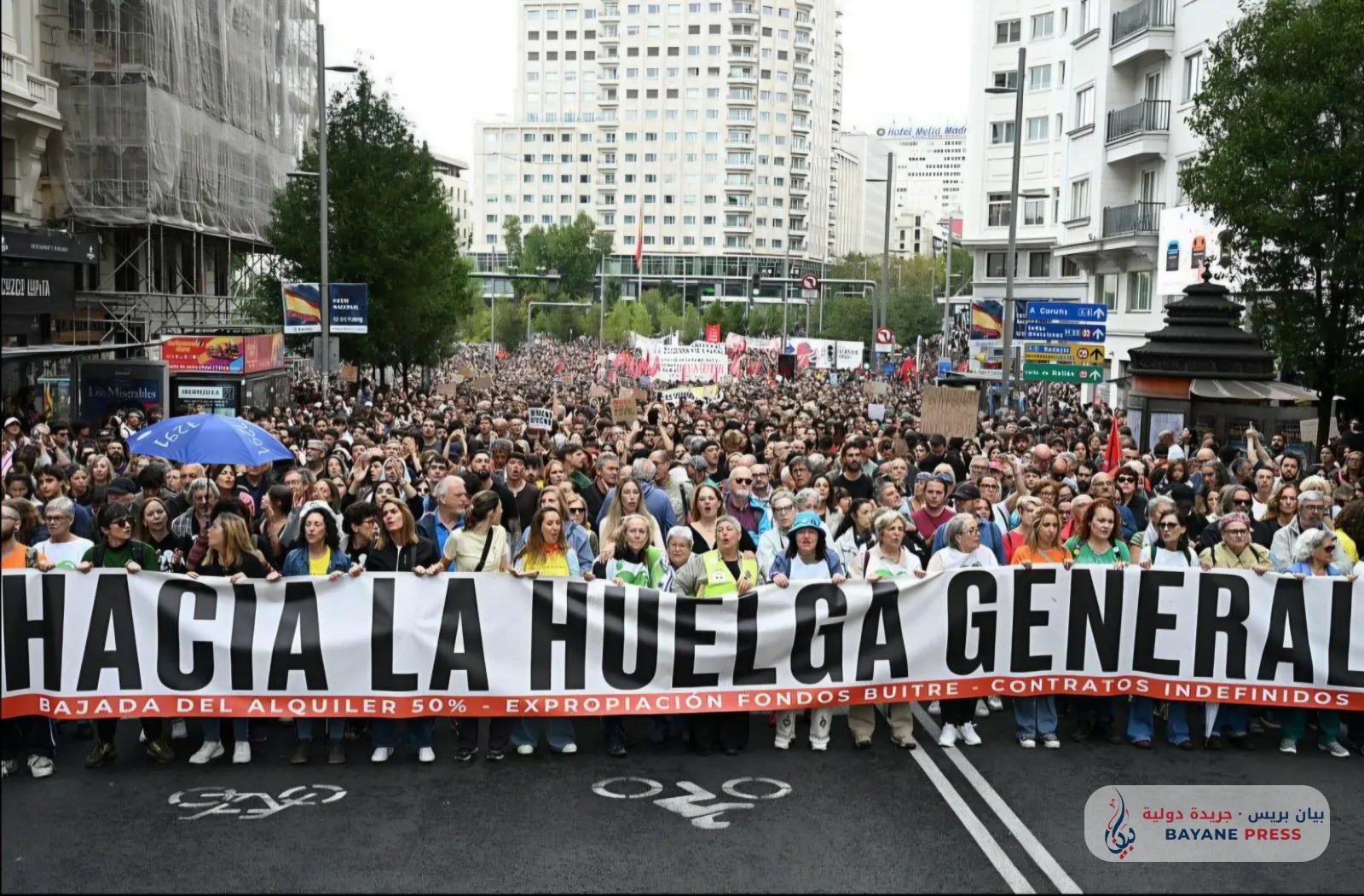
Spain witnessed, on Wednesday, November 11, 2026, a general strike that spread across the country in protest against the worsening housing crisis, rising living costs, and weak purchasing power. This broad trade union mobilization has brought social unrest back to the forefront of the Spanish political scene, less than three weeks before the early legislative elections scheduled for November 29.
The strike began at midnight to last for twenty-four hours, called by the most prominent trade union organizations, led by the General Union of Workers (UGT) and the Workers' Commissions (CCOO), alongside other unions and associations representing tenants. It is the first general strike the country has seen since 2012, when workers protested against the austerity measures that accompanied the European debt crisis.
The protesters' primary demands center on taking urgent measures to curb rising rental prices, expanding the supply of public housing, improving wages to match the cost of living, as well as reducing working hours, combating professional precariousness, and enhancing the quality of public services.
Transportation and transit were affected in several Spanish cities, with authorities implementing minimum service levels to ensure the continuity of essential facilities. In Madrid, it was decided to operate 80 percent of metro services during peak hours and 50 percent for the rest of the day, while the minimum service for suburban trains was set at 75 percent during peak times and 50 percent outside of them.
Regulatory measures extended to the aviation sector, where minimum service levels ranged between 18 and 85 percent, depending on the nature of the flights and available alternatives, while varying disruptions were recorded in several economic and service activities as a result of worker participation in the strike.
The capital, Madrid, saw tension between police and participants in a union sit-in at the "Mercamadrid" central market area, after the Secretary-General of the General Union of Workers, Pepe Álvarez, accused security forces of obstructing the exercise of the constitutional right to strike—accusations that could not be independently verified.
Conversely, political and economic circles criticized the timing of the action, especially with the approach of the elections, while unions argued that the social crisis cannot wait until after the elections, and that the right to housing and a decent wage transcends partisan calculations.
The strike comes at a time when Pedro Sánchez's government is facing increasing pressure due to the housing crisis, which has become one of the most prominent issues affecting the daily lives of Spaniards, especially in major cities that have seen a continuous rise in rents and property prices, making it increasingly difficult for young people and low-income families to access suitable housing.
The breadth of union and social participation in the movement reflects the growing link between professional demands and living conditions, as protests are no longer limited to wages and working conditions, but have extended to demanding housing policies that ensure household income is not drained by rental costs.

Comments (0)
No comments yet. Be the first to react!