

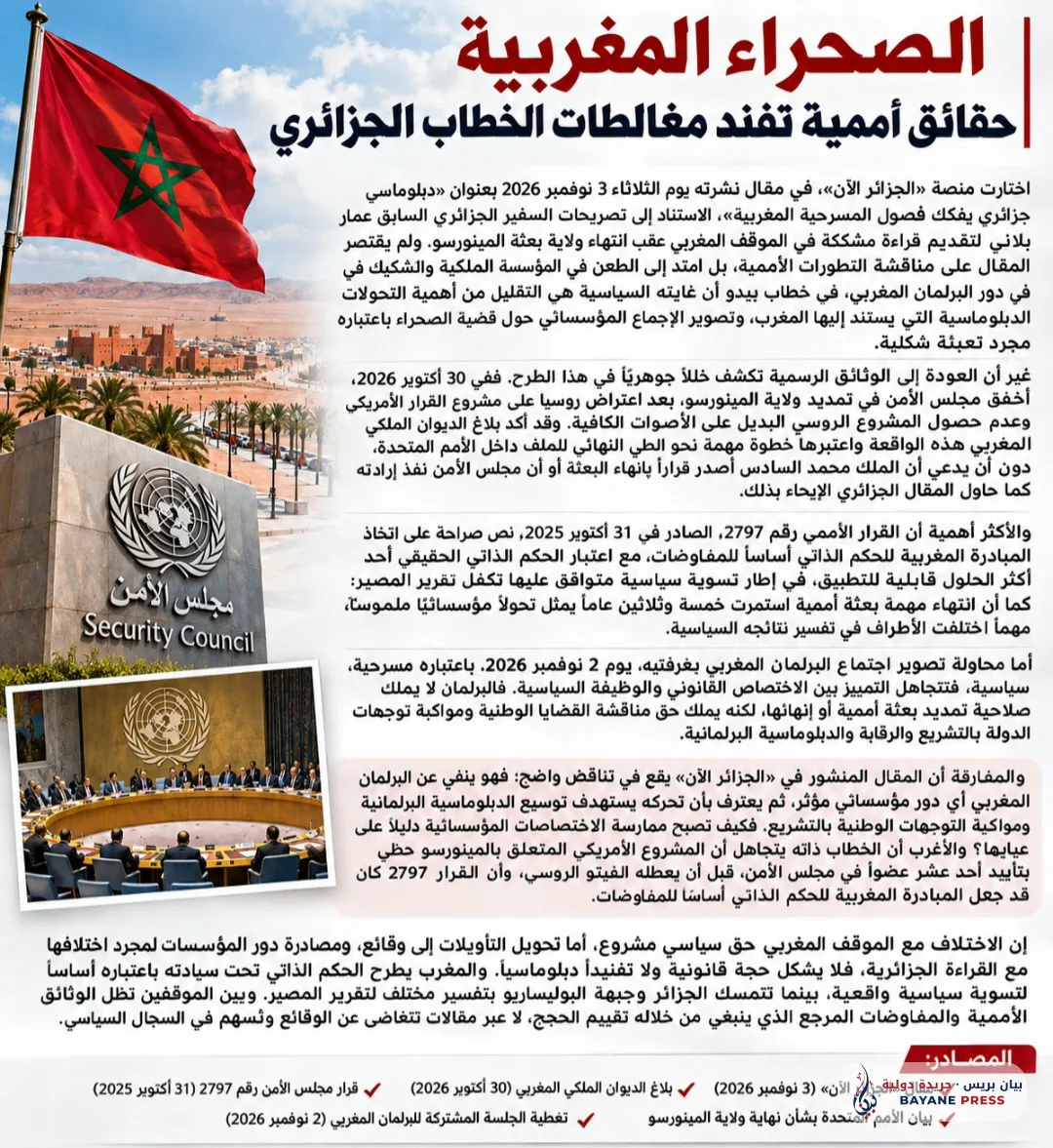
In an article published on Tuesday, November 3, 2026, titled "Algerian Diplomat Deconstructs the Chapters of the Moroccan Farce," the "Algeria Now" platform chose to rely on statements by former Algerian ambassador Amar Belani to present a skeptical reading of the Moroccan position following the expiration of the MINURSO mission's mandate. The article was not limited to discussing UN developments, but extended to attacking the Royal Institution and questioning the role of the Moroccan Parliament, in a discourse whose political aim appears to be minimizing the importance of the diplomatic transformations upon which Morocco relies, and portraying the institutional consensus on the Sahara issue as merely a superficial mobilization.
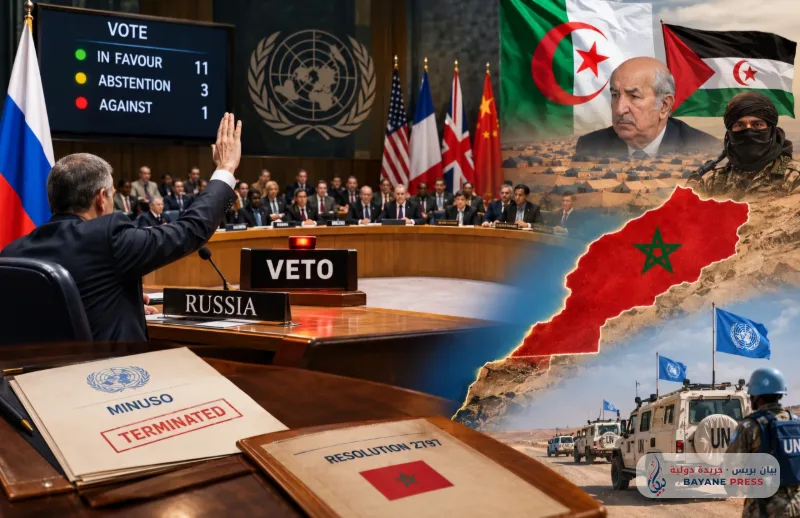
However, returning to official documents reveals a fundamental flaw in this premise. On October 30, 2026, the Security Council failed to extend the MINURSO mandate after Russia objected to the US draft resolution and the alternative Russian draft failed to secure sufficient votes. The communiqué of the Royal Cabinet of Morocco confirmed this fact and considered it an important step towards the final closure of the dossier within the United Nations, without claiming that King Mohammed VI issued a decision to terminate the mission or that the Security Council implemented his will, as the Algerian article attempted to suggest. The difference is clear between declaring a sovereign position on an international development and claiming the authority to make decisions within a UN institution.
More importantly, UN Resolution 2797, adopted on October 31, 2025, explicitly established the Moroccan Autonomy Initiative as the basis for negotiations, considering genuine autonomy as one of the most viable solutions within the framework of a negotiated political settlement ensuring self-determination. This is a proven fact in an official document issued by the Security Council, which cannot be nullified by a press article or a counter-diplomatic reading. Furthermore, the conclusion of a UN mission that lasted for thirty-five years represents a tangible institutional transformation, regardless of how different parties interpret its political outcomes.
As for the attempt to portray the meeting of both houses of the Moroccan Parliament on November 2, 2026, as a political farce, it ignores the distinction between legal jurisdiction and political function. Parliament does not possess the authority to extend or terminate a UN mission, but it holds the right to discuss national issues and accompany state orientations through legislation, oversight, and parliamentary diplomacy. It is illogical to dismiss the value of legislative institutions simply because they do not control Security Council decisions; such a standard does not apply to any parliament in the world.
It is only fair to acknowledge that the end of MINURSO does not legally mean the disappearance of the issue from the United Nations system, as the Secretary-General has emphasized the continuation of political efforts through his Personal Envoy. However, this reality does not negate Morocco's right to demand the termination of the current UN track, nor does it invalidate the prominent standing that the Autonomy Initiative has accumulated in international resolutions. Here it becomes clear that the reading conveyed by "Algeria Now" seeks, by focusing on the Royal Institution and Parliament, to shift the debate from the substance of UN documents to a controversy over the legitimacy of Moroccan institutions.
The most persuasive response to this discourse is not based on a mutual exchange of accusations, but rather on relying on texts and facts. Morocco puts forward autonomy under its sovereignty as the basis for a realistic political settlement, while Algeria and the Polisario Front cling to a different interpretation of self-determination. Between the two positions, UN documents and negotiations remain the reference by which arguments should be evaluated. As for ridiculing Moroccan institutions, it will neither change the substance of an international resolution nor serve as a substitute for confronting political and legal transformations with arguments of equal strength and clarity.
Comments (0)
No comments yet. Be the first to react!