


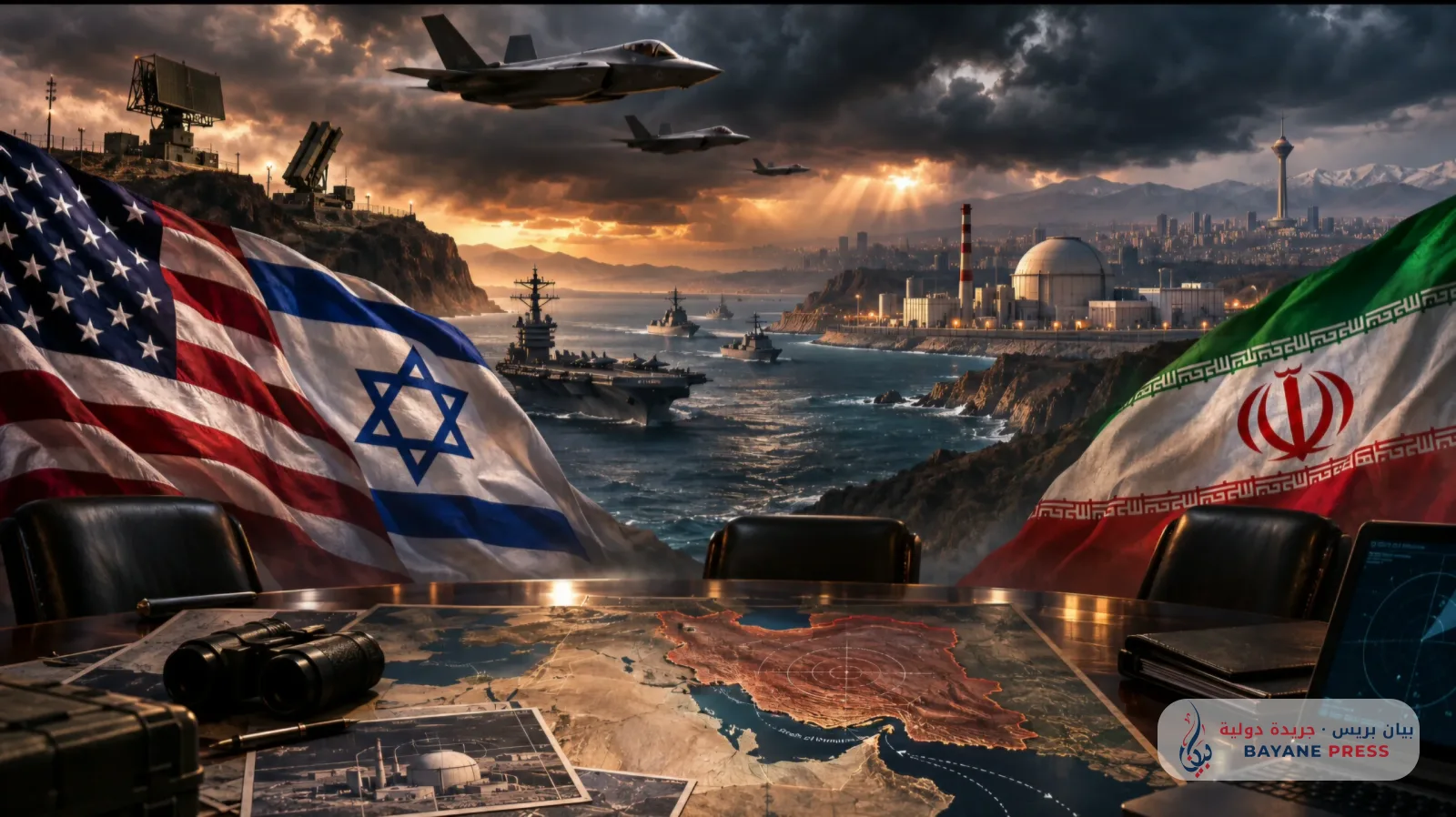
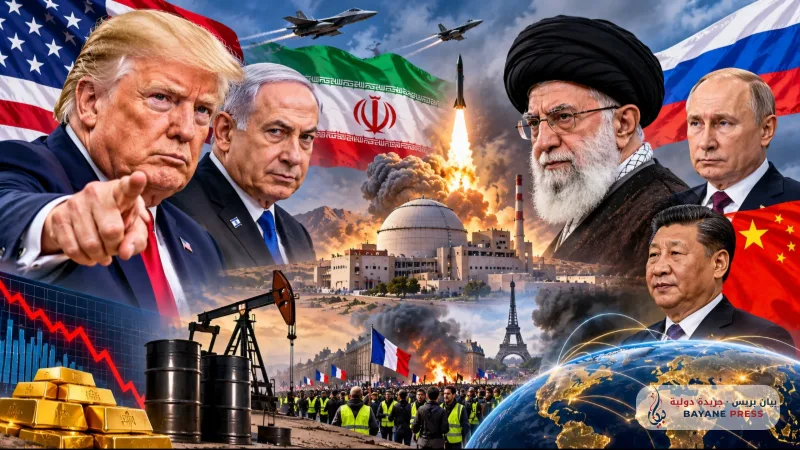
As of November 3, 2026, the Middle East stands at a highly sensitive strategic crossroads, where US and Israeli military threats intertwine with Iranian warnings, and the political calculations of US President Donald Trump and Israeli Prime Minister Benjamin Netanyahu intersect with intense diplomatic moves to avert a renewed all-out war. The question at hand is no longer limited to the likelihood of a military confrontation among the three parties—after the United States and Israel launched their war on Iran on February 28th—but rather whether Washington and Tel Aviv are preparing to launch a new, broader, and more destructive military campaign, or whether the military build-up and mutual statements are merely pressure tools to extract a political agreement on different terms. This question becomes even more pressing after US officials confirmed the execution of limited strikes targeting Iranian sites on Qeshm Island in the Strait of Hormuz on Monday, November 2nd, coinciding with ongoing indirect negotiations, in a scenario reflecting the fragility of the truce and the potential for localized clashes to escalate into a broader regional confrontation.
A careful reading of Trump's recent statements reveals that the US administration is deliberately keeping military and diplomatic options open without announcing a final decision to resume wide-scale operations. On October 31st, the US President spoke about the necessity of dealing with one or two sites inside Iran, pointing to a mountain facility suspected of links to the nuclear program, known as "Pickaxe Mountain," and affirming the capability of US forces to target it on short notice. However, his rhetoric shifted notably on November 2nd, when he answered in the negative to a question regarding the possibility of new strikes following the congressional midterm elections, before confirming in an interview with the "Axios" website that he is not in a rush to make a decision to resume the war, and that reaching an agreement with Tehran remains possible. This contrast between threat and hesitation reflects the nature of complex US calculations; Washington possesses the military capability to deliver impactful strikes, but it faces counter-challenges regarding the costs of war, the prospects of Iranian retaliation, and its repercussions on the US economy and regional stability.
On the military level, available indicators go beyond political statements. The "Associated Press" revealed that US officials warned several Middle Eastern nations and Washington's allies of the potential resumption of military operations against Iran after the November 3rd elections, with expectations of retaliatory responses that could target energy facilities and critical infrastructure. The United States also reinforced its military presence in the region with additional forces, naval assets, and marine units, as part of a reinforcement estimated at around 9,000 troops. International reports indicated that US forces now possess the necessary capabilities to carry out extensive operations within a short period. Nevertheless, the completion of military preparations does not necessarily mean a decision has been made to use force; these reinforcements can be employed for deterrence and negotiating pressure, or to provide multiple options starting with limited strikes and ending with all-out military operations.
As for the Israeli stance, it reflects a more hardline approach toward the future of the Iranian regime and its nuclear program. On October 21st, Netanyahu declared that overthrowing the Iranian regime represents, from his perspective, the path to ending the threat posed by Tehran to Israel, confirming that he has instructed the army and intelligence agencies to work toward this goal. His statements came amid Israeli accusations that Iran is seeking to rebuild its nuclear and missile capabilities—accusations that must be distinguished from independent evidence proving the nature of Iranian activities and their actual objectives. Following the Israeli legislative elections held on October 27th, which resulted in the Likud party securing 27 seats without any of the major camps securing the parliamentary majority required to form a government, the political calculations surrounding any new confrontation have grown increasingly significant. "Associated Press" and "Axios" cited informed sources stating that Netanyahu tried to persuade Trump to resume strikes following the US elections, without securing a pledge to do so. In contrast, Israel's Ambassador to the UN, Danny Danon, denied that his government exerted pressure on the US President, emphasizing that Israel will support whatever decision Washington makes. The divergence of these accounts highlights the necessity of separating media leaks from official positions, particularly when dealing with decisions that could alter regional security equations.
In Tehran, the Iranian leadership adopts a rhetoric combining military readiness with adherence to strict negotiating conditions. Iranian Supreme Leader Mojtaba Khamenei warned on October 31st that any new US or Israeli attack would be met with a strong and immediate response, while Iranian military officials affirmed that a renewed confrontation could lead to a longer and wider war. These statements reflect an Iranian attempt to raise the anticipated cost of any attack, conveying the message that strikes will not pass without a response necessarily exceeding the limits of direct military objectives. Reuters reports indicated Iranian preparations for the possibility of expanding the response to include US military interests and bases, as well as vital facilities in the region. These threats do not necessarily mean that Tehran possesses the capability to execute all declared scenarios, but they reveal the Iranian leadership's reliance on a strategy based on widening regional risks, making the decision to attack more complex for Washington and Tel Aviv.
Parallel to the military escalation, diplomacy continues its activity through regional mediators, led by Qatar and Pakistan, in an attempt to bridge gaps and contain the confrontation. Iranian Foreign Minister Abbas Araghchi affirmed on November 2nd that consultations via mediators have become extremely intensive, and that Tehran has presented its conditions and proposals while awaiting the US position. The negotiations are based on an Iranian proposal comprising seven steps, put forward last September, before the announcement of simplifying its implementation mechanisms to allow the completion of its initial phases within two days instead of seven days. The proposal includes lifting the US naval blockade on Iranian ports, reopening the Strait of Hormuz, easing restrictions on oil exports, and lifting economic sanctions, as a prelude to moving on to other files. However, the core dispute lies in the sequencing of obligations and guarantees for their implementation; Tehran conditions the resumption of detailed negotiations on the nuclear program on verifying the response to its demands, while Washington seeks verifiable guarantees to prevent the development of an Iranian nuclear weapon. This chasm remains one of the most prominent obstacles to reaching a comprehensive settlement, despite ongoing indirect contacts.
The equation is further complicated by differing trends within US decision-making circles regarding the most appropriate way to deal with Iran. According to a report published by the "Axios" website on November 2nd, Vice President JD Vance and US Envoy Steve Witkoff are pushing to give negotiations an additional chance, while other figures, including Defense Minister Pete Hegseth, support returning to military action. Conversely, the report attributes to prominent officials—including Treasury Secretary Scott Bessent, Secretary of State Marco Rubio, and CIA Director John Ratcliffe—a tendency to continue economic pressure without rushing into a new war or striking an agreement that fails to meet US demands. Although these data are based on sources cited by the website and do not represent an official announcement of a division within the administration, they help explain the disparity in messages emanating from Washington. Furthermore, Vance's statements regarding progress made in talks give the diplomatic track actual importance and confirm that military options are not the only path before Trump.
The Strait of Hormuz stands out as the most sensitive link in this confrontation, having transformed from a strategic corridor for international trade and energy transport into one of the most prominent tools of mutual pressure between the United States and Iran. The US blockade imposed on Iranian ports and exports, along with corresponding restrictions and assaults targeting commercial navigation, have made Gulf security an essential part of the calculations of war and peace. In a highly significant development, Reuters confirmed on November 3rd, citing US officials, the execution of limited strikes targeting Iran's Qeshm Island, while Iranian media reported hearing explosions on the island. A US official described the operations as defensive in nature, explaining that they targeted sites associated with the use of surface-to-air missiles against US aircraft or military equipment, and that they do not represent an announcement of the resumption of major combat operations. The importance of these developments lies in the fact that they confirm the continuation of localized clashes despite negotiations, and reveal that any limited military incident could escalate into a broader confrontation if followed by mutual responses that are difficult to contain.
Economic repercussions in turn impose heavy constraints on the decisions of the three parties. The estimated cost of the war for the United States has reached approximately $47.1 billion, according to estimates cited by the "Associated Press," while the turbulence in energy markets and rising fuel prices have increased economic and political pressure on the US administration. In Iran, sanctions and the naval blockade have inflicted severe damage on oil exports and the national currency, alongside a surge in the annual inflation rate to 73.6 percent in September, according to data released by the Statistical Center of Iran. Meanwhile, Gulf states fear that their oil facilities, ports, and military bases could become targets in a confrontation whose outbreak or trajectory they cannot control. Regional officials have warned of the danger of sliding into a new round of military operations, while oil prices fell by about four percent during the trading session on November 2nd, driven by renewed hopes for a diplomatic settlement. These fluctuations reflect how sensitive markets are to any signal regarding escalation or de-escalation, especially in a region through whose maritime corridors vast amounts of global energy supplies pass.
By linking these data points, three strategic paths emerge that could determine the nature of the next phase, without asserting that any of them will necessarily materialize. The first path involves the resumption of a broad US-Israeli air campaign targeting Iran's nuclear facilities, missile stockpiles, and military infrastructure—and potentially economic and strategic sites—if negotiations collapse or a major confrontation erupts in the Gulf. The second path is based on the continuation of limited military strikes and selective operations, parallel to maintaining the economic blockade and diplomatic pressure, in pursuit of extracting concessions without bearing the exorbitant costs of an all-out war. The third path consists of reaching an interim understanding starting with mutual de-escalation measures in the Strait of Hormuz and ending the naval blockade, before moving on to address the nuclear file and security guarantees. These paths remain tied to field and political developments whose outcomes are difficult to fully control, especially since any wide Iranian response targeting US forces or Israeli territory could alter the parties' calculations within a short span of time.
A comparison between the positions of Washington, Tel Aviv, and Tehran reveals that the core of the dispute is not limited to Iranian nuclear and missile capabilities, but extends to the nature of the required settlement, the future of the Iranian regime, and the security balance in the Gulf. Israel, according to Netanyahu's statements, views the survival of the Iranian regime as the persistence of the source of the threat, while the US administration focuses in its public rhetoric on preventing the development of an Iranian nuclear weapon and ensuring the security of its forces and allies and freedom of international navigation. As for Tehran, it treats the lifting of the blockade and obtaining guarantees preventing renewed attacks as two fundamental conditions for any agreement. This divergence makes reaching a comprehensive settlement much more complex than merely declaring a ceasefire; each party ties its future security to commitments and concessions that the other party views as a violation of its strategic interests.
An analytical reading of the scene indicates that Washington possesses the military capability and necessary preparations to resume wide-scale strikes, and that the Israeli leadership continues to push toward a more decisive confrontation with Iran; however, possessing the capability and political desire alone are not enough to prove that a joint decision for war has been made. Conversely, Tehran realizes that entering an all-out confrontation with the United States and Israel could multiply its military and economic burdens, but it also fears that making concessions under threat would weaken its negotiating position and damage its deterrence capability. Hence, the current phase appears governed by a delicate balance between using force to improve negotiating terms and refraining from steps that could lead to a loss of control over the escalation trajectory.
Accordingly, the facts available up to the morning of November 3, 2026 confirm that the risk of renewed broad US and Israeli strikes against Iran remains real, supported by documented military preparations and explicit threat rhetoric, but they do not prove that a final decision has been issued to launch a new joint campaign, nor do they allow for a definitive date to be set. What field developments confirm is the continuation of military confrontation in limited forms, running concurrently with negotiations that have not achieved a decisive breakthrough. Therefore, the most critical question is no longer whether Washington and Tel Aviv are capable of striking Iran—they have already proven they possess this capability—but rather whether Trump will consider the resumption of military operations a more effective means of achieving his demands than a negotiated agreement, and whether Tehran is prepared to make concessions that allow avoiding a new round of war. Between these two possibilities, the Middle East stands before an extremely fragile equation, where a political settlement might pave the way toward de-escalation, or a limited strike and uncalculated response could push the region into a broad confrontation whose boundaries no party can control or predict its end.

Comments (0)
No comments yet. Be the first to react!