


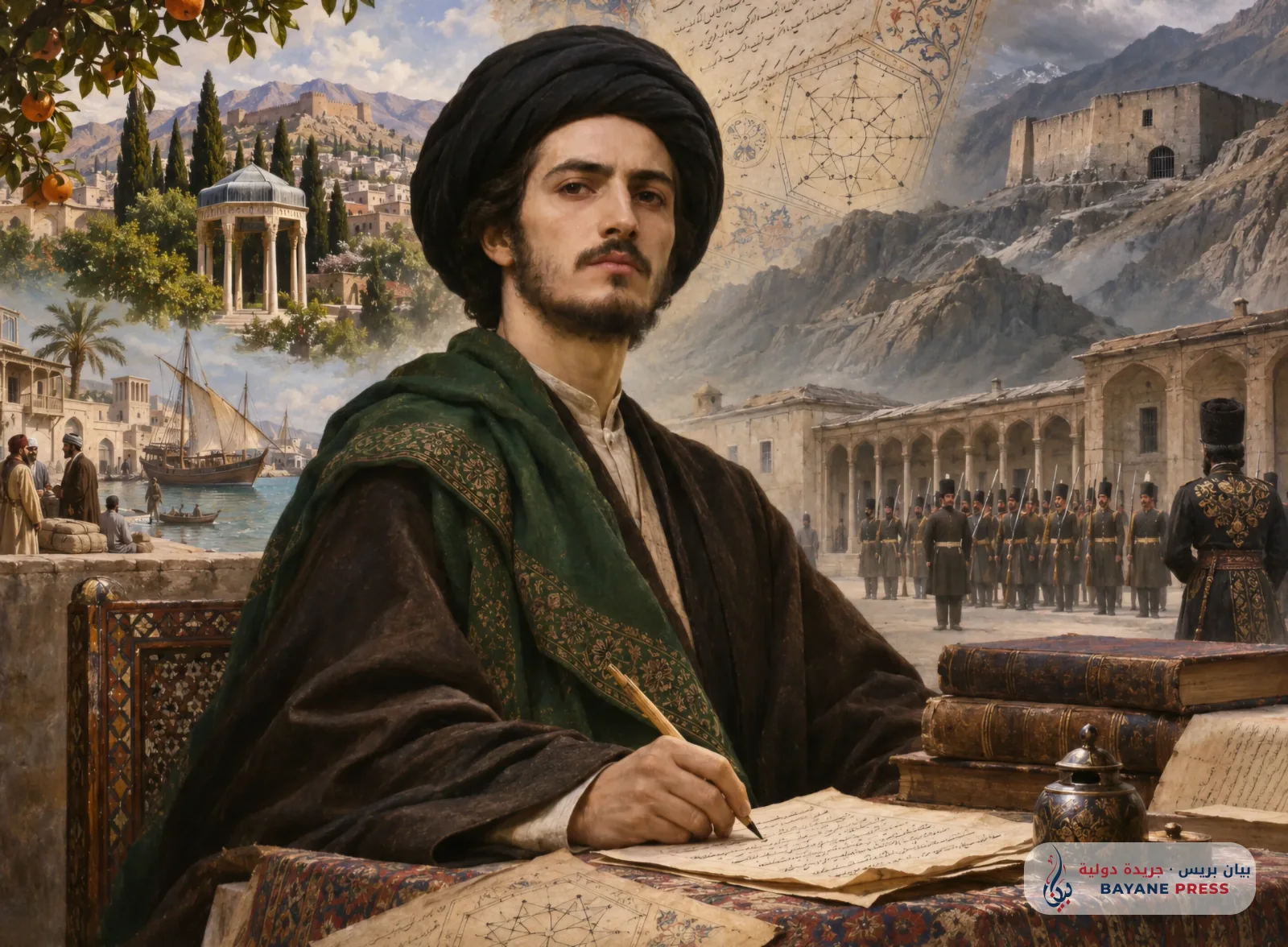
On the first day of Muharram in the year 1235 AH, corresponding to October 20, 1819 AD, a child named Ali Muhammad was born in the Persian city of Shiraz. No one at the time could have imagined that this name would become, a quarter of a century later, the center of one of the most controversial religious movements in the history of Iran and the modern Islamic East. His short life was linked to the rise of the Babi movement, which emerged from a Shiite environment saturated with Mahdist expectations, then evolved into an independent religious call, and ended with the execution of its founder in Tabriz in 1850, before branching into competing doctrinal trends, most notably Azali and Baha'i.
Ali Muhammad Shirazi descended from a merchant family that, according to genealogical sources, traced its lineage to the Prophet's household through Imam Hussein ibn Ali. His father, Sayyid Muhammad Rida, known as the cloth merchant (al-Bazzaz), worked in the textile trade, while his mother, Fatima Begum, belonged to a Shiraz family known for its commercial activity. The family was not among the major scholarly houses directly linked to the religious establishment, although some of its members had ties to the Shaykhi school, which would later play a fundamental role in the emergence of his call. Historical sources differ regarding his age at the time of his father's death; some state he was an infant or a young child, while other accounts place the death when he reached the age of nine. However, it is certain that his maternal uncle, Hajj Mirza Sayyid Ali, took charge of his care and upbringing, becoming one of the closest figures to him during his childhood and youth, before eventually being executed for embracing his nephew's call.
Accounts describing Shirazi as an unusual child began from the time he entered Shaykh Abid's school in Shiraz, where he received the basics of reading, writing, the Quran, and calligraphy. Some early Babi and Baha'i sources describe him as being very silent, contemplative, inclined toward solitude and prayer, and not showing the same enthusiasm as his peers for traditional lessons. Other accounts add that he would ask religious questions that his teacher found difficult to answer, and that Shaykh Abid once returned him to his family, declaring his inability to teach him. However, this story, despite its fame, belongs primarily to the literature written to glorify his personality after the emergence of his call, and there is no independent contemporary testimony that allows it to be considered a settled historical fact.
Despite the image his followers painted of his innate knowledge, specialized sources indicate that he received a primary education that lasted several years and showed interest in jurisprudence, interpretation, theology, and some religious works, even if he did not undergo a regular seminary training that would qualify him for the rank of Ijtihad known among Shiite scholars. This point would later become one of the most important reasons for the controversy surrounding his personality; his opponents saw the limitation of his formal studies as evidence of his unfitness for the religious claims he announced, while his followers considered his independence from traditional education as evidence that his knowledge came from a source that transcended standard study.
When he was about fifteen, he joined his family's commercial activity and moved to the port of Bushehr on the Gulf, where he spent about five years working in the trade of fabrics and goods exchanged between Iranian ports and regional trade centers. Bushehr was then one of the important commercial gateways for Persia, connecting local merchants to the markets of India, Oman, Bahrain, and the Gulf ports. In this commercial environment based on bargaining, credit, and profit calculation, other aspects of his personality began to appear, as described by those close to him.
He was famous in some biographies for his honesty, calmness, and precision in transactions. Stories were reported that he did not tend toward intense bargaining and that he was satisfied with the prices offered to him without entering into long arguments with buyers. Some accounts even go so far as to say that merchants complained to his uncle about his leniency in selling, only to be surprised that the commercial agency's accounts did not suffer the losses they expected. Later accounts add that his uncle discovered exceptional profits, but these economic details are not based on preserved account books or sufficient independent testimonies to prove them, and therefore they remain closer to family and religious memory than to documented financial facts.
Some reports attribute to Shirazi the habit of filling his commercial papers with religious writings and numerological calculations, in a way that suggests the blending of his daily work with a preoccupation with symbols and numbers. Although no original commercial books have been found to prove this story, his later interest in the science of letters and symbolic forms is proven through his remaining works and calligraphic traces. Cut letters, numbers, and geometric shapes became part of the expressive structure of his call and were not just incidental practices in his life.
In addition to his commercial activity, some sources report news of his practice of asceticism and devotion to worship, the most famous of which is the account of him standing for long hours on the roof of his residence under the scorching sun in Bushehr, engrossed in prayers and supplications. Some of his opponents used these reports to accuse him of exaggerating in spiritual exercises and of being physically and psychologically affected by isolation and heat, while his followers gave them a different meaning, considering them a stage of spiritual preparation for his upcoming call. There is nothing that allows for the conclusion that he suffered from a mental disorder from these accounts, nor is there independent evidence proving that he intended to harness planets and spirits in the way some polemical writings attributed to him.
Personal accounts describe him as slender, handsome, very concerned with cleanliness, soft-spoken, and inclined to wear clean clothes and a turban that indicated his descent from the Sayyids. We will later find evidence supporting some of these traits in the testimony of Dr. William Cormick, who met him during his detention in Tabriz and left a direct description of his appearance, voice, and manner of interaction.
Around the years 1839 and 1840, Shirazi made a decision that changed the course of his life, as he temporarily left commercial work and headed to the Shiite shrines in Iraq, where he spent about a year, most of it in Karbala. There, he connected with the circles of Sayyid Kazim Rashti, one of the most prominent figures of the Shaykhi school, which was founded on the teachings of Shaykh Ahmad al-Ahsa'i. This school had developed special readings of Shiite doctrinal issues, especially Imamate, Occultation, Return, and Resurrection, with an interest in esoteric and mystical interpretations.
Some Shaykhi circles were living in a state of escalating expectation for the appearance of the Hidden Imam and were discussing the nature of the spiritual knowledge that would allow for contact with the reality of the Imam or pave the way for his appearance. In this climate, Shirazi met a number of Rashti's students, some of whom would later become the first believers in his call. Baha'i sources narrate that Rashti showed him special respect and that some students noticed this, but researchers do not have enough contemporary documents to confirm that Rashti saw him as his successor or as the bearer of a future call.
His family urged him to return to Shiraz, fearing his continued detachment from trade and social life, so he returned to his hometown and married in August 1842 to Khadija Sultan Begum, a relative of his family from his mother's side. The marriage was a step toward returning him to family stability, but his spiritual interests did not recede. In the following year, a child named Ahmad was born to him, but he died very early; some sources even mention the possibility that he was stillborn, and Shirazi left no children who survived him.
Baha'i memory preserves testimonies attributed to his wife, Khadija Begum, about his domestic life before the announcement of his call. She narrated that he would return home after sunset, turn to prayer and supplication, then ask for his papers and account books, and continue writing during the evening hours. She initially thought he was reviewing trade transactions, but she noticed that the papers included religious phrases and writings that did not resemble standard accounts. When she asked him about their nature, he was reported to have replied that they related to the accounts of the people of the world. Accounts also mention that he would cover his papers with a piece of cloth when he feared they would be tampered with or that their contents would be revealed.
Some family reports add that he went through dream and spiritual experiences that left a deep impact on him, and that he would sometimes wake up in a state of unusual religious excitement. Among the texts that reveal this stage are his writings about visions and inspiration, including what he mentioned about a vision related to Imam Hussein, in which he saw himself drinking from the blood of his severed head, a symbolic image that Shirazi himself described in some of his works as being related to the opening of the door of religious knowledge for him. This story should not be read as a physical event, but as a dream experience expressed in a symbolic language that belongs to the doctrinal environment in which he grew up.
The death of Sayyid Kazim Rashti in late 1843 was the beginning of a crisis within the Shaykhi school, as he did not leave a successor agreed upon by his students. In this atmosphere, Mulla Husayn Bushru'i, one of Rashti's most prominent students, went out looking for the personality he believed would reveal the meaning of the Mahdist promises. After a journey during which he contacted a number of figures, he arrived in Shiraz, where the meeting that would become the founding point of the Babi movement took place.
On the evening of May 22, 1844, Mulla Husayn met Ali Muhammad Shirazi, who invited him to his home. Accounts differ on the details of the meeting and its dialogues, but they agree that Shirazi announced in it his possession of the station of the "Bab" (the Gate), and that Mulla Husayn became the first to believe in his call. Shirazi was then twenty-four years old by the Gregorian calendar, although he had entered his twenty-fifth year. Babi accounts state that Mulla Husayn asked him for a statement proving his claim, so he began reciting and writing parts of the commentary on the Surah of Yusuf, known as "Qayyum al-Asma," in a rhymed style that borrows much from the Quranic expressive structure and re-employs it in a new symbolic and doctrinal context.
The significance of the title "Bab" at that stage was not exactly the same as what his call later ended up being. In some of his first writings, he presented himself as a mediator to the Hidden Imam and a precursor to his appearance, and used titles such as "the Remembrance" (al-Dhikr), "the Gate of the Imam," and "the Seal of the Gates," while phrases carrying hints of a higher station also appeared in his early writings. Hence, researchers differed on the timing of his transition from the claim of mediation to the claim that he was the Qa'im Mahdi himself, and then to his announcement of an independent divine manifestation and the bearer of a new law.
The first believers in his call followed until their number reached eighteen, who were called the "Letters of the Living" (Huruf al-Hayy), and Mulla Husayn was the first of them, which is why he was titled "Bab al-Bab." Among the most famous of them were Mulla Muhammad Ali Barfurushi, known as Quddus, and the poet and scholar Fatima Baraghani, who was famous by the title Qurrat al-Ayn or Tahirih. Sources mention that Qurrat al-Ayn did not meet Shirazi directly, but she believed in his call through correspondence and news that reached her, which made her one of the exceptional figures in the early history of the movement.
The number nineteen acquired a central symbolic status, as it was linked to the eighteen Letters of the Living and the founder of the call, and then entered into the construction of legislation, acts of worship, and the calendar. Numerical and letter-based divisions appeared in some later texts that link divine names to numbers and forms of writing, in an extension of a wide interest in some Islamic and philosophical currents in the science of letters, Jafr, and numerical interpretation.
This interest had a tangible material aspect embodied in amulets and calligraphic symbols. Shirazi produced forms known as "Haykal" (Temples), which are letter-based texts and prayers sometimes written in the form of a pentagram or a multi-sided geometric structure, in addition to "circles" that include lines, overlapping rings, and religious names. Preserved manuscripts show examples of these forms attributed to his hand, and his rulings indicate the use of Haykals for men and circles for women. They were not intended merely for decoration, but carried symbolic meanings related to protection, religious remembrance, and connection to the divine manifestation, within a culture that had known the use of talismans and squares for centuries.
Studies of texts and manuscripts also reveal his interest in rings, precious stones, beautiful calligraphy, and personal seals. Mention of agate rings and others was made among his effects and belongings, and some of the symbols he wrote contained numerical repetitions of religious names and attributes. However, the generalization that he forced all his followers to wear red agate and Nishapur turquoise with uniform inscriptions needs to specify the intended texts of the rulings. Likewise, talk of a comprehensive and absolute prohibition of black clothing cannot be made without distinguishing between positions related to clothing, mourning rulings, and practices that differed between the Babi stage and the later Baha'i stages.
After establishing his first group, Shirazi directed his students to different regions of Iran and Iraq, seeking to expand the circle of the call and attract students of religious schools. He then left Shiraz on September 10, 1844, heading to Mecca to perform the Hajj. He was accompanied on the journey by Mulla Muhammad Ali Barfurushi, known as Quddus, and a servant of Ethiopian origin, and he took the sea route via Bushehr and the Gulf to Jeddah.
Some accounts depict the sea voyage as an arduous experience that witnessed rough seas, lack of supplies, and physical exhaustion, with Shirazi continuing to recite prayers and dictate religious texts to his companion. Later stories add details about seasickness and the little food and drink he consumed during the voyage, but these details do not all have independent contemporary evidence. What is certain is that he continued to write and correspond, and that the Hajj journey represented an important stage in the attempt to present his call outside of Persia.
During his presence in the Hijaz, he sought to announce his call in Mecca, and sources mention that he sent a letter to its Sharif, without achieving a significant response. He also visited Medina and wrote religious texts related to the journey, most notably "Sahifa bayn al-Haramayn." Among the incidents supported by the study of his manuscripts is the theft of some of his writings while he was in the region between Mecca and Medina in February 1845. One textual reference indicates that the theft included a saddlebag containing papers and works, including part of his commentary on the Surah of Al-Baqarah.
This incident acquires special importance in the study of Babi heritage, because some of the first works did not reach researchers in their entirety. However, the claim that "Sahifa bayn al-Haramayn" was lost forever in that incident is incorrect, as there are known manuscript copies of it. Also, the stories that talk about Shirazi's sadness over spiritual secrets falling into the hands of those who do not understand them cannot have their wording proven precisely, even if they are consistent with the image conveyed by biographies about his view of his writings.
He returned to Bushehr in May 1845, but found that the activity of his followers in some cities had provoked strong reactions. Some of them were accused of introducing formulas related to his call into the Adhan (call to prayer), and of calling for his appearance as a figure with a Mahdist station. Mulla Ali Bastami, one of the first believers, had been arrested in Ottoman Iraq, and his case became part of the tension between Babi preachers and some Shiite scholars and local authorities.
In this context, the governor of Fars, Husayn Khan, issued an order to arrest Shirazi during his return to Shiraz in the summer of 1845. He was detained in his uncle's house under the supervision of the authorities, but he was able to continue communicating with his followers, writing letters, and receiving some visitors. The confrontation with the city's scholars intensified until he was forced to appear publicly in the Vakil Mosque, where he denied to those present some of the claims attributed to him regarding the special deputyship of the Hidden Imam.
This position sparked a long-standing disagreement among historians; accounts opposed to the movement considered it a clear retreat under the pressure of authority, while his supporters interpreted it in the context of Taqiyya (dissimulation) and protecting followers from persecution. The study of his writings at this stage confirms the existence of phrases denying the claim of special deputyship in the traditional sense known to the Shiites, which makes the matter more complex than just portraying it as a complete retreat from the call or a continuation of it without change.
In September 1846, a cholera epidemic swept through the city of Shiraz, causing widespread disruption in daily life and the administration of the city. Babi and Baha'i sources mention that the outbreak of the epidemic and the confusion of the authorities contributed to easing the restrictions imposed on Shirazi, and that he was able to leave the city and head to Isfahan, after his stay in Shiraz became fraught with risks.
In Isfahan, he first stayed as a guest of a prominent religious figure, then news of him began to spread among scholars and notables, and debates and disputes were raised about his call, which ended with some clerics demanding his punishment. However, the powerful governor of Isfahan, Manuchehr Khan Mo'tamad al-Dawla, who was of Georgian origin, showed unusual interest in his personality and ideas and provided him with direct political protection that prevented his opponents from reaching him.
Sources narrate that Manuchehr Khan used a trick to hide him from view, showing people that Shirazi had been moved out of the city under guard, while he secretly returned him to his residence, where he continued to live away from the eyes of the local religious authorities. Some accounts go so far as to say that the governor offered him financial and military assistance to spread his call, and that he was thinking of presenting him to Shah Muhammad Qajar, and perhaps benefiting from his presence to weaken the influence of the Grand Vizier Hajj Mirza Aqasi within the court. But the seriousness of these plans and the extent of what was actually offered to him remain a matter of debate, especially since sources differ in portraying the governor's motives between religious conviction and political calculations.
Some Baha'i biographies mention that he married a second woman during his stay in Isfahan named Fatima Khanum, but the information related to her life and the nature of this marriage is limited compared to what is available about his first wife, Khadija Begum. In February 1847, Manuchehr Khan died, so Shirazi lost the most powerful political ally he had known since the announcement of his call, and thus ended the period of protection that allowed him to reside away from the authority of the clerics opposed to him.
Gurgin Khan, a relative of the late governor and his successor, took over dealing with his situation, so he sent Shirazi under guard toward Tehran and informed the Qajar court of his matter. However, instructions were issued during the journey to prevent his arrival in the capital and to move him to Azerbaijan, where he spent a period in Tabriz before being deposited in Maku Castle in the summer of 1847. Some historians linked this decision to the fears of the Grand Vizier Hajj Mirza Aqasi that Shirazi would influence Shah Muhammad Qajar if he met him, as he did with the governor of Isfahan.
Maku Castle was located in a mountainous region near the Russian and Ottoman borders, which made it suitable for isolating the prisoner from the major religious and political centers in Iran. Nevertheless, the authorities did not fully achieve their goal; his followers were able to visit him, and correspondence and religious letters continued to move from his prison to various cities. Baha'i accounts state that the commander of the castle, Ali Khan Maku'i, was influenced by his calm behavior and allowed for the easing of restrictions on him, while political facts indicate that the increase in the movement's activity was raising the concern of the Qajar authorities.
The fears extended to the Russian legation in Tehran, as the Russian Minister Plenipotentiary, Prince Dmitry Dolgorukov, pressured for his removal from Maku, for fear of the spread of Mahdist-style unrest to the Caucasian regions under the Russian Empire. The Caucasus was then witnessing complex religious and political tensions, and the Russian authorities did not want the emergence of a new movement with cross-border extensions.
In May 1848, Shirazi was moved to Chihriq Castle near Urmia, where stricter surveillance was imposed on him, although his letters to his followers did not stop. During this stage, the most important doctrinal shifts in his life emerged; he moved from using titles that indicate mediation from the Hidden Imam to announcing more clearly that he was the Expected Qa'im Mahdi, then his writings evolved to present himself as a divine manifestation and the bearer of a new law.
These shifts were more than just a difference in terminology; they redefined the relationship between Islam and Babism, between the Hidden Imam and the person announcing the appearance, and between the previous law and the new law. In the traditional Twelver Shiite conception, the Mahdi is linked to the Hidden Imam Muhammad ibn al-Hasan al-Askari who will appear at the end of time, while Shirazi began to propose a different understanding of appearance, return, and resurrection, based on the realization of spiritual meanings in his person and his call.
During that period, he wrote works carrying a direct address to political authority, including letters to Muhammad Shah Qajar and Hajj Mirza Aqasi. One of the letters addressed to the Grand Vizier is known as "Al-Khutba al-Qahriyya" (The Compelling Sermon), which is a strongly worded text containing religious and warning phrases. There is also a letter attributed to Shirazi addressed to the Ottoman Sultan Abdülmecid I, linked in its early context to an attempt to intervene in the case of one of his followers detained in Ottoman Iraq.
The study of these correspondences reveals that some of them were written during his stay in Bushehr or after the Hajj journey, and not all of them were from the castles of Maku and Chihriq, as some later accounts state. Likewise, there is no evidence proving that all the letters reached the rulers to whom they were addressed, or that the Qajar and Ottoman courts took unified decisions regarding them as a declaration of political rebellion. However, their content reveals the breadth of Shirazi's religious ambition and the transition of his discourse from the circle of students and disciples to addressing those in power directly.
In his isolation, he wrote important parts of the "Persian Bayan" and the "Arabic Bayan," which are among his most prominent doctrinal and legislative works. They included a new conception of worship, society, and the organization of religious life, with a system of rulings replacing previous Islamic rulings. Also appearing in his other works, including "Kitab al-Asma" (Book of Names) and "Kitab al-Khams Sha'n," was a highly dense symbolic language that uses names, letters, repetitions, and numerical formulas to a degree that makes reading them difficult outside the context of early Babi thought.
These works reveal a remarkable contrast in his legislative vision; they included rulings calling for constant cleanliness, the use of perfumes and rose water, attention to appearance and clothing, the choice of good paper and beautiful calligraphy for writing religious texts, kindness to children and not harming them, and limiting the introduction of sadness into people's hearts. Some rulings also included easing the restrictions imposed on women in social life and emphasized treating them well, and even made the punishment associated with causing a woman's sadness more severe in some places.
However, these rulings were accompanied by other texts that were extremely strict toward those who did not believe in the call. It was stated in the "Bayan" the order to destroy books that do not support the new religion, and its texts also included restrictions on the residence of non-Babis in five provinces: Fars, Azerbaijan, Khorasan, Mazandaran, and Iraq-i Ajam, which is a historical Iranian province that should not be confused with the current Iraq. Some legislation dealt with the property and rights of non-believers and set rulings that cannot be separated from the conception of the establishment of a Babi authority that would undertake their implementation.
The texts of the "Bayan" also spoke about changing some existing institutions and rituals, rearranged the relationship with previous holy places, and imposed obligations related to spending, fines, and social life. There are varying numerical details in later works and commentaries regarding some fines and financial amounts, and therefore attributing a specific amount of thousands of golden mithqals to a general ruling, without specifying its place in the original text, may lead to historical confusion.
One of the most prominent changes proposed by Shirazi was the reorganization of the calendar based on the number nineteen, as the year was divided into nineteen months, each containing nineteen days, with additional days to complete the solar year, and Nowruz was made the beginning of the new year. This numerical structure became an important element in the religious heritage that the Baha'is would later develop, even if they did not keep all the details of the Babi rulings in their original form.
Most of these legislations were not actually applied in Shirazi's lifetime, because the movement could not establish a state that would undertake their implementation. Also, Baha'u'llah would later amend many of the rulings or cancel them, including the order to destroy books. Hence, a distinction should be made between Babi legislation as it appeared in its texts, the actual practices of Babi groups, and then the Baha'i religious system that emerged after that.
At the time when Shirazi was detained in Azerbaijan, the movement began to witness transformations no less dangerous in other parts of Iran. In the summer of 1848, about eighty of his most prominent followers met in Badasht, near Shahroud, and among them were Quddus, Qurrat al-Ayn, and Baha'u'llah, who had not yet announced the call with which he would later found the Baha'i faith. The meeting was linked to discussing the future of the movement and its relationship with Islamic law, and to thinking about the situation of its detained founder.
Qurrat al-Ayn was one of the most influential figures in that meeting, as she boldly announced the transcendence of traditional Islamic rulings and the beginning of a new religious stage. Babi and Baha'i accounts mention that she appeared before those present without the veil she was accustomed to wearing, and delivered a speech that some of those present considered a declaration of the end of the previous religious system. The scene caused shock within the group itself, because many of its members still viewed the call as a reformist or Mahdist movement within Islam.
Among the most famous things linked to this event is the story of Abd al-Khaliq al-Isfahani, who Baha'i sources narrate was struck by severe panic when he saw Qurrat al-Ayn unveiled, so he wounded his neck with his hand and fled the place covered in blood. This account turned in some later writings into a story of his suicide in front of those present, but the source that preserved it does not prove his death at that moment. Accounts also mention that some followers rejected what Qurrat al-Ayn announced, and that they resorted to Shirazi to resolve the dispute, so his supporters considered his later position an endorsement of the trend she represented.
In July 1848, Shirazi was moved from Chihriq to Tabriz to appear before a council that included Crown Prince Nasir al-Din Mirza and a number of senior clerics and officials. The council was an attempt to resolve the nature of his religious claim and the extent of its danger to the Qajar system. Sources differ in the order of questions and answers, but they agree that he announced during the interrogation his claim regarding the station of the Expected Qa'im, and that the council witnessed a sharp confrontation between him and scholars who debated him in jurisprudence, grammar, interpretation, and the sciences known at the time.
His opponents focused on what they considered linguistic and grammatical errors in his Arabic texts, and on the incompatibility of his interpretations with the principles adopted in Shiite schools. As for Shirazi, he used a religious language that differed in its structure from traditional jurisprudential writing, and presented his texts as being issued from an inspiration that transcends the rules of familiar composition. Hence, the debate turned into a clash between two concepts of epistemic authority: the authority of the jurist who derives his legitimacy from study and Ijtihad, and the authority of the bearer of the call who announces his possession of direct religious knowledge.
The council ended without issuing a death sentence to be carried out immediately, but he was subjected to the punishment of beating on the soles of his feet. Sources mention that he suffered a wound to his face during the punishment, and Dr. William Cormick was called to treat him. Cormick was a British doctor of Irish descent, born in Tabriz in 1822 to an Irish father working in medicine and a local Armenian mother, then received his medical education in Britain and returned to Iran to work in the environment of the Qajar court.
His testimony acquires exceptional importance, because he is considered the only Westerner known to have met Shirazi personally. He examined him within a medical and political context related to the desire of some officials to evaluate his condition.


Comments (0)
No comments yet. Be the first to react!