



A comparison between Mosaic Law and Islamic Sharia reveals significant differences in the nature of the community addressed by the legislation, as well as in the regulation of financial transactions and religious authority. These differences are not limited to individual rulings but extend to the institutional and social structure of each system. While Mosaic legislation was historically linked to the covenant made with the Children of Israel, the Muhammadan message, in the Islamic conception, was addressed to all people, without requiring affiliation to a specific nationality or lineage.
The Mosaic covenant in the Torah is linked to the exodus of the Children of Israel from Egypt and the subsequent events at Sinai. As stated in the Book of Exodus, Chapter 19, verses 5 and 6, the address concerns the exclusivity of the Israelite community to the covenant and its commitment to the commandments. This relationship became the foundation for understanding the identity of the Jewish religious community and the specificity of the laws binding upon it.
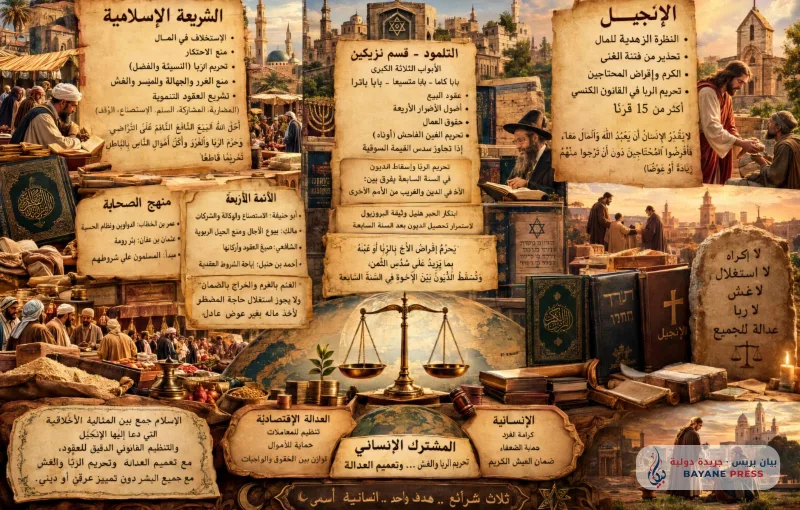
However, the specificity of the covenant does not mean that Jewish thought lacks a conception of general moral and religious duties. Rabbinic jurisprudence distinguished between the commandments specific to the Children of Israel and the laws it deemed binding upon all humanity, known as the Seven Laws of Noah, found in the Babylonian Talmud, Tractate Sanhedrin, 56a.
In the well-known Rabbinic formulation, these laws include the establishment of courts, the prohibition of idolatry, blasphemy, murder, theft, forbidden sexual relations, and eating a limb taken from a living animal. This conception is based on the belief in a general moral and religious obligation for humanity, while maintaining specific laws for the community bound by the Sinai covenant.
As for the Holy Quran, it declared the universality of the Muhammadan message in the words of the Almighty: ﴿And We have not sent you except comprehensively to mankind as a bringer of good tidings and a warner﴾ (Saba: 28), and His saying: ﴿Say, "O mankind, indeed I am the Messenger of Allah to you all"﴾ (Al-A'raf: 158). These texts establish that the Islamic call transcends national and lineage-based affiliation, and that entering Islam is based on faith and religious commitment.
This universality has been reflected in the history of Islamic sciences, where scholars of both Arab and non-Arab origins participated in building jurisprudence, Hadith, exegesis, and linguistics, and the Islamic civilizational sphere expanded to include multiple peoples and cultures. However, this expansion did not prevent the emergence of social and political distinctions in some stages of Islamic history, which necessitates distinguishing between the universality of declared principles and the practices of societies and states.
In financial transactions, a striking legislative difference appears in the rules regarding lending money at interest. In the Book of Deuteronomy, Chapter 23, verses 19 and 20 according to common Christian numbering, a distinction is made between lending to an Israelite brother and lending to a foreigner. The 15th chapter of the same book also contains provisions for the release of certain debts in the seventh year, with a distinction regarding the foreigner.
Interpretations of these rulings have evolved in Jewish jurisprudence, and their application has been linked to regulations concerning the nature of the loan, the status of the borrower, and the relationship between the religious community and the external society. It is not accurate to consider all these rulings as a comprehensive expression of the Jewish moral stance toward non-Jews, because the Torah contains texts that call for protecting the stranger and not oppressing them.
In the Book of Leviticus, Chapter 19, verses 33 and 34, there are rulings concerning not oppressing the resident stranger, and a call to treat them with love and fairness. The combination of these texts with the specific financial rulings reveals that the Torah system contains different levels of legislation, some linked to the religious identity of the community, and others expressing moral obligations toward others.
As for the Quran, it prohibited usury (Riba) in Surah Al-Baqarah, verses 275 to 279, and the majority of Muslim jurists decided that the prohibition encompasses transactions between Muslims and non-Muslims, despite a historical disagreement regarding some forms related to the 'Dar al-Harb' (abode of war) among a number of Hanafi jurists. Therefore, it is more accurate to say that the general rule among the majority of jurists is the prohibition of usury regardless of the religion of the transacting party, without ignoring the limited doctrinal disagreement in some cases.
The Quran linked human transactions to the principle of justice, as the Almighty said: ﴿And do not let the hatred of a people prevent you from being just. Be just; that is nearer to righteousness﴾ (Al-Ma'idah: 8). It also permitted kindness and equity toward non-Muslims who did not fight Muslims over religion or drive them out of their homes, according to Surah Al-Mumtahanah, verse 8.
However, historical Islamic jurisprudence also knew legal differences in some rulings between Muslims and non-Muslims, and in matters related to covenants, political status, rights, and obligations. This makes scientific comparison more accurate when it distinguishes between the general moral principle and historical legal application.
From financial transactions, the comparison moves to the structure of religious authority, where a clear institutional difference appears. The Torah assigned the functions of the priesthood related to the Temple and the offering of sacrifices to the descendants of Aaron, while assigning other functions related to temple service and rituals to the rest of the members of the tribe of Levi, as stated in the Book of Numbers, Chapters 3 and 18.
The functions of the priests included offering sacrifices, performing certain purification rituals, and examining cases of skin diseases with ritual implications, as in the Book of Leviticus, Chapters 13 and 14, in addition to the priestly blessing and certain rights related to tithes and offerings. The exercise of sacrificial functions was linked to strict lineage and ritual conditions, and the Torah included severe punishments for some forms of encroachment on the priests' jurisdiction, as in the Book of Numbers, Chapter 16, which recounts the rebellion of Korah and his group.
Nevertheless, hereditary priesthood does not mean a monopoly on religious education and interpretation in an absolute sense; the institution of Rabbis, based on knowledge, study, and transmission, arose in Judaism, and this institution was not confined to the descendants of Aaron. After the destruction of the Second Temple in 70 AD, the role of the Rabbis grew as interpreters of the law and organizers of religious life, while the continuation of sacrificial rituals associated with the Temple became impossible.
In Islam, there is no hereditary priestly institution similar to the Temple priesthood in offering sacrifices or acting as a necessary intermediary for the acceptance of repentance. Scientific authority in issuing fatwas, interpretation, and judiciary is based on qualification, knowledge, and Ijtihad (independent reasoning) according to its conditions, even if Islamic schools of thought and states differ in organizing religious institutions and the limits of their jurisdiction.
In early Islamic history, scholars of diverse social and national origins emerged, including Ata ibn Abi Rabah in Mecca, Tawus ibn Kaysan in Yemen, and Hasan al-Basri in Iraq. These and others contributed to building jurisprudential and Hadith knowledge, indicating that scientific status was not limited to a hereditary priestly lineage.
This structure is connected to the principle of collective responsibility for religious values, as in the Almighty's saying: ﴿You are the best nation produced [as an example] for mankind. You enjoin what is right and forbid what is wrong﴾ (Al-Imran: 110). Jurists have discussed the limits of exercising this duty and its regulations, to prevent it from turning into an encroachment on rights or an overstepping of the authority of the judiciary and competent authorities.
This comparison reveals that the shift from the specificity of the Mosaic covenant to the universality of the Islamic message was not limited to the expansion of the scope of the call, but was also linked to differences in financial regulation, religious authority, and sources of legislative power. However, fairness requires acknowledging that Judaism knew non-hereditary scholarly traditions, and that Islam knew religious and scholarly institutions with regulatory authority, which makes the difference related to the nature of the institution and the source of its legitimacy, not merely the presence of clergy in one law and their absence in another.
The universality of legislation in the Islamic conception is not understood as an abolition of scientific specialization or all legal differences, but as the establishment of a message whose address to humans does not depend on lineage-based affiliation. From this perspective, the importance of studying the reflection of this vision on daily human life becomes clear, primarily purity, acts of worship, and religious time, which are the topics we will address in the fourth part.


Comments (0)
No comments yet. Be the first to react!