

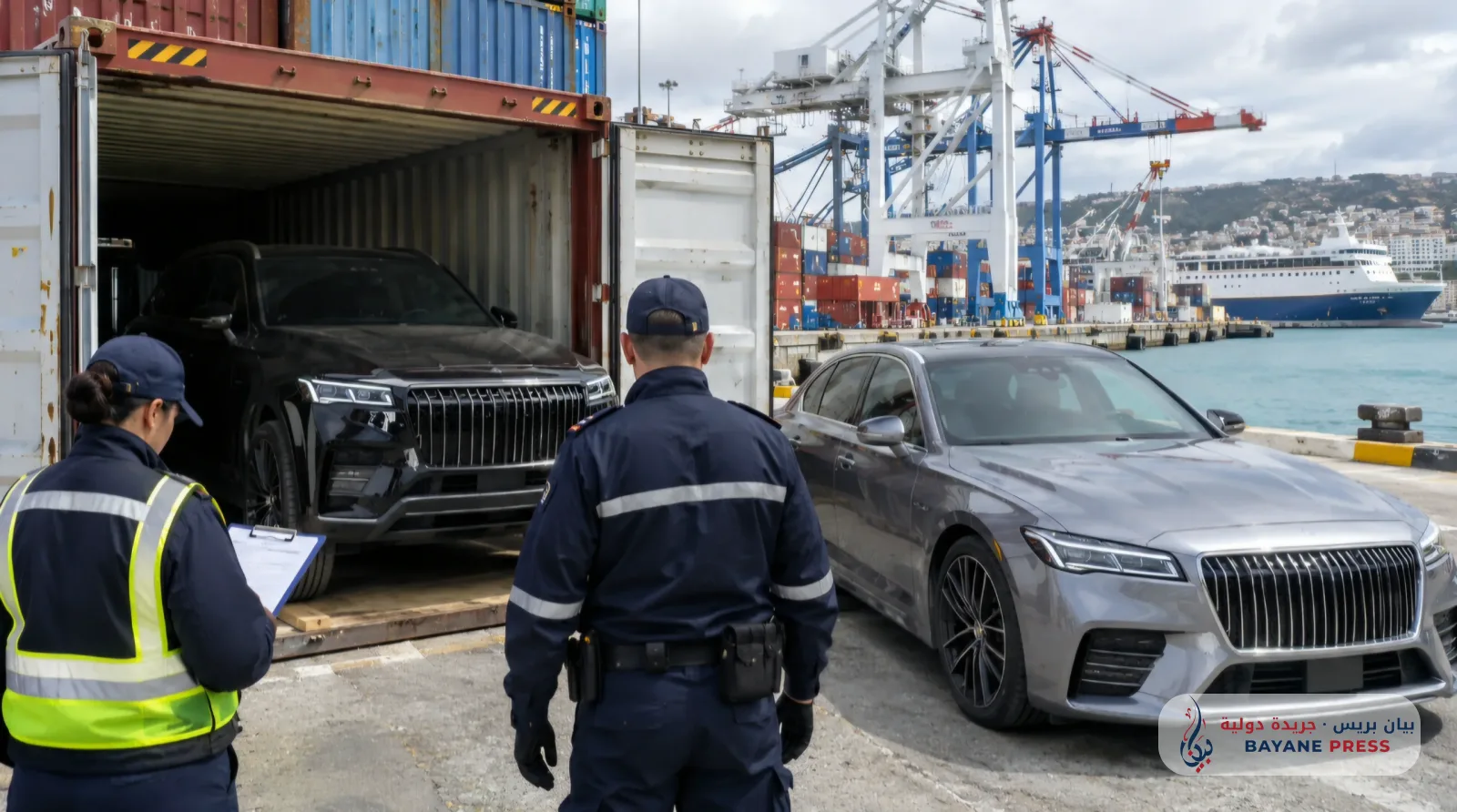
The international security operation "Carback 2," the results of which were announced by Interpol on Friday, November 20, 2026, has revealed complex extensions of stolen vehicle trafficking networks. These operations go beyond traditional theft into a transcontinental criminal system, involving document and chassis number forgery, maritime smuggling, drug trafficking, and money laundering. Morocco emerged as a key participant in these international tracking and security coordination efforts.
The Moroccan contribution was not limited to intercepting two luxury vehicles stolen from Canada as they passed through the port of Tangier, following intelligence provided by Canadian customs regarding suspicious shipments. The European Border and Coast Guard Agency, "Frontex," reported that representatives from Interpol's National Central Bureau in Morocco participated, alongside their Canadian counterparts and regional African offices, in supporting vehicle tracking operations and facilitating their seizure within an international coordination system based on real-time information exchange.
Frontex data highlighted some of the technical methods used by smuggling networks. Italian security services, in cooperation with Interpol and the European agency, successfully intercepted two stolen vehicles at the port of Genoa destined for Tunisia, where forged registration documents and tampered vehicle identification numbers were discovered. Investigators were able to recover the original numbers using an electronic diagnostic device, a case demonstrating that verifying visible documents alone may not be sufficient to detect stolen vehicles whose true identities have been concealed.
Tracking operations extended to other routes across the African continent, where Mauritanian authorities seized a Toyota stolen from France, while specialized agencies in Senegal and Nigeria recovered two vehicles stolen from Portugal. In Bolivia, real-time tracking data led to the location and recovery of a vehicle stolen from Argentina, reflecting the importance of technology and intelligence coordination in pursuing vehicles even after they have traveled thousands of kilometers from their point of theft.
In Europe, information exchange between German and Polish agencies led to the location of a vehicle stolen from Germany on a highway near Warsaw, before it was intercepted and a suspect was detained. Furthermore, direct communication between Serbian and Croatian authorities thwarted the passage of a vehicle stolen from France that was en route to Serbia, highlighting the speed at which these networks move across international borders.
The parallel European operation "JAD Mobile 9," led by Frontex in conjunction with Interpol's movements, revealed criminal extensions beyond vehicles. Its seizures included 34 boats, 41 marine engines, 127 forged documents, and 80 firearms, in addition to more than 7.4 tons of cocaine. These results pertain to the parallel European operation and should not be counted as part of the independent outcome of operation "Carback 2."
In the context of strengthening the capabilities of law enforcement agencies, Frontex organized remote awareness sessions benefiting approximately 1300 participants, covering registration plate forgery, heavy machinery crimes, and methods for identifying the true identity of vehicles. Liaison officers from the World Customs Organization also contributed to supporting coordination between participating services, reflecting the shift in combating these crimes from traditional inspection to a system combining intelligence analysis, technical examination, and border surveillance.
These events confirm that international ports and border crossings have become primary arenas for confronting stolen vehicle trafficking, and that the success of security agencies is measured not only by the number of recovered vehicles, but by their ability to uncover the financial and logistical paths of criminal networks and cut their lines of communication. In this context, Morocco's participation in the operation stands out as part of international security cooperation aimed at preventing the exploitation of legitimate trade corridors for the disposal of property obtained through crime.


Comments (0)
No comments yet. Be the first to react!