


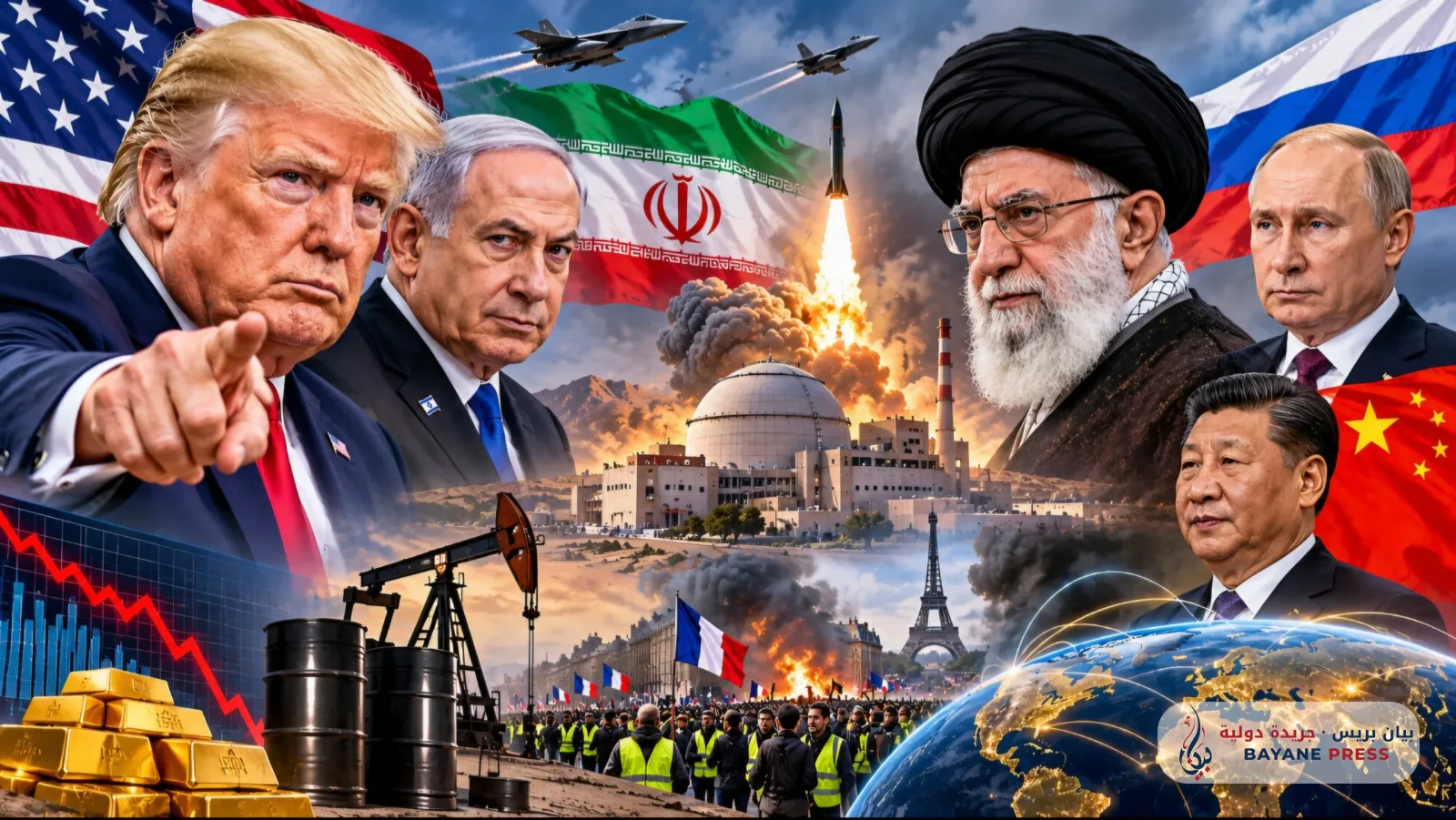
A bare machine-reading of the theater of operations stretching from the Iranian Plateau to European capitals reveals that public statements are merely an external veneer hiding military doctrines and financial engineering whose dimensions are understood only by strategic planners in operations rooms. When the US President publicly announces his intention to target the fortified Kuh-e-Bax facility south of Natanz and sets a time limit of ten minutes only for the operation, this does not represent a political slip of the tongue, but rather a literal application of an intelligence tactic known in modern military doctrine as kinetic and electronic bait. The hidden purpose of naming this specific site before striking it is to force the Iranian Revolutionary Guard to activate secret emergency protocols—either by moving high-enriched uranium shipments and advanced centrifuges to alternative shelters, thereby exposing their routes to thermal satellites, or by pushing field commanders to break radio silence and make encrypted communications with control rooms inside the mountain. This provides American and Israeli electronic reconnaissance aircraft with precise coordinates for ventilation points, power switches, and communication nodes that would be impossible to detect under normal circumstances.
Based on these operational data, the upcoming US-Israeli strike following the close of the midterm election ballots has become a mathematical certainty unless Tehran makes a concession in the Doha negotiations to hand over its nuclear stockpile—a condition classified by the Iranian security doctrine as regime suicide. However, engineering intricacies confirm that the anticipated strike will not be a traditional destructive raid; those well-versed in geological weaponry sciences know that the Kuh-e-Bax facility is carved at a depth ranging between eighty and one hundred meters beneath hard granite rocks, making it impervious even to American GBU-57 deep-penetration bombs if dropped individually. Therefore, the ten-minute operation mentioned by the Pentagon is based on the doctrine of strategic burial and organ paralysis. It relies on the simultaneous and sequential dropping of bunker-buster bombs by B-2 stealth bombers into the same geographical breach to seal tunnel entrances and destroy ventilation shafts, in parallel with an Israeli cyber and electromagnetic attack that detonates cooling and power stations from within. This turns the mountain into a closed rocky sarcophagus that buries the Iranian nuclear program alive without the need to breach the central room or get entangled in a ground invasion.
The circle of these military secrets is completed by adding the most dangerous dimension kept under wraps by Pentagon circles: the dilemma of depleting the strategic stockpile of interceptor missiles. In modern warfare calculations, power is not measured solely by the number of bomber aircraft, but by the equation of cost and time required to replace defensive munitions. Every wave of ballistic missiles or suicide drones launched by Iran and its allies forces US and Israeli forces to consume interceptor missiles from THAAD, Patriot, and Arrow systems costing millions of dollars each, while production lines in US arms companies require about two years to replace what is consumed in a single night of bombardment. This critical logistical gap means that prolonging the confrontation or proceeding with a strike on the Kuh-e-Bax facility will place the US military before the nightmare of exposing its defensive stockpile allocated for the Pacific theater and the Taiwan Strait. Added to this is the technical dimension related to orbital blinding warfare; military intelligence reports indicate the deployment of advanced electronic warfare and laser systems on the Iranian Plateau designed to cause electromagnetic jamming that blinds synthetic aperture radar satellites and disrupts space guidance signals during the ten-minute window designated for the US strike, turning the surgical operation into an adventure with uncertain outcomes.
As for the fundamental question regarding the world drifting toward a Third World War, strategic calculations rule out the outbreak of classical armies' warfare, confirming instead that the world has effectively entered the phase of comprehensive hybrid warfare targeting non-military lifelines. Iran realizes that completely closing the Strait of Hormuz with naval mines is a fatal strategic mistake because it would choke the Chinese buyer, who represents Tehran's sole economic lung. Therefore, the Iranian military leadership designed an alternative deterrence plan based on covert selective targeting. In the hours following the strike on Kuh-e-Bax, Iran will not launch its missiles randomly; instead, it will activate a target bank focusing on submarine fiber-optic cables connecting Eastern and Western data in the Red Sea and the Arabian Gulf, major regional data centers, and water desalination plants. This will be synchronized with the activation of smart acoustic mine tactics and loitering drone submarines on the seabed, programmed via acoustic algorithms to distinguish the engine signatures of tankers insured by Western companies and target them exclusively without harming oil tankers heading to Asia—which explains the recent mysterious attack on the Qatari gas tanker as a field calibration test to test the response speed of Western fleets before zero hour.
Here lies the hidden link connecting military operations rooms in the Middle East to the collapse of financial markets and the explosion of the European street. The ordinary observer stands helpless before the paradox of gold prices dropping to settle around four thousand one hundred and seventeen dollars per ounce, coinciding with the beating of war drums, Brent crude prices jumping above one hundred and seventeen dollars, and US bond yields reaching five percent. However, the secrets of financial engineering reveal that the rising cost of energy and the acute diesel crisis created inflationary panic that led to a violent sell-off in the global bond market, causing an immediate shortage of cash liquidity and triggering margin calls in sovereign funds and major banks. This forced these institutions to liquidate and sell their highly liquid profitable assets, foremost among them gold, to obtain the US dollars necessary to cover debts and finance expensive energy purchases. The drop in gold here is not a sign of peace, but a mechanical symptom of a stifling global liquidity crisis that swallows up capital and forces it to flee toward the dollar at the expense of other currencies and economies.
From the womb of this calculated chaos and stormy turbulence emerges the map of the major beneficiaries who manage the crisis or reap its fruits in silence and cold mechanics. Foremost among them is the financial, military, and energy cartel inside the United States itself, which is achieving historical profits at the expense of the European ally, which represents the soft underbelly of the Western system. The disturbances in France, Italy, Belgium, Austria, Portugal, and Albania—along with the accompanying burning of the Limoges town hall, union strikes, and the return of the Yellow Vests under the weight of an energy inflation reaching nineteen percent and fatal budget deficits—are not merely transient living standard protests, but the inevitable result of a financial war of attrition that caused what is strategically known as the de-industrialization process of the European continent. The rise in gas, diesel, and electricity prices, coinciding with city fires, is driving giants of heavy industry, petrochemicals, and automobiles in Germany, France, and Italy to close their factories and migrate with their capital and technologies toward the US market to enjoy cheap energy and geographical security, while Washington reaps trillions of dollars from selling liquefied natural gas to Europe at multiplied prices, from emergency arms contracts, and from the influx of fleeing global liquidity toward bonds and the US dollar.
On the opposite side of the world, Russia emerges as a direct geopolitical and economic winner without firing a single shot in the waters of the Arabian Gulf. The spike in oil prices toward testing the one-hundred-and-forty-dollar barrier per barrel with the onset of winter pumps billions of additional dollars into the Kremlin's treasury, completely neutralizing the impact of Western sanctions and funding Russian military operations with a comfortable financial surplus. More importantly, Washington's diversion of air defense batteries and smart munitions toward the Middle East to protect Israel and American bases has left the skies of Ukraine exposed. Meanwhile, social uprisings in Paris, Brussels, Milan, and Vienna are destabilizing and exhausting European governments that are hardline against Moscow, paving the way for the collapse of ruling coalitions and the rise of new European political forces that will find themselves forced to negotiate with Russia to reopen gas pipelines, and even break the American cordon by opening secret and independent negotiation channels with Tehran to ensure energy flows and escape comprehensive economic and social collapse.
As for the deepest long-term strategic beneficiary, it is China, which watches the United States immerse itself once again in the shifting sands of the Middle East with deep relief. Every US aircraft carrier, every dollar, and every intelligence effort drained in the confrontation with Iran is a direct deduction from Washington's ability to implement the containment strategy in the South China Sea and Taiwan, granting Beijing a golden time window extending to a full decade to complete its military and technological supremacy. In addition to its continuous acquisition of Iranian and Russian oil at heavy discounts settled in Chinese yuan outside the SWIFT system, Chinese investment funds are exploiting stagflation and liquidity shortages in Europe to quietly acquire European assets, technology companies, and ports suffering from the risk of bankruptcy. Also emerging on the list of winners are countries owning land corridors and alternative pipelines bypassing the Strait of Hormuz, and major sovereign wealth funds holding cash liquidity that are preparing to devour distressed global assets at rock-bottom prices. Ultimately, it becomes clear that what lies ahead is not a traditional world war with cannons and tanks, but a forced surgical operation to redistribute wealth and power in the world through algorithmic wars and the choking of supply chains, wherein the Western alliance gradually disintegrates from within and the European continent emerges battered and stripped of the welfare state, while Washington, Moscow, and Beijing divide the spoils of the new international order over the ruins of crises.

Comments (0)
No comments yet. Be the first to react!