


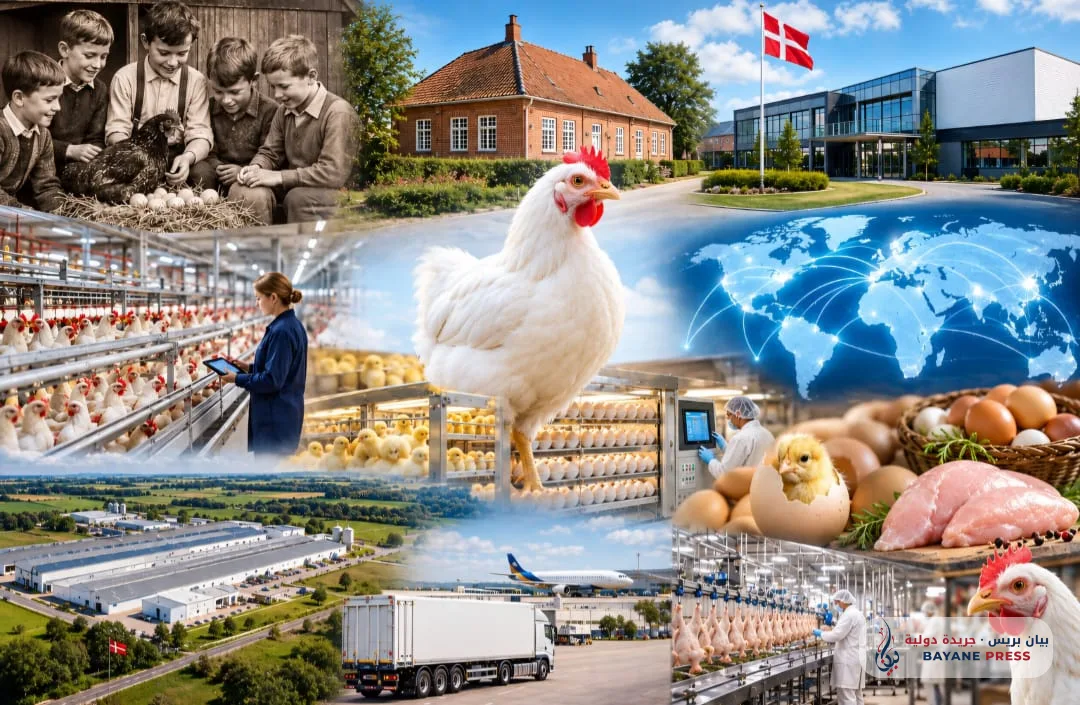
In the late 1930s, specifically within a quiet rural farm in the town of Vraa, located in the northern region of Jutland, Denmark, the five brothers of the Mølberg family could not have imagined that their early passion for purebred chicken breeds would transform decades later into one of the largest biological and food empires on the European continent and the world. The five young men pooled their modest savings to buy just fourteen hatching eggs and placed them under a bantam hen responsible for naturally incubating them, sprouting from that modest rural experience the initial core of a company officially founded in 1939 by the pioneer Knud Mølberg under the name Mølberg Incubator. The company's headquarters has remained firmly rooted in the same historical site on Rogerivej Street in the town of Vraa for eighty-five years, before management relocated in 2024 to a modern and larger facility commensurate with the scale of its continental operations.
The company's archival documents and commercial records show a precise trajectory of capital transformations and strategic mergers, as ownership of the incubator passed in 1973 to the feed and grain company KFK, which managed it until 2002—a crucial year that witnessed its acquisition by a consortium of leading Danish feed companies and cooperatives, led by agribusiness giants DLG and Danish Agro, in collaboration with Aabenraa Andel and Hedegaard. On August 1, 2003, the Mølberg incubator merged with the Velligårdvej incubator in the city of Randers to officially give birth to the entity known as DanHatch, which continued its internal expansion with the acquisition of the Holmegårds incubator in 2005. The DLG and Danish Agro groups share ownership of the DanHatch holding equally, with the group's actual sales jumping in 2025 to 553 million day-old chicks, achieving revenues of 227 million euros through a team of over six hundred specialized employees and a total production capacity close to sixty million chicks annually under the leadership of the group's CEO, Annette Hermansen, who assumed full responsibility in 2026 after years of shared management with Lasse Olesen.
This numerical leap was not solely the result of the Scandinavian market, but constituted the fruit of a cross-border expansion strategy that placed DanHatch at the forefront of broiler and hatching egg producers in Europe. Between 2009 and 2012, the group acquired DanHatch Poland in the Stary Widzim region, where it built advanced facilities for hatching egg production with a capacity of up to ten million eggs per facility. In 2015, it founded its Finnish subsidiary DanHatch Finland following the purchase of two incubators belonging to the HKScan group, followed in 2017 by the founding of a company specialized in poultry breeder production in Finland, raising its market share there to ninety percent by 2020. Meanwhile, the most prominent expansion took place in the French market starting in 2017 through a joint venture with the Belgian group Yellow Bird to acquire the large Guasdoué hatchery in the Brittany region, followed by a rapid acquisition between 2018 and 2023 of the hatcheries in Saint-Marcellin, Josselin, Avi Loire, Amilly, and Saint-Hilaire, culminating this trajectory in 2026 with the full one-hundred-percent acquisition under the name DanHatch France. The group's annual financial reports reveal a crucial strategic decision adopted in 2022 stipulating the definitive exit from the pig breeding sector and the closure of the Dan Piglet company, which it had acquired in 2010, in order to concentrate all its scientific and financial resources on the poultry sector and feed the world with white protein.
The true strength of DanHatch lies in its precise engineering of the three links of biological production, beginning with the breeding bird phase, or what is scientifically known as the breeder and grandparent flocks. In biologically isolated primary breeding farms, such as the Arup farm—which houses fifty thousand hens and roosters—the company receives the breeding chicks immediately upon hatching from pure genetic line suppliers, notably the Ross 308 strain, widely distributed globally for its feed-to-meat conversion efficiency, and the slow-growing Hubbard strain, intended for markets demanding high welfare standards such as France and organic farms. These birds undergo a rigorous selection process to ensure the procurement of breeders and roosters with a solid body structure, great vitality, and innate disease resistance. During the rearing period spanning from day one until reaching sexual maturity around the twentieth week, the company applies a comprehensive immunization and vaccination program to both roosters and hens, the scientific objective of this procedure being not only to protect the breeding flock, but to stimulate the breeders' bodies to generate antibodies transmitted biologically via the hatching egg yolk to the embryo, equipping subsequent chicks with early maternal immunity against epidemics before they step out into life.
When the breeding flocks reach maturity, they are carefully transferred to the second link, represented by hatching egg production farms, most notably the Søholm farm, which houses forty thousand birds including breeders and roosters. The breeding hen begins laying fertilized eggs from the twenty-fourth week to the sixty-second week of life, laying an average of about 183 eggs per hen during its productive cycle, from which approximately 175 eggs suitable for incubation are extracted, yielding about 150 live chicks. Laying houses are equipped with special nests and instant electronic monitoring technologies that record climate, feeding, and production data moment by moment, in parallel with the periodic extraction of blood samples from the breeder flocks throughout their life to verify the total absence of epidemic diseases. DanHatch produces about thirty percent of its hatching egg requirements on its own farms, while sourcing the remainder from contracted farms governed by its regulations, in addition to exporting more than thirty-two million hatching eggs annually from Denmark alone to international markets. This activity integrates with the table egg production system in Denmark, which annually produces fifty-five million kilograms of eggs through three and a half million laying hens managed by major companies and institutions like Dafa Foods and Danæg under the umbrella of the Danske Æg federation—a system that stands out globally for being practically free of salmonella bacteria thanks to a control program that examines flocks every two weeks, and even weekly in the case of some producers, a pace exceeding the European average twentyfold, alongside the total ban on chick beak trimming in Denmark since 2014 and the mandatory organic feeding from day one for organic chicks.
Meanwhile, the third link, which is the most sensitive, takes place inside DanHatch's gigantic industrial incubators, where the journey begins immediately upon the arrival of hatching eggs with their disinfection and transfer from farm carts to primary incubation carts. The eggs are placed in smart incubators for eighteen days under strict control regulating temperature, humidity percentage, and oxygen flow, with the incubators performing automatic and frequent egg turning in faithful imitation of the mother hen's behavior in nature to prevent embryo adhesion to the shell membrane and provide the best opportunity for growth. These incubators have engineered an ecosystem that recovers the biological heat naturally emitted by millions of developing embryos inside the eggs and recycles it to heat the facilities and water, achieving exceptional energy consumption efficiency. On the eighteenth day, the eggs undergo an automated optical and laser examination that isolates unfermented eggs, before transferring live eggs to hatching rooms for three additional days, equipping modern incubators with dim lighting and early feeding until chick hatching is completed on the twenty-first day.
Immediately after hatching, the company harnesses the chicks' innate biological advantage consisting of the latent yolk sac in their abdomen, which provides them with autonomous food and water for seventy-two hours, enabling the transport of day-old chicks in trucks and planes equipped with air conditioning systems and precise protection filters against infections to export them to every corner of the planet. The other part is allocated to feed Danish broiler farms, including the Dan Broiler company belonging to the same group, and supplying broiler farms for giants of the poultry meat industry in Denmark, which produce about 115 million broilers annually without the habitual use of antibiotics and under government control examining the health of the birds' footpads as a strict criterion for measuring chicken quality of life on farms. Heading these producers is the Danpo company, which slaughters forty-five million chickens annually according to halal slaughter standards approved at its slaughterhouse in the city of Aars and produces forty-five thousand tons of chicken products at its factory in the city of Farre, alongside the prestigious Rose Poultry company, founded in 1952, which applies the Danish "five-times" criterion guaranteeing that the breeders, hatchery, farm, feed, and slaughterhouse are entirely Danish until the chicken reaches slaughter weight between the thirty-sixth and forty-ninth day of life.
Reading the complete archive of DanHatch and the Danish poultry system reveals how a small country has managed to transform itself into a genetic and food laboratory supplying the world's tables with hundreds of millions of poultry annually, based on the fact that chicken meat and eggs represent the most economically viable source of protein, with the lowest carbon footprint and widest acceptance by all cultures and religions without exception. Despite severe challenges documented in company reports between 2023 and 2026—headed by fluctuations in global grain and soybean prices, waves of highly pathogenic avian influenza hitting European supply chains, and constant preparedness to repel any salmonella bacteria infiltration—the legacy initiated by the Mølberg brothers with fourteen eggs and a bantam hen in the town of Vraa has become an indispensable pillar in the equation of global food security.

Comments (0)
No comments yet. Be the first to react!