


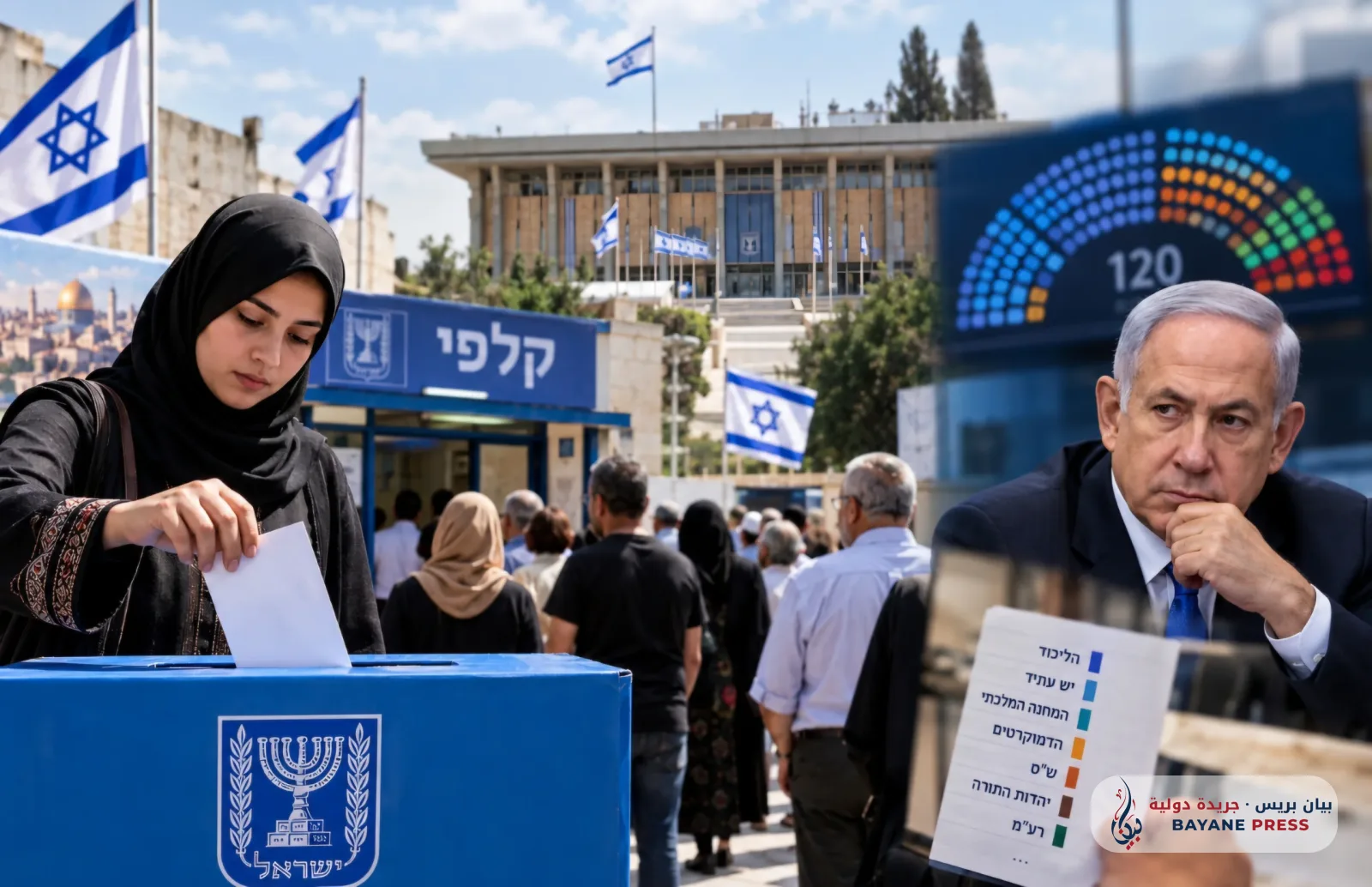
Arab voter participation and the issue of expatriate voters are emerging as crucial factors in the upcoming 2026 Knesset elections, amid scenarios pointing to a rise in turnout and the possibility of increasing Arab representation to 15 seats. As the Israeli Knesset elections approach, attention is turning to one of the most significant variables that could impact the future of Israel's political landscape: the level of electoral participation, particularly among Arab citizens within the Green Line. Amid fierce competition between Prime Minister Benjamin Netanyahu's camp and his political opponents, Arab voter turnout is gaining special significance as a factor that could alter the distribution of parliamentary seats and affect the ability of various alliances to reach the majority required to form a government. The results of the last Knesset elections in 2022 reveal a clear gap between general turnout, which stood at around 70%, and Arab turnout, which was only about 53%. This gap indicates the existence of a vast Arab electoral bloc that did not participate in the previous ballot, making any tangible increase in their participation rate a factor worth monitoring in the upcoming elections. In an electoral system based on proportional representation, where the Knesset consists of 120 seats and a government needs the support of a majority of 61 lawmakers, limited shifts in seat distribution can have a major impact on the prospects of forming government coalitions. Hence, the importance of the Arab vote is not limited to the size of parliamentary representation alone, but extends to its potential impact on the balance between Netanyahu's camp and the political forces opposing it.
Some electoral estimates project a scenario in which the representation of Arab parties could rise to about 15 seats if the upcoming elections witness a significant increase in Arab voter turnout and favorable conditions for distributing their votes among electoral lists. This level of representation is not unprecedented in the history of the Knesset, as the Joint List previously won 15 seats in the 2020 elections, when Arab turnout rose to about 65%. However, reaching this figure again depends on a set of factors, most notably the level of participation, the nature of alliances between Arab parties, and the ability of competing lists to cross the electoral threshold. Should this scenario materialize, the rise in Arab representation could impact the calculations for forming the next government, especially if the results of the major political blocs prove close. Nevertheless, an increase in the number of Arab lawmakers does not necessarily mean they will transition into a unified political camp or participate in an alternative government coalition, given the political and programmatic differences among the Arab parties themselves. Among the scenarios circulating regarding the 2026 elections is the likelihood of general turnout rising to around 80%, compared to nearly 70% in the 2022 elections. If such an increase occurs, it will represent a significant shift in electoral behavior, but it does not automatically mean a particular political party will benefit. The decisive factor is not voter turnout alone, but the identity of the voters who decide to cast their ballots and the distribution of their votes among different parties and lists, alongside potential shifts in Jewish voter participation and political stances.
Alongside Arab participation, the issue of Israeli citizens residing abroad stands out as a file requiring special attention when analyzing voting percentages. Estimates suggest there are hundreds of thousands of Israeli citizens living outside the country, a large number of whom may be listed on eligible voter rolls. The importance of this issue lies in the fact that Israeli law does not generally permit voting from abroad, with the exception of specific categories, forcing most citizens living abroad to return home if they wish to cast their ballots. Consequently, the non-participation of large numbers of registered voters residing abroad could affect the declared overall turnout rate. However, assessing the magnitude of this impact requires distinguishing between the total number of citizens living abroad, the number actually registered in the voter registry, and individuals covered by legal exemptions. Moreover, estimates regarding the number of returnees from abroad to participate in the elections should be approached with caution in the absence of precise official data.
The importance of Arab participation goes beyond increasing the number of seats won by Arab parties, reaching its potential impact on Netanyahu's ability to gather the parliamentary majority necessary to form a new government. If increased Arab participation leads to a change in seat distribution among various blocs, the parliamentary calculations of both the ruling coalition and the opposition could be affected. This impact intensifies if the results of the political camps are close, giving each additional seat greater weight in the equation to reach 61 lawmakers. However, this equation remains tied to other factors, including the results of Jewish opposition parties against Netanyahu, their ability to reach political understandings, and the stances of Arab parties regarding participating in the government or supporting it from outside the coalition. It is important here to distinguish between weakening the parliamentary capacity of Netanyahu's camp and forming an alternative government, as achieving the latter goal requires political compromises that may be more complex than simply possessing a sufficient number of opposition seats.
In conclusion, the aforementioned data shows that the upcoming Knesset elections will not be decided solely through traditional competition between parties, but will also be influenced by the levels of electoral mobilization among various groups. Arab participation stands out in this context as an important variable, especially in light of the recorded gap between it and general participation in the 2022 elections, and the previous experience in which Arab representation reached 15 seats. In contrast, the participation of Israelis living abroad, overall voter turnout, and the electoral threshold remain additional factors that could affect the final results. Therefore, the central question in the 2026 elections relates not only to the number of seats Netanyahu or his opponents will secure, but also to the volume of Arab voter participation, how their votes are distributed, and the extent to which this reflects on the balance of power within the Knesset. In a political landscape where the ability to form a government is determined by narrow seat margins, Arab participation may become one of the influential factors shaping the future of the ruling coalition and the nature of the upcoming Israeli government.
Comments (0)
No comments yet. Be the first to react!