


In the depths of the seas and oceans, where total darkness prevails and water pressure is immense, a vast network of undersea cables stretches out, forming the backbone of global communications and carrying most international data traffic between continents. Despite the advanced engineering protection these cables enjoy, they remain vulnerable to breakage and damage. The most common causes are ship anchors and fishing nets, alongside underwater earthquakes and landslides, which raises a fascinating question: how do engineers manage to repair a delicate cable that stretches for thousands of kilometers and sometimes rests at a depth exceeding five thousand meters?
The repair process begins before any ship reaches the site of the fault, as coastal communication stations constantly monitor cable performance, using specialized measuring devices to analyze optical and electrical signals and estimate the distance between them and the point of failure. These measurements, along with precise maps of cable routes, help narrow the search area and identify the region where maintenance teams should head, without the need to inspect the entire ocean floor.
Once the approximate location is identified, a specialized cable-laying ship intervenes, equipped with massive cranes, precise navigation devices, and equipment for retrieving and handling cables, as well as a stock of fiber optics, connectors, and spare parts. These ships can maintain their position over the work area using advanced positioning systems, even in the presence of ocean currents, which is crucial when repairs are conducted in deep waters. Before starting work, coastal stations cut off the electrical power supplying the cable to ensure the safety of the crew.
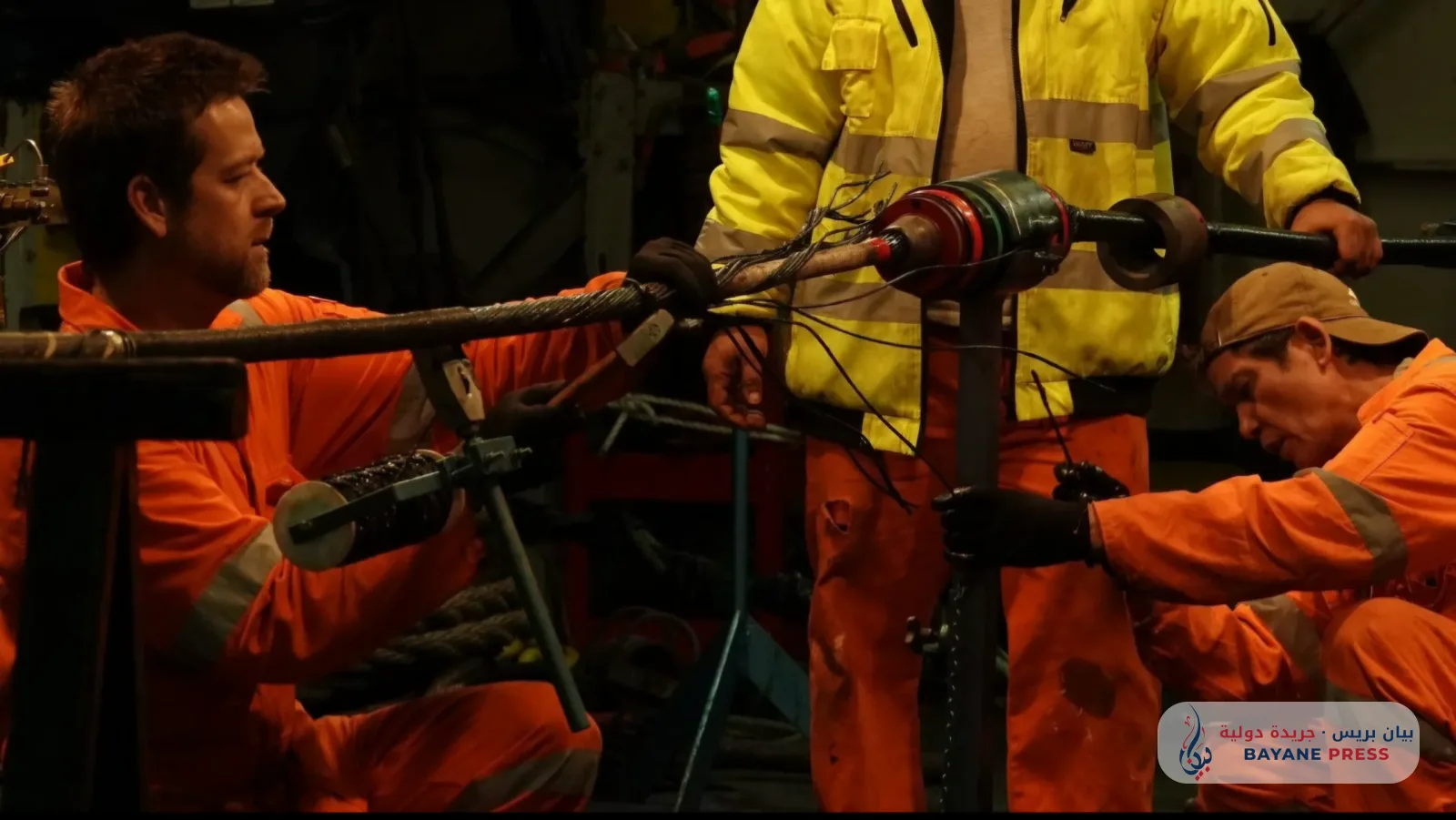
The most complex phase involves extracting the cable from the seabed. In deep areas, marine grapnels designed to catch cables are used, and the cable is often cut at the bottom with a cutting grapnel, because lifting it folded from a depth of thousands of meters could subject it to tension exceeding its load-bearing capacity. Remotely operated vehicles (ROVs) can also be used to locate the cable or free it from sediment. After finding it, one end is gradually raised to the ship's deck, while monitoring the tension to avoid causing additional damage, then it is secured and inspected before dealing with the other end.
Contrary to popular belief, divers do not descend to depths of thousands of meters to perform repairs, as the main part of the operation is carried out on the ship's deck. Technicians begin by removing the damaged part of the cable, then cleaning the ends and preparing them for reconnection. A new piece of spare cable is usually added, not only to replace the damaged part but to provide the extra length needed to safely lower the cable back to the seabed after its ends have been raised to the surface.
The true precision lies in handling the optical fibers inside the cable, which are extremely thin glass strands that transmit information as pulses of light. Engineers use precise fusion splicers to join the fibers together, taking care to minimize signal loss to the lowest possible level. Once finished, the splice points are protected inside special joints resistant to water, pressure, and corrosion, and the insulation and protection layers are restored to ensure the cable's ability to function for many years in the harsh marine environment.
Faults are not limited to the fiber breaks themselves; damage can also affect the optical signal amplifiers distributed at regular intervals within long undersea systems, which are devices that help signals travel thousands of kilometers without weakening to the point where they cannot be received. In some cases, the repair requires extracting the faulty amplifier and replacing it, which increases the complexity and cost of the operation.
After reconnection, the cable undergoes a series of tests to verify the integrity of the fibers, the quality of the signals, and the electrical stability of the components that require power. When measurements confirm the success of the repair, the process of lowering the cable back into the sea begins, carefully distributing its length to avoid subjecting it to excessive tension. In coastal and shallow areas, specialized marine vehicles can be used to re-bury it under sediment to protect it from ship anchors and fishing activities.
However, the repair process does not always proceed at the same speed; it may take a few days under favorable conditions, or extend to weeks or even months when the fault location is far from maintenance ports, weather conditions hinder ship movement, the operation requires permits to work within a specific country's territorial waters, or it is located in a region experiencing security tensions. Multiple faults or damage resulting from earthquakes and underwater landslides can also prolong the intervention time.
Meanwhile, the cutting of an undersea cable does not necessarily lead to an internet blackout in the countries connected to it, because telecommunications operators can, where alternative routes and sufficient capacity are available, reroute data traffic through other cables. However, this redirection may cause network congestion, a decrease in connection speed, and an increase in latency, especially when several cables are damaged in the same area.
These operations reveal an invisible side of the infrastructure upon which the digital world is built. While banks, stock exchanges, airports, media, and government institutions rely on the flow of information across borders, specialized ships work in the middle of the oceans to maintain the continuity of this flow. Ironically, repairing a fault in a highly sophisticated network may begin with a metal hook dragged across the seabed, before ending with the welding of glass fibers, each of which is barely thicker than a human hair.
Repairing undersea cables is a precise engineering and logistical process that involves the sciences of telecommunications, navigation, mechanics, and marine robotics. As the world's reliance on digital services grows, so does the importance of these cables and the crews that maintain them, as a hidden pillar of the global economy and communication between peoples.

Comments (0)
No comments yet. Be the first to react!