


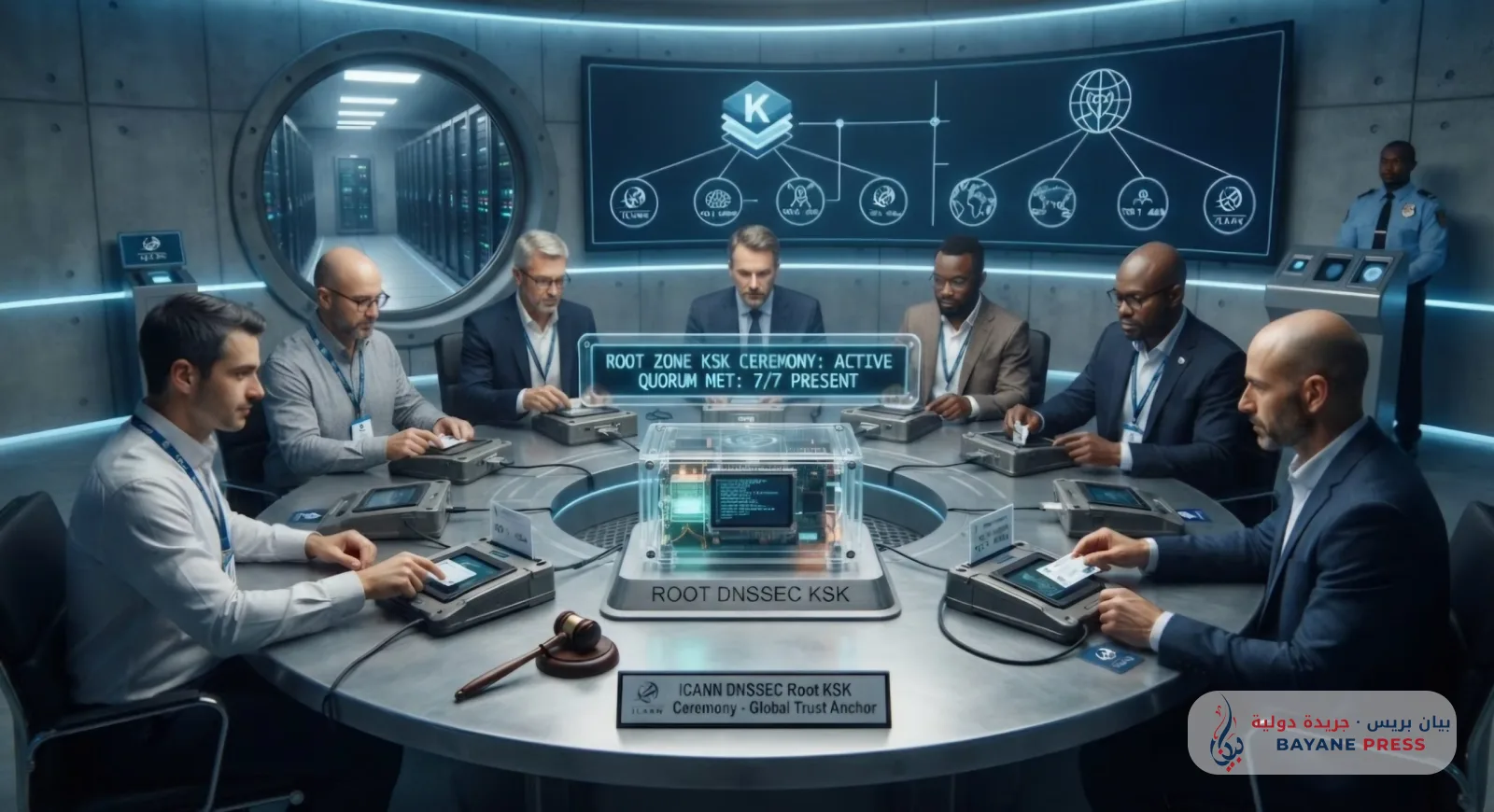
The modern internet space forms the main backbone of contemporary life, connecting national economies, vital institutions, and the communications of hundreds of millions of people worldwide. Although this space appears to observers to be borderless and far from physical frameworks, its stability and security rely on a strict infrastructure protected with extreme care. One of the most astonishing and curious tales in this context is the story of the seven internet keys, which serve as the final line of defense for the planet's digital safety—a story that blends advanced cryptographic precision, human guardianship, and highly complex security protocols that prevent an unprecedented global catastrophe.
To understand the depth of this issue and the precise mechanism governing it, one must dive into the technology behind the Domain Name System (DNS), which acts as a massive phone book translating website names we type into browsers into actual digital addresses known as IP addresses through which servers and devices communicate with each other. To protect this sensitive system from manipulation and digital route hijacking, global technical bodies developed an advanced security system known as DNS Security Extensions (DNSSEC). This system relies on asymmetric encryption to create an unbroken chain of trust starting from the root servers down to country domains and sub-domains, ensuring through a digitally signed cryptographic signature that incoming data has not been tampered with or altered midway by internet hackers.
At the heart of this vast hierarchical chain stands the Root Zone Key Signing Key, representing the absolute root of trust in the global digital space. It is a unique digital code managed through an extremely rigorous human protocol, with its parts distributed among seven core members and an equal number of alternates, bringing the total to fourteen individuals carefully distributed across various continents. These individuals, officially known as Trusted Community Representatives, do not carry traditional keys to physical doors, but rather encrypted smart cards containing crucial parts of the master code responsible for updating and securing the internet's foundational root. They were selected according to extremely rigorous criteria regarding technical expertise, integrity, and absolute neutrality to ensure no single nation, no matter how powerful, holds absolute control over the keys of global digital sovereignty.
Highly secretive security ceremonies known as Key Ceremonies are periodically held in facilities fortified and subjected to the highest levels of physical security in Virginia and California, USA. This event requires the presence of a specific quorum of key holders and alternates, usually ranging from three to five members, to ensure no single party makes unilateral decisions. These sessions are subject to strict security procedures including passing through multiple steel doors, biometric fingerprints, and sitting inside rooms completely isolated from the internet to prevent any digital breach. The smart cards are retrieved from special tamper-resistant storage bags sealed with unique serial numbers that are carefully checked, before being connected to specialized and completely isolated hardware security modules known as Hardware Security Modules (HSMs) to generate the new key or update it in accordance with the highest global encryption standards.
This system was not merely a hypothetical theory, but underwent harsh and major practical tests, most notably on October 11, 2018, when ICANN executed the first historical change of the root signing key known as the KSK Rollover. This was an extremely risky step that required updating the settings of hundreds of millions of internet service provider servers and institutions worldwide to ensure no interruption in digital connectivity or website browsing disruptions. This complex technical procedure succeeded thanks to precise and rigorous advance coordination.
This complex entanglement between pure mathematical encryption, strict human protocols, and impenetrable hardware guards reflects a deep philosophy based on the idea that the internet is not merely a network of cables and passing satellites, but a conscious societal and human construct that requires renewed and wisely distributed protection. Thanks to these meticulous procedures and the concerted efforts of those trusted guardians, the internet remains a safe haven for information and an impregnable citadel protecting global human communication from the greed of hackers and attempts at domination, keeping the story of the seven keys one of the greatest epics of engineering and digital security in modern human history.




Comments (0)
No comments yet. Be the first to react!