

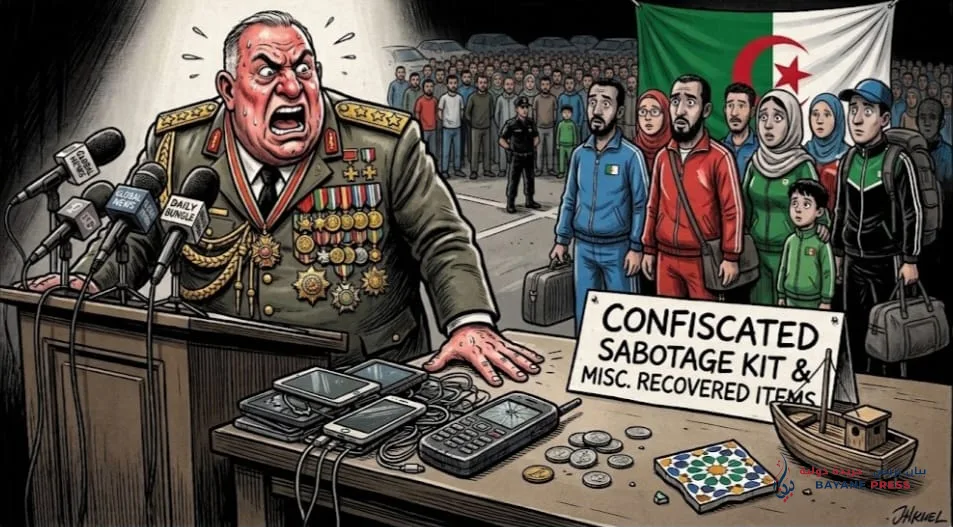
When the official security apparatus on the eastern side of the border decides to present the world with a dramatic plot worthy of silent cinema screens, it is not content with weaving the threads of absurdity; rather, it presents a bizarre intelligence report detailing an unprecedented “security epic”. The General Directorate of National Security released a statement claiming the dismantling of a dangerous international criminal network comprising sixty-one Moroccan nationals, described as being on the verge of executing “sabotage acts” and striking the stability of public order in the city of Oran. According to the official narrative—circulated quite seriously by news agencies and Algerian media—this “transcontinental” cell chose a staggering logistical route: its members traveled by air from Morocco to Tunisia due to a lack of direct flights, then infiltrated on foot through rugged paths and border forests in the “El Kala” region, reaching the west of the country, laden with a “devastating arsenal” of mobile phones, passports, cars with local license plates, and “Zodiac” boats, without forgetting to bring along women and men to deceive intelligence. Instead of submitting this play to cinematic juries to win an Oscar in dark comedy, the detainees were brought before the specialized penal pole, in a scene proving that the official narrative offers nothing but security farcicality trying vainly to cover the failure of reality.
The Realism of Seized Items and the Destruction of Intelligence Operations' Fundamentals:
From the perspective of intelligence operations rules and the basics of covert security work, this “official narrative” self-destructs and aborts the simplest rules of military and intelligence planning. The first stumbling block begins with the loose and vague concept of the accusation; the authorities sufficed with the elastic phrase “executing sabotage acts” without daring to define their nature! In criminal law and security sciences, sabotage requires precise characterization: Were we facing a bombing plot targeting sovereign headquarters? Or firearm attacks on infrastructure? Or riots and arson? Or piracy and digital espionage? Intentionally leaving the charge “loose” without a title indicates the absence of any material evidence, and confirms that security agencies did not find a single explosive, detonator, or map of a vital facility to attach to the report!
As for the means of execution, any infiltration operation aimed at “sabotage” is subject to strict protocols known as Operations Security (OpSec) and Communications Security (COMSEC); where secret cells rely on encrypted communication devices or satellite phones to prevent geographical tracking. However, what was displayed on security tables were personal and ordinary smartphones, which serve as “digital tracking beacons” instantly revealing the locations of their carriers!
Logistical Impossibility and Digital Footprint (The Knockout Blow to the Plot):
The plot becomes even more flimsy when applying the principle of field tracking and geographic data (metadata) to the alleged path. The claim that this group crossed a distance exceeding 1,000 kilometers on foot from the forests of “El Kala” in the far east to “Oran” in the far west, accompanied by women and individuals lacking official residency papers, strikes at the simplest facts of the Algerian security reality, which is characterized by dense checkpoints and National Gendarmerie stops along national and highways. Infiltrating an entire country lengthwise and crosswise without detaining a single individual either undermines the efficiency of the internal security system or proves the glaring truth: the detainees were present locally and normally in Oran and were gathered there!
Furthermore, the directorial flaw is complete regarding the issue of financing and financial liquidity; the seized items showed amounts of money in Moroccan dirhams and a few euros, whereas the basics of financial concealment for any cell require moving its funds either with the Algerian dinar for local purchases without arousing suspicion, or via digital currencies and indirect havens. As for being present with the “Moroccan dirham” inside Algerian territory for a “sabotage” mission, this is either operational stupidity that exists only in the imagination of the play's director, or blatant proof that the detainees are merely ordinary people whose identities or the nature of their work have not yet been determined, carrying their individual savings and pockets full of their mother country's currency before traveling! The absence of any explosive materials, firearms, or plans from the seized items, and their limitation to “Zodiac” boats exclusively designated for irregular migration networks and harraga aides, turns these seized items into evidence of the detainees' innocence and the fragility of the regime's plot.
The Gathering Scenario and the Collapse of Human Intelligence (HUMINT) Recruitment Standards:
Even in the basics of managing human assets and sleeper cells (HUMINT), high-risk intelligence operations require the selection of militarily trained elements characterized by a high capacity to withstand pressure, completely separated from normal civilian or family environments. As for a “transcontinental sabotage cell” comprising a random mixture of ordinary people whose professional backgrounds have not yet been revealed, and even women whose faces showed signs of misery and bewilderment for not comprehending the reason for this injustice, this represents a blatant violation of the most basic axioms of security sciences. Intelligence does not involve civilians and families whose specific identities are unknown in bare-chested sabotage missions without any weapon, not even a kitchen knife, which confirms that we are facing an operation of “arbitrary gathering” of individuals and irregular migrants who were detained in sweeping campaigns, and then a massive file was fabricated to shift the charges into a “major conspiracy.”
The Engineering of Diversion and the Timing of Regional Noise:
The media mobilization accompanying the official bulletin was neither an accidental coincidence nor an uncalculated security slip; the crisis management literature in totalitarian regimes relies on the method of “manufacturing an imminent external danger” whenever social and economic pressures and internal popular resentment increase. At a time when local markets suffer from Kafkaesque queues extending for hundreds of meters in search of essential basic materials (such as milk, oil, and flour/semolina) in addition to frequent drinking water cuts in entire provinces, the regime prefers to direct the spotlight and national mobilization toward an “imaginary external enemy” threatening the nation and national sovereignty. This intensive media promotion also coincides with attempts to create a second front for diplomatic and media distraction and noise against Rabat, coinciding with the anticipation of other regional movements and interactions, such as the anticipated visit of the Spanish King to the occupied cities of Ceuta and Melilla, to employ the card of these ordinary people as scapegoats to cover up external political embarrassments.
Is Algeria Looking for a Pretext to Declare War?
In light of this security surrealism and the succession of hollow accusations, observers raise a fundamental question: Do these security theatrics constitute a prelude and heralds to manufacturing a pretext leading to the declaration of direct military confrontation?
From a strategic and military analysis perspective, declaring war between states requires logistical build-ups, general mobilization, and complex calculations that cannot be based on “fabricating cases for harraga networks and ordinary migrants”; regimes moving seriously toward the option of armed confrontation do not rely on a comical media show whose tools are ordinary phones, pieces of dirhams, and vague accusations without bombing evidence. However, the inherent danger here does not lie in the existence of a real decision for war, but in the “strategy of brinkmanship”; continuously injecting public opinion with the doctrine of the “imminent enemy” to cover up social crises and internal collapse causes the erosion of psychological and diplomatic barriers, an irresponsible behavior that may lead to miscalculation and uncalculated field slippages on the border strip, whose heroes are soldiers fleeing the reality of queues toward adventure.
Human Rights Repercussions and Anticipated Judicial Fallout:
Despite the official media and the specialized penal pole in Oran continuing to market and inflate the file, the rope of fabrication and falsification is very short; the extensive movements led by human rights activists and associations from Tunisia, Algeria, and Morocco to file a joint lawsuit and send documents backed by material evidence to Amnesty International and relevant UN institutions will put the Algerian judiciary before an unprecedented international human rights test. The absence of conclusive material evidence and the lack of an actual criminal description of sabotage, in addition to the logistical impossibility of the alleged route and the absence of the simplest rules of intelligence operations, will make this alleged trial merely an exposed arbitrary file added to the record of violations and political score-settling, leaving the coming days to bear witness that turning into the manufacturing of “folklore conspiracies” grants no legitimacy, but only exposes the fragility of a neighbor fleeing the milk and oil queue to invent imaginary enemies carrying Moroccan dirhams and ordinary phones.
The Flop of Direction and the Exposure of the “Striking Force” Slogan:
This incident highlights a glaring paradox that wise leaderships and circles holding the reins of decision-making should have paid attention to; how can an institution claiming absolute possession of deterrence tools and projecting the influence of the “striking force,” which spends billions to enshrine its regional prestige, fall into a security directorial blunder of this naivety? Promoting a fragile narrative unsupported by the basics of geography or intelligence rules drops the dignity of totalitarian institutions and reveals floundering in managing external crises. Instead of projecting the state's capabilities and field efficiency, this narrative turned the scene into an explicit indictment of decision-makers, showing that showing off with big slogans fails to cover up a security confusion that has nothing to do with the wisdom of states or the majesty of intelligence.



Comments (0)
No comments yet. Be the first to react!