


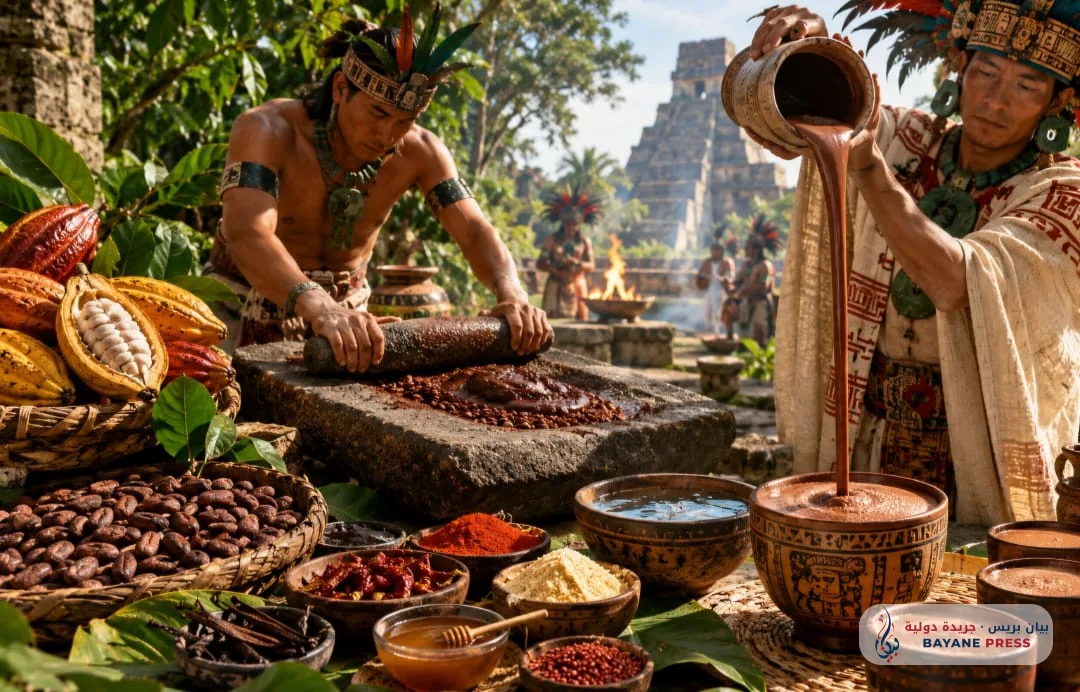
The cacao tree, known in the original Mesoamerican languages as "kakaw," occupies a central place in the worldview of the Maya civilization, a status that transcends food to achieve the category of ritual sanctity, as recorded in the Dresden Codex and the Madrid Codex, as well as in ceramic vessels discovered in classic royal tombs, such as the vessel from the tomb of "Río Azul" in Guatemala, which dates back to the 5th century AD and bears an explicit hieroglyphic text specifying the vessel's use for storing the frothy cacao beverage. In Maya mythology recorded in the book "Popol Vuh," cacao was not merely an agricultural product, but divine blood and one of the sacred elements brought by the gods to build and nourish the first man, and its preparation was subject to a strict protocol practiced by nobles and priests on solemn occasions.
The classic recipe for sacred Maya cacao is composed of fermented and roasted cacao beans, fresh water extracted from natural rock sinkholes known as "cenotes," finely ground and roasted corn flour to set the consistency, dry wild chili, achiote plant seeds to give the drink an intense red hue that mimics the color of vital blood, aromatic wild vanilla pods, and drops of honey from native stingless bees known as "melipona." This mixture was not sweet like contemporary cacao, but a stimulating, thick, spicy drink with a rich bitterness designed to stimulate the heart, dilate blood vessels, and elevate the levels of consciousness and concentration of priests and warriors before going to war or celebrating astronomical ceremonies.
The preparation steps begin by harvesting ripe cacao pods from the humid lowland forests, opening them to extract the beans coated in sugary white pulp, and placing them inside pits covered with wide banana leaves to ferment naturally for several days until their bitterness dissipates and their deep flavors develop. The beans are then dried under sunlight on woven reed mats, and then gently roasted on a flat clay griddle called a "comal," heated over low heat until the thin husks separate from the oily beans. The beans are peeled by hand and placed on a curved basalt grinding stone called a "metate," where they are crushed with a stone roller in successive movements; kinetic friction generates enough heat to melt the cocoa butter inside the beans, transforming the solid beans into a dark, glossy, and ultrafine paste.
Precise amounts of chili powder, ground achiote, and vanilla are added to the liquid cacao paste, kneaded with a little ground corn atole, and then the mixture is diluted by pouring warm water and melipona honey gradually while continuously whisking. Then comes the crucial and most sacred stage of the recipe, which is the formation of the thick upper foam that the Maya considered the dwelling place of the vital spirit; the preparer stands holding a tall cylindrical ceramic vessel and pours the flowing liquid from a high elevation at chest level into another vessel placed on the floor, repeating this pouring process several times with extreme skill until a cohesive brown velvet foam rises, crowning the beverage for several centimeters. This elixir was drunk warm in king enthronement rituals and royal weddings to cement the bonds between humans and the worlds of the gods.
Comments (0)
No comments yet. Be the first to react!