

Traditional education in Morocco constitutes a fundamental tributary of national and spiritual identity, and a central component in the civilizational and intellectual construction of Moroccan society throughout the ages. It is not merely a transient traditional educational style, but an integrated system that roots tolerant Islamic values, preserves the nation's linguistic and cultural heritage, and enshrines its religious constants—represented by the Maliki school of jurisprudence, the Ash'ari creed, and Sunni Sufism. This has made it an impenetrable fortress protecting Moroccan identity from all forms of cultural fragmentation or dissolution.
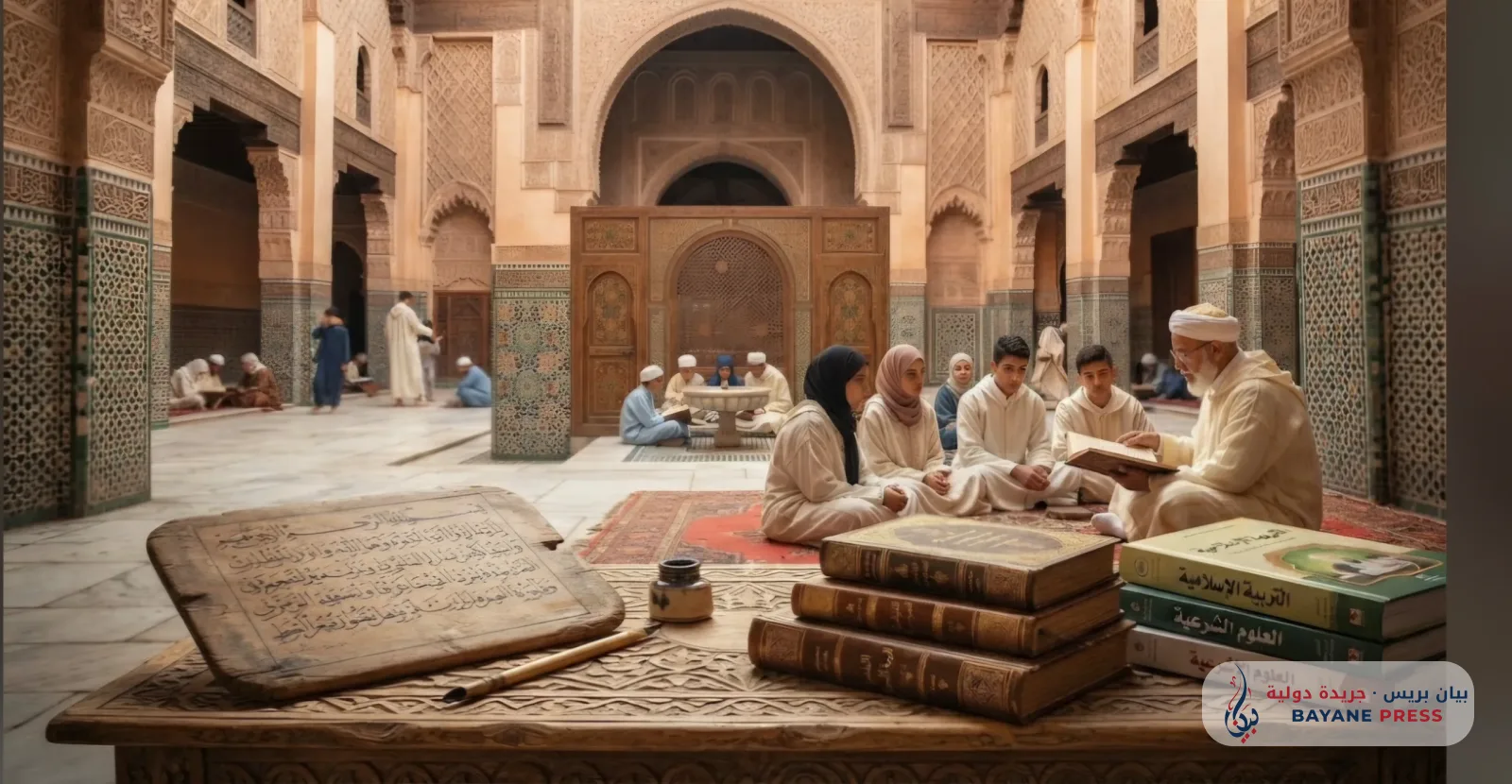
The roots of this educational system date back to its ancient institutions, such as the Quranic schools (Msids) spread throughout the veins of cities and rural areas, which formed the primary incubator for teaching the Holy Quran and the principles of the Arabic language. This extends to prestigious universities like Al-Qarawiyyin in Fez and Ibn Youssef in Marrakech, which played pioneering roles as scientific beacons, attracting students from all corners of the Islamic world and contributing to the radiance of human and scientific thought. This education has evolved through successive historical stages, maintaining its authentic essence while flexibly adapting to the political and social transformations witnessed by the country.
Beneath the surface of this ancient edifice of traditional education in Morocco lie hidden worlds and subtle stories that do not appear in official texts, but are guarded by the memory of Zawiyas, Quranic schools, and forgotten manuscript libraries. Among these is the system of "Rifqa" (companionship) and traditional scientific travel, which drove students to traverse vast distances toward the ancient schools of the Souss region and the schools of the South and East. There, students of knowledge lived a life of collective austerity, supported by the tribe and the local community through shared religious endowments (Habous), instilling in them humility, intellectual endurance, and the sharing of bread and salt in study circles and nocturnal discussions by the light of an oil lamp. There is also the unique pedagogical aspect associated with wooden tablets and the making of natural ink from buckthorn gum and charcoal; erasing and washing the tablet was not merely a cleaning process, but a spiritual ritual in which the student practiced the purity of memory and renewed their commitment to memorizing the Quran and texts, as the washings of the tablet were poured in pure places out of reverence for the Word of God. These aspects are also evident in private libraries and remote Zawiyas, such as those in Draa, Taroudant, and Tafraout, which silently housed unique manuscripts in astronomy, folk medicine, and local legal precedents (Nawazil), written in a clear Maghrebi script bearing the marks of anonymous scribes who spent their lives in the service of the Arabic letter. Furthermore, there is the hidden role of women in this educational structure; women of scholarly families and Zawiyas were faithful guardians of texts, passing down the narration of Hadith and the preservation of the Sahih collections, and participating in the care of students through hospitality and feeding. Moreover, women's endowments formed a decisive economic tributary that continued for centuries to fund scholarly chairs and Quranic schools.
With the dawn of independence, the Moroccan educational system faced the challenge of duality between modern schools and traditional Quranic schools, which prompted the state to establish bridges of communication and integration by creating traditional education tracks within the official educational system. This approach aimed to merge authenticity with modernity by offering programs that combine classical religious and linguistic sciences with modern sciences such as mathematics, experimental sciences, and living languages. This has enabled graduates of this system to combine a heritage-based knowledge base with openness to the requirements of the modern era.
Curricula in traditional education are characterized by comprehensiveness and depth, focusing on the study of jurisprudence (Fiqh), Hadith, principles of jurisprudence (Usul), grammar, morphology, and rhetoric, alongside Islamic history, philosophy, and human thought. This rigorous training does not merely transmit accumulated knowledge, but develops the faculty of criticism, analysis, and Ijtihad (independent reasoning), and instills in learners the spirit of moderation, balance, and saturation with the values of positive citizenship, far from extremism and radicalism, which contributes to strengthening the spiritual and intellectual security of Moroccan society.
Despite the noble roles played by traditional education, it faces today significant challenges related to developing teaching mechanisms, modernizing the infrastructure of its host institutions, and enhancing the pedagogical attractiveness of its tracks in light of the massive digital and technological acceleration. There also emerges the professional challenge related to integrating graduates of this education into the labor market and expanding their future horizons, which requires renewed national strategies that restore the prestige of this vital branch and support its added value in the path of sustainable human development.
The continuity and development of traditional education in Morocco is an indispensable strategic necessity, as it forms the bridge connecting the nation's glorious past with its future-oriented present. Caring for this educational and scientific legacy and developing its tools is not an intellectual luxury, but a real investment in collective consciousness and civilizational identity, and a fundamental guarantee for building a Moroccan individual who is proud of their origins and values, and at the same time capable of contributing effectively and positively to building contemporary human civilization.

Comments (0)
No comments yet. Be the first to react!