

The events in the Mansouria forest, known in the media as "Forest 33," have reopened the debate on security responsibility for criminal activities that have taken refuge in some of its parts, after extensive combing operations revealed dens, hideouts, and prohibited materials. Amid the criticism leveled at the Royal Gendarmerie and legitimate questions about the rise of crime in the region, geographical, organizational, and field data emerge that deserve an objective reading—one that transcends hasty judgments and places responsibilities within the context of working conditions and available resources.
The Royal Gendarmerie, especially in territorial centers, does not limit its tasks to fighting crime and pursuing suspects; its duties include maintaining public order, protecting persons and property, regulating traffic, monitoring roads, investigating traffic accidents, receiving complaints, drafting reports, executing public prosecution instructions, searching for wanted individuals, and intervening in disputes and distress calls. These responsibilities become increasingly complex when distributed across dispersed residential clusters, rural areas, main roads, secondary paths, and vast forest spaces, forcing personnel to balance administrative and judicial duties with field presence, in light of growing security needs.
The Mansouria forest reveals a geographical specificity that complicates this equation, as its territory extends between two jurisdictions: one under the Benslimane province and the other under the Mohammedia prefecture, in an area crossed by the Nefifikh River. This situation poses a significant security challenge, namely the possibility of suspects moving between parts of the forest belonging to different jurisdictions, taking advantage of the connected natural terrain and its complex paths. If a security operation begins from the Benslimane side, some may find room to move toward the Mohammedia side, and vice versa, while security intervention requires coordination between the concerned units according to legal and regulatory rules. Although the law allows the Gendarmerie to intervene outside its jurisdiction in urgent cases under specific guidelines, the nature of this area requires constant field cooperation so that administrative boundaries do not become a factor that complicates pursuit operations.
Another issue arises regarding the nature of some overt security interventions, where gendarmes appear in their official uniforms and distinctive vehicles, sometimes using warning lights when the mission requires it. In a vast forest space, this visibility may affect the element of surprise, especially if criminal groups use lookouts to monitor movements around their area of activity and relay information, giving suspects an opportunity to leverage their knowledge of the paths and terrain. However, the existence of such monitoring networks in the Mansouria case specifically requires confirmation from investigations and should not be considered an established fact simply because it is widely discussed.
It is important here to distinguish between regular patrols and specialized judicial operations, as wearing an official uniform or using warning lights is not mandatory in all Royal Gendarmerie interventions. Furthermore, working in plain clothes and conducting secret investigations is not exclusive to national security services, but is subject to the nature of the tasks, competencies, and legal regulations. The real problem lies in the extent to which territorial centers have the specialized human and technical support to confront criminal activities that benefit from the vastness of the area and the difficulty of monitoring it continuously.
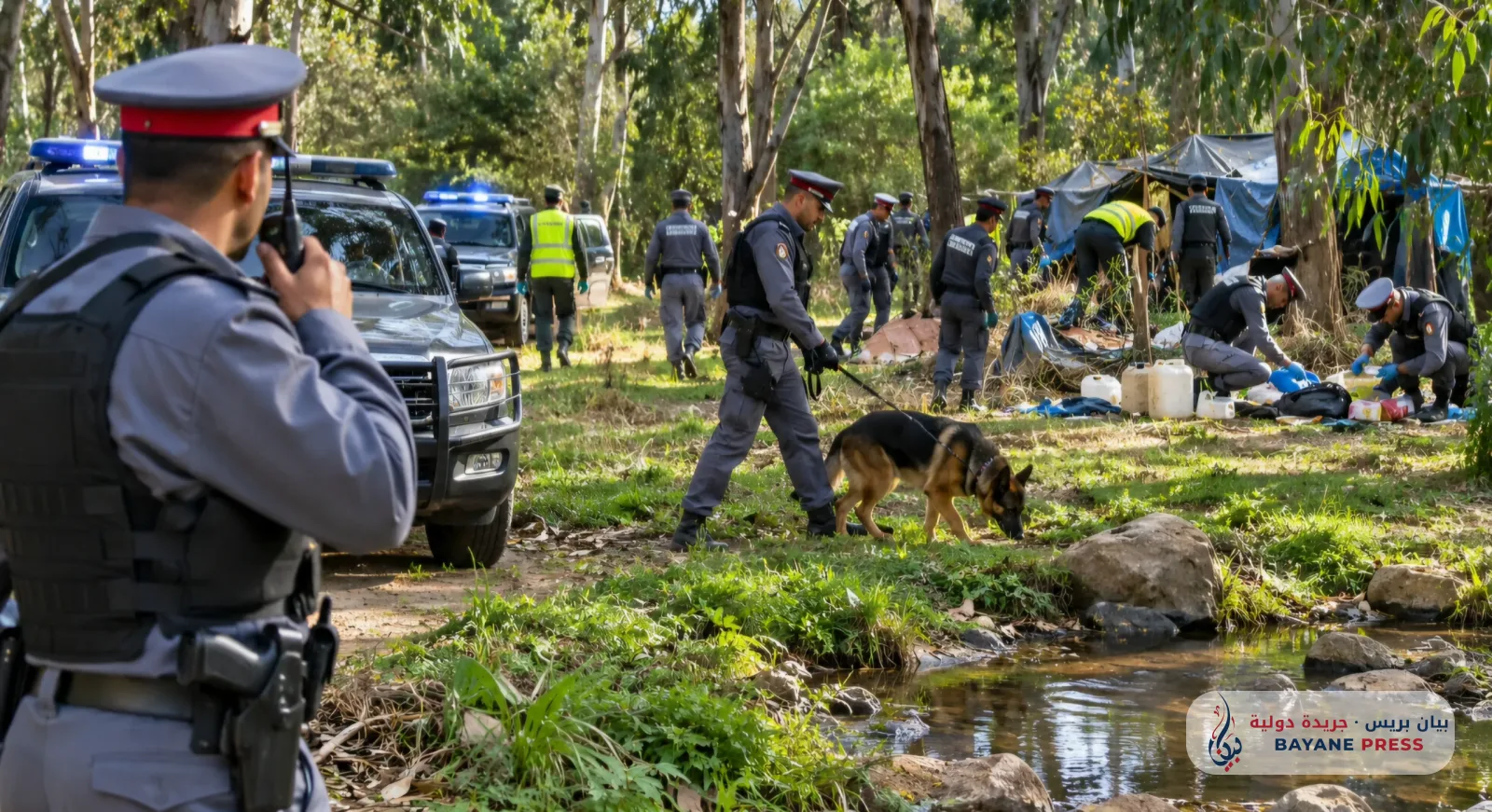
Perhaps the scale of the mobilization witnessed in the Mansouria forest following the discovery of the bodies of two young men provides a clear indicator of the complexity of the task. Press reports mentioned the participation of about 260 Royal Gendarmerie personnel, supported by approximately 58 Auxiliary Forces members, in extensive combing operations involving units from Mohammedia, Benslimane, and Bouznika, utilizing trained dogs, drones, and field search equipment. According to published data, these operations resulted in reaching suspicious sites, removing makeshift huts and tents, and seizing narcotics, vehicles, and items related to judicial investigations.
Here, the fundamental question that should be at the heart of the debate arises: if a single security operation required the mobilization of hundreds of personnel, how can a territorial center, tasked with responding daily to a wide range of responsibilities, provide permanent monitoring of a forest area of such complexity on its own? It is a matter of the difference between routine capabilities and exceptional mobilization, a difference that should be taken into account when evaluating security performance. However, determining the adequacy of human resources at a specific center remains dependent on knowing the actual number of its personnel, the area of its jurisdiction, and the volume of interventions assigned to it—data for which no official figures have been published to allow for an accurate judgment.
In reality, the Mansouria forest was not entirely absent from previous interventions; local reports spoke of security campaigns carried out by the Royal Gendarmerie over the past months, which resulted in the seizure of narcotics and the removal of some dens. However, the persistence of suspicious activities raises an issue regarding the effectiveness of intermittent interventions against groups capable of reorganizing their activities, which calls for the adoption of a continuous preventive approach based on gathering and sharing information and strengthening monitoring and coordination between the various competent authorities.
On the other hand, one cannot ignore what some media coverage has reported regarding the opening of administrative inquiries and investigations into Royal Gendarmerie personnel on suspicion of potential links to drug trafficking networks. These are data that require verification, the completion of legal procedures, and the assignment of individual responsibilities based on evidence, while respecting the presumption of innocence. Acknowledging professional constraints does not justify any proven breach of duty, just as the suspicion of individual transgressions does not allow for a generalized accusation against an entire institution.
Furthermore, protecting forest areas from criminal exploitation is not the responsibility of the Royal Gendarmerie alone; it requires the involvement of local authorities, the Auxiliary Forces, the services responsible for forest management, and territorial communes, each within their respective competencies. The Mansouria operations highlighted the importance of joint mobilization in dismantling criminal dens and strengthening security presence, but the final eradication of these activities remains linked to the results of investigations, continued monitoring, and preventing networks from returning to the sites that were cleared.
The Mansouria forest case transcends the criminal facts witnessed in the region, revealing a deeper issue related to the extent to which human and logistical resources are commensurate with the vastness of territorial areas and the complexity of security tasks. This is an issue that requires an accurate assessment of field needs, the development of monitoring and investigative tools, and the strengthening of coordination between neighboring units, ensuring the effectiveness of interventions without disrupting the daily security services that citizens need.
One cannot demand that a gendarme be present everywhere, monitor every path, respond to every distress call, and pursue every criminal, and then ignore the vastness of the area they secure and the multiplicity of tasks placed upon their shoulders.
True fairness requires combining support for personnel who perform their duties with integrity, holding accountable anyone proven to have failed in their responsibilities, and addressing the organizational and human imbalances that may limit the effectiveness of security work. The lessons learned from the Mansouria forest should not end with the conclusion of the combing operations; rather, they must be transformed into an opportunity to strengthen the security coverage system, so that geographical difficulties and the pressure of responsibilities do not become loopholes that crime exploits at the expense of citizens' safety.




Comments (0)
No comments yet. Be the first to react!