


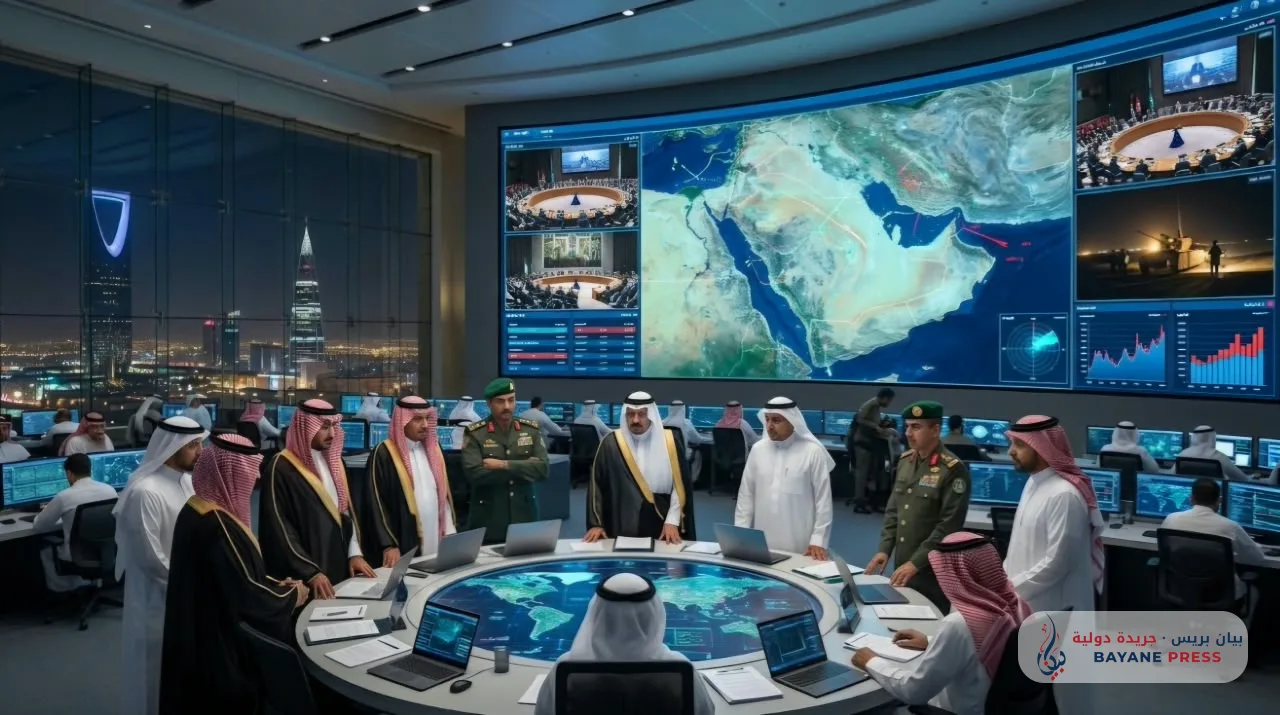
The statements made by US President Donald Trump on October 16, 2026, in which he openly called on the Kingdom of Saudi Arabia to accept Israeli military assistance to counter Houthi attacks while linking this to the revival of the "Abraham Accords", go beyond fleeting diplomatic stances to reveal the final chapter of a meticulously planned regional crisis engineering. The scene being drawn today on the map of the Middle East does not merely reflect the spontaneous repercussions of a military conflict, but rather represents the pinnacle of a joint strategy between Washington and Tel Aviv based on deliberately fanned regional fires, fully aware that the sparks will inevitably reach the Gulf states, in order to later offer the "Israeli fire extinguisher" in exchange for a heavy political price represented by forced normalization and the reshaping of the Islamic world according to security standards that serve Washington and Tel Aviv.
The foundational threads of this research date back to the spring of 2026, specifically March and April, when the United States and Israel launched their extensive military operation against Iran. Behind the scenes in the Pentagon and Israeli intelligence, strategic assessments prior to the zero hour of that war matched by 100% in predicting that the Iranian military doctrine—based on "mosaic defense" and the activation of its regional proxies—would not limit the confrontation to Iranian geography, but would immediately strike the Gulf's depth and vital facilities to raise the economic and geostrategic cost of the war globally. This prior realization proves that the decision to go to war inherently involved a deliberate provocation to cancel the regional de-escalation path, destroy the "Beijing Agreement" signed in March 2023, and forcibly pull the 6 member states of the Gulf Cooperation Council out of the zone of positive neutrality under the weight of missiles and drones that hit the territories of Saudi Arabia, the UAE, Kuwait, and Bahrain.
The plan did not stop at the borders of detonating the region; its most cunning dimensions manifested in June 2026, when the US administration suddenly shifted toward a unilateral negotiation track with Tehran, isolated from its regional allies. This negotiation line left the Houthi militia's missile arsenal in Yemen intact and operational along a border exceeding 1,400 kilometers with the Kingdom of Saudi Arabia, without a final settlement to put an end to the militia threat. Through this maneuver, Washington succeeded in shifting the burden of operational attrition from itself and Tel Aviv to the Gulf front—a reality summarized by American press reports, including the "Washington Post", which explicitly pointed out that escalating Houthi attacks in October 2026, including attempts to target King Khalid International Airport in the capital Riyadh, place the Kingdom before a heavy bill for an US war that Riyadh did not participate in deciding to ignite.
Although the Houthi group operates textually, ideologically, and armament-wise as an organic part of the Iranian axis seeking to wrest leverage in the Red Sea and the Arabian Peninsula, the practical results of its attacks functionally match the Israeli agenda to the point of complete impact overlap. Every drone or missile launched from Sana'a against civilian targets and Saudi economic facilities immediately transforms in the planning rooms of Tel Aviv and Washington into a tool of dual political and economic pressure. On one hand, these pressures aim to militarize the Red Sea—through which about 15% of global trade passes—to extort the mega-projects of "Vision 2030" on the western coast, whose total investments are estimated at over 3 trillion dollars; on the other hand, they seek to force Riyadh to accept the integration of its maritime and air security within the India-Middle East-Europe Economic Corridor project, making Israel the central node and security guarantor for trade and energy flows.
However, US and Israeli administrative calculations collided with Saudi sovereign calculations. Riyadh's moves during the current week of October 2026 demonstrated a deep strategic awareness of the dangers of these traps and a flat-out refusal to submit to the policy of "extortion by fire." Instead of requesting Israeli support or begging for interception systems to compensate for the depletion of defense reserves, the Kingdom chose the path of sovereign, independent, and decisive response: on October 13, 2026, Saudi forces launched targeted airstrikes destroying 3 strategic fuel and military supply depots belonging to the Houthis in Yemen, following this field step with a diplomatic victory on October 15, 2026, represented by extracting a decisive resolution from the 15 member states of the UN Security Council condemning Houthi attacks and recognizing the Kingdom's legitimate and inherent right to defend its territories in accordance with Article 51 of the UN Charter, thus cutting off any attempt to impose external security tutelage or Israeli military cover.
This Saudi resistance rests on 3 pillars of strategic deterrence that make Riyadh unyielding and resolute. Pillar 1 lies in the firm conviction that relying on the Israeli security umbrella will not bring stability, but will rather turn Saudi geography into an advanced defensive line and a permanent arena for settling scores on behalf of Tel Aviv, in addition to gifting Iran and the Houthis a propaganda card to portray their aggression as a battle against a "US-Zionist alliance," striking the Kingdom's spiritual and leadership standing in the hearts of nearly 2 billion Muslims distributed across 57 countries within the Organisation of Islamic Cooperation. Pillar 2 is represented by breaking the monopoly on armaments by accelerating plans to localize over 50% of Saudi military spending by the year 2030 and diversifying defense and technology partnerships with international powers such as China, Russia, France, and the United Kingdom. As for pillar 3, it is embodied in Riyadh's possession of the economic deterrence weapon most capable of curbing American pressures through its leadership of the "OPEC+" alliance comprising 23 countries, and its ability—by controlling production approaching 9 million barrels per day—to cause deep disruptions in global energy markets if Washington attempts to tamper with Saudi national security. Thus, Riyadh's sovereign equation remains firm in rejecting free normalization and insisting on the establishment of an independent Palestinian state along the 1967 borders as a non-negotiable condition.
Comments (0)
No comments yet. Be the first to react!