


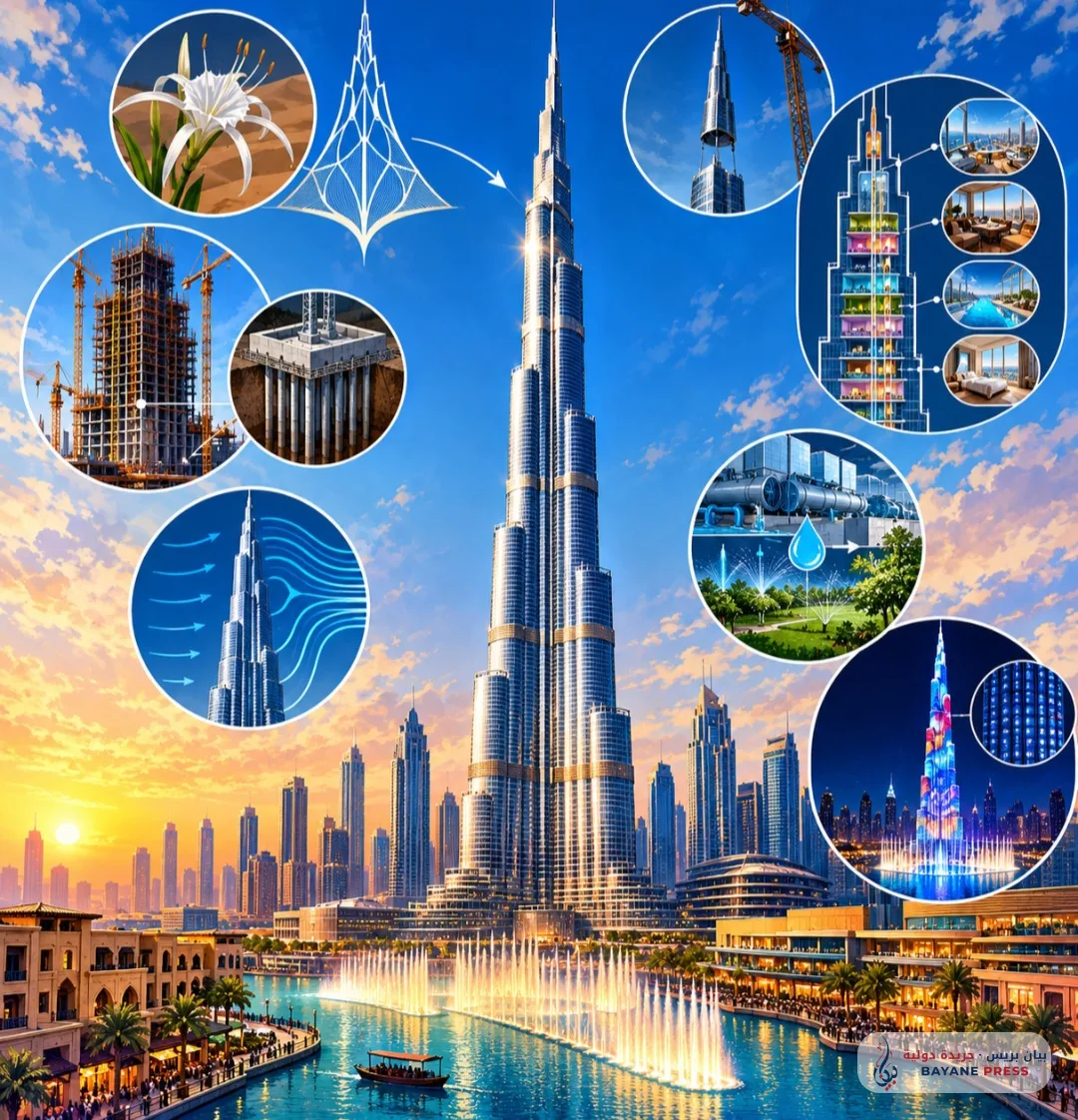
Rising in the heart of the Arabian desert like an obelisk of steel, glass, and light, the Burj Khalifa pierces the clouds, marking Dubai's transformation from a traditional coastal settlement into a global capital of the future and architectural innovation. The inauguration of this edifice on January 4, 2010, with its record-breaking height of 828 meters (2,716.5 feet) spanning over 163 inhabited floors followed by dozens of technical levels in its pointed spire, was not merely a shattering of global records; it was the physical embodiment of His Highness Sheikh Mohammed bin Rashid Al Maktoum's vision to erase the word "impossible" from the emirate's developmental lexicon, and a historic tribute to the late Sheikh Khalifa bin Zayed Al Nahyan, turning the tower into an icon that encapsulates Dubai's greatness and boldness in redrawing the horizon of contemporary human civilization.
Architect Adrian Smith and the team at Skidmore, Owings & Merrill (SOM) drew inspiration for the tower's optical engineering from the region's environment and rich heritage, cleverly blending the tripartite geometry of the desert spider lily (Hymenocallis) with the geometric patterns of classical Islamic architecture, specifically historical spiral minarets such as the Great Mosque of Samarra. This visual harmony was not an aesthetic luxury, but formed the functional basis for the invention of the unique structural system known as the "Buttressed Core"; a structure based on a highly rigid, hexagonal central core from which three wings arranged in a "Y" shape branch out, allowing each wing to support the other against enormous lateral loads at soaring heights.
Because constructing an edifice of this height atop desert sands and limestone sedimentary rock represented an unprecedented geotechnical challenge, the engineering marvel began deep underground before rising a single centimeter into the air. The tower's base was constructed upon a massive reinforced concrete mat foundation 3.7 meters thick, which in turn rests on 192 concrete piles, each 1.5 meters in diameter and plunging more than 43 to 50 meters deep into the earth. To protect these foundations from corrosion by highly saline groundwater, the base was equipped with an advanced "cathodic protection" system utilizing titanium plates and a precise electrical current to prevent steel rusting for decades to come.
As the construction soared toward the sky with the participation of more than 12 thousand workers and engineers at peak operations, the engineers faced the skyscrapers' fiercest enemy: fierce winds and vortex shedding. Here, the tower's aerodynamic genius was manifested through the design of 27 setbacks cascading in an asymmetric spiral pattern as the building rises higher. This alters the tower's cross-section at every level—a technique described in engineering terms as "confusing the wind," preventing it from organizing its ranks or forming simultaneous vortexes that could shake the structure. Consequently, residents on the upper floors feel no noticeable sway.
The construction of this giant consumed approximately 330 thousand cubic meters of high-performance concrete and 39 thousand tons of structural steel. Construction teams devised exceptional solutions to overcome the Gulf's summer heat: concrete was mixed with crushed ice and poured only at night to ensure homogeneity and prevent cracking, while ultra-high-pressure pumps successfully pushed liquid concrete in a single stage to a world-record height of 606 meters. As for the 200-meter-plus, 4,000-ton steel spire, it was fully assembled inside the tower's structure and then hydraulically lifted from within to its final position at the top. The tower was then clad with 103 thousand square meters of double-glazed glass panels (over 24 thousand glass panes) coated with microscopic layers of silver and titanium to reflect ultraviolet rays and block solar heat, equivalent in surface area to about 17 football fields.
Inside this glistening glass envelope, the tower pulses as an integrated "vertical city" managed by the world's most advanced mechanical and environmental systems. It features 57 elevators—many of them double-deck—moving at a blistering speed of 10 meters per second (36 kilometers per hour), transporting visitors and residents between diverse worlds starting from the lower floors embraced by the Armani Hotel Dubai with the touches of international designer Giorgio Armani, passing through about 900 luxury residential apartments spanning from floors 19 to 108, interspersed with "Sky Lobbies" on floors 43, 76, and 123 featuring suspended pools and health clubs, and culminating in international corporate suites and elite offices occupying the upper floors up to floor 154.
The tower's engineering is not limited to luxury; it extends to smart sustainability. The colossal cooling system, whose capacity equates to melting 13 thousand tons of ice daily, is linked to a smart network that collects water condensed from the coastal atmosphere's humidity via air conditioning units. This provides about 15 million gallons of water annually, gathered in underground tanks and used to irrigate the gardens and green spaces surrounding the tower. Meanwhile, meteorological monitoring systems embedded at its peak protect the building and its surroundings from lightning by safely discharging massive electrical charges deep into the earth.
On the tourism front, the Burj Khalifa has transformed into the beating heart of "Downtown Dubai" and the preeminent tourist magnet in the Middle East. It welcomes millions of visitors annually who head to the famous observation decks, "At The Top" on floors 124 and 125, and the "SKY" platform on floor 148 at a height of 555 meters, as well as the fine dining experience among the clouds at "At.mosphere" restaurant on floor 122, and "The Lounge" spanning floors 152 to 154, the highest lounge in the world. In the evening, integrated with the dancing Dubai Fountain on the surrounding lake and the adjacent Dubai Mall, the tower transforms into a cosmic stage dazzling the planet through its facade equipped with over 1.2 million LED light points. During New Year's Eve and major events, it paints visual displays watched by billions of eyes, standing as a living testament to human ingenuity when engineering meets ambition, and to the greatness of Dubai, which insisted on placing its architectural signature at the highest point ever reached by humans on Earth.
Comments (0)
No comments yet. Be the first to react!