

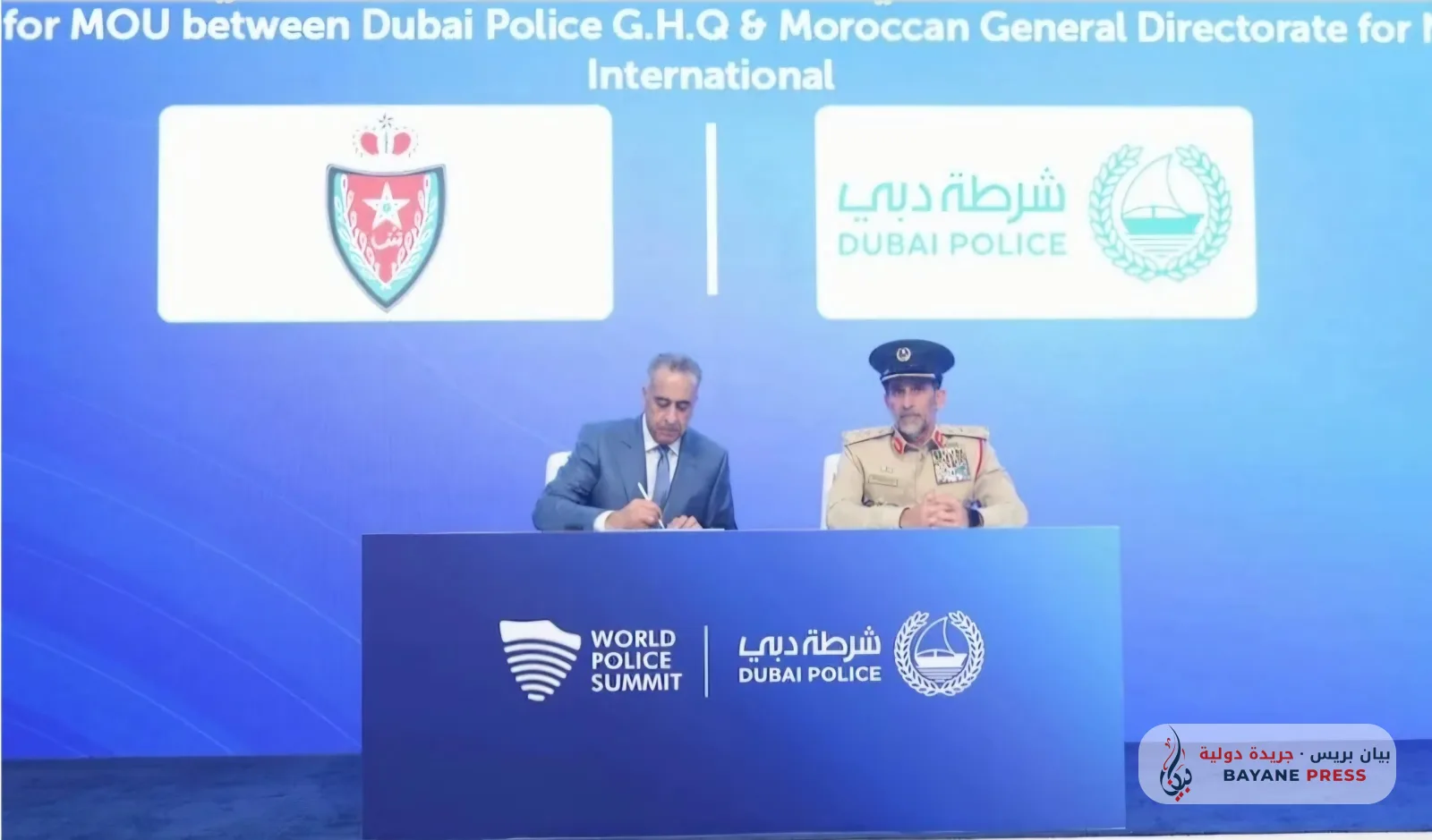
In a move reflecting the growing strategic cooperation between the Kingdom of Morocco and the United Arab Emirates, the city of Dubai witnessed the signing of a new security memorandum of understanding aimed at enhancing field coordination and the exchange of information and expertise. This initiative keeps pace with the rapid shifts in crime patterns and cross-border threats, granting the partnership between the two countries a more practical and expansive dimension.
The memorandum was signed on Tuesday, November 17, 2026, by the Director General of National Security and Territorial Surveillance, Abdellatif Hammouchi, and Lieutenant General Abdullah Khalifa Al Marri, Commander-in-Chief of Dubai Police. The signing took place on the sidelines of the Moroccan security official's participation in the fifth edition of the World Police Summit, hosted by Dubai with the participation of security leaders and international experts.
The memorandum establishes the foundations for institutional cooperation based on developing direct communication channels and exchanging criminal intelligence, alongside mutual utilization of modern research and investigation techniques and monitoring emerging criminal methods. It also includes enhancing the capabilities of security personnel through specialized training programs and study visits, contributing to the development of police performance and increasing readiness to face common challenges.
The scope of cooperation extends to combating terrorism, extremism, organized crime, money laundering, human trafficking, drugs, and psychotropic substances, as well as addressing financial and economic fraud, illegal migration and residency, and the illicit trafficking of cultural and artistic property and dual-use materials. The memorandum also includes the exchange of expertise in security management and monitoring at air border crossings.
This agreement does not represent the beginning of security cooperation between Rabat and Abu Dhabi, but rather serves as an extension of the security cooperation and counter-terrorism agreement signed between the two countries on March 17, 2015, with a focus on developing more regular mechanisms for information exchange, operational coordination, and professional training.
This step gains particular importance in light of the changing nature of cross-border crime, which is no longer limited to traditional activities but now leverages technological development and the interconnectedness of international financial and communication networks. From this perspective, strengthening cooperation between Moroccan and Emirati security agencies provides broader opportunities to exchange expertise and improve capabilities for prevention and early detection of threats, although the signing of the memorandum alone does not guarantee immediate operational results.
Hammouchi's visit to the UAE, spanning from November 16 to 18, provided an opportunity to hold discussions with several senior security officials, including the Inspector General of the UAE Ministry of Interior, Ahmed Nasser Al-Raisi, and the Head of State Security in Dubai, Talal Belhoul, in addition to a meeting with Mohamed bin Ali Koman, Secretary General of the Council of Arab Interior Ministers, to discuss ways to enhance Arab security coordination and joint action in combating crime.
These moves reflect a Moroccan-Emirati trend toward consolidating security cooperation as a core component of the strategic relations between the two countries, at a stage where renewed security challenges necessitate a shift from traditional expertise exchange to building institutional partnerships capable of rapid response, effective coordination, and keeping pace with the evolution of crime at both regional and international levels.
Comments (0)
No comments yet. Be the first to react!