


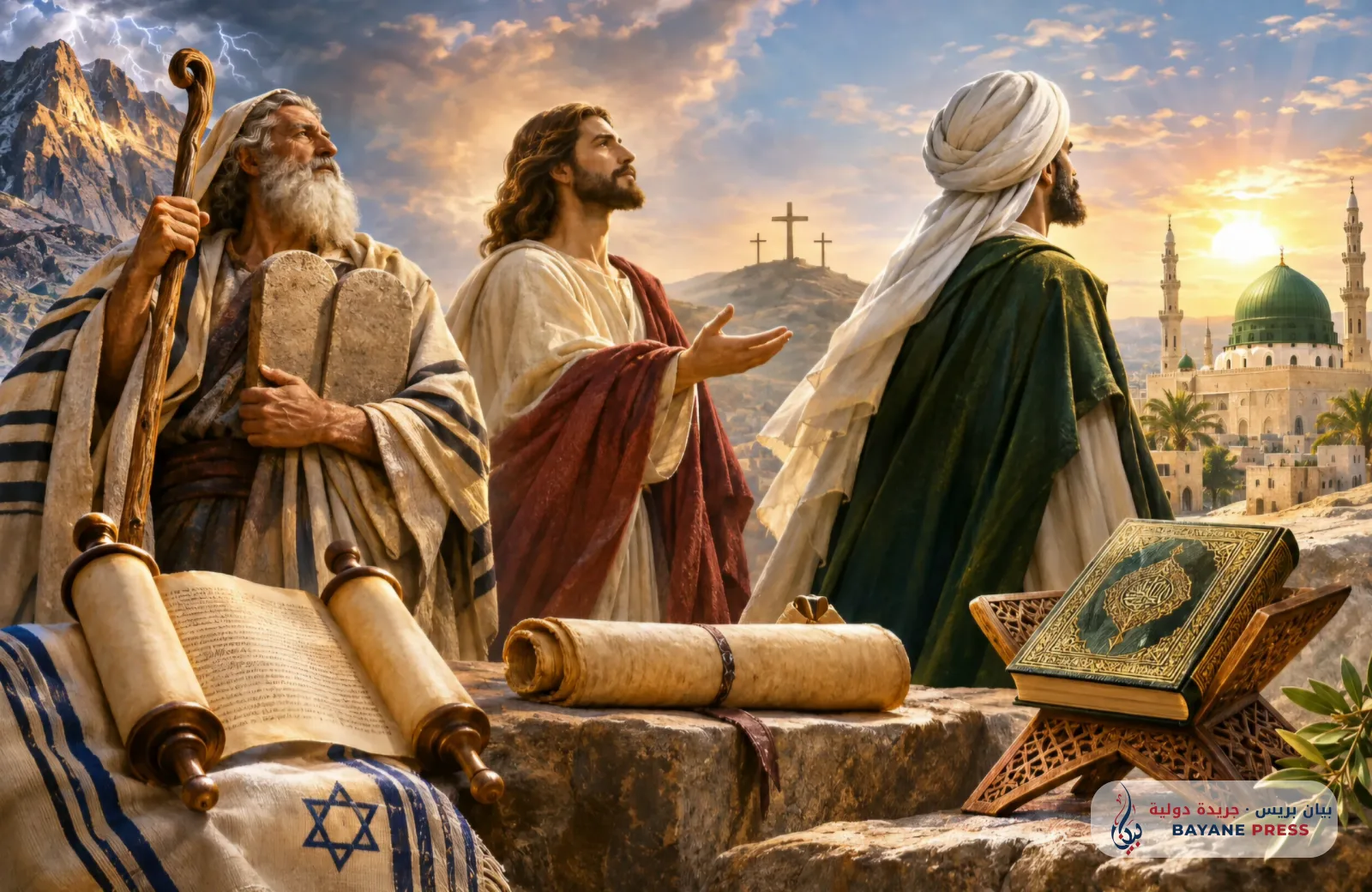
The disagreement over the abrogation of laws between Jewish and Muslim scholars was not merely a dispute over the interpretation of a religious text, but a profound conflict regarding the nature of divine legislation and the limits of its continuity, and the extent to which rulings could change while divine knowledge remained fixed, free from deficiency or alteration. This issue became one of the central themes in religious debates during the Islamic eras, as Jewish scholars defended the permanence of the Law of Moses, while Muslim scholars established the possibility of ending the application of previous legal rulings through a subsequent text.
In traditional Rabbinic Jewish thought, the eternity of the Torah constitutes a foundational creedal principle. Maimonides asserts in his "Mishneh Torah," in the section on the "Foundations of the Torah," Chapter Nine, that the laws brought by Moses are not subject to replacement by subsequent legislative revelation. As for the science of Islamic legal theory (Usul al-Fiqh), abrogation (naskh) is the lifting of a legal ruling by a later legal proof according to conditions established by jurists, and it does not mean that the first ruling was incorrect or that God discovered something He did not previously know.
Imam al-Haramayn al-Juwayni in "Al-Burhan" and Al-Ghazali in "Al-Mustasfa" discussed this issue within the chapters of abrogation and 'bada' (divine change of intent), emphasizing the distinction between the change of a ruling directed at the accountable subjects and the change of divine knowledge. For in Islamic doctrine, God knows eternally the time for the application of every ruling and the time of its expiration; thus, the transition of the accountable subjects to another ruling does not necessitate a change in His knowledge or wisdom.
On the Jewish side, Saadia Gaon, who died in 942 AD, emerged as one of the most prominent defenders of the permanence of the Mosaic Law. In his book "The Book of Beliefs and Opinions," particularly the third treatise concerning commandments and prohibitions, he discussed the issue of the abrogation of the Torah and the continued obligation to its laws, relying on rational and traditional arguments related to the stability of the divine covenant and the truth of revelation. His methodology was influenced by the tools of Kalam (theology) known in his era, without abandoning the Jewish creedal foundation from which he started.
In this context, Jewish scholars invoked biblical texts that describe certain rulings as an everlasting ordinance or a statute for generations, as in the Book of Exodus, Chapter 12, verse 14, and the Book of Leviticus, Chapter 23, verse 21. These phrases formed one of the pillars of the argument for the continued obligation to the Mosaic Law.
Conversely, Muslim scholars sought to discuss the claim of the impossibility of abrogation from within the biblical texts themselves. Among the most prominent were Ibn Hazm al-Andalusi in his book "Al-Fasl fi al-Milal wa al-Ahwa' wa al-Nihal" and Al-Samawal al-Maghribi in "Ifham al-Yahud," where Islamic debates brought up discrepancies between the rulings attributed to previous prophets and those contained in the Law of Moses.
Examples addressed in this debate include Jacob's marriage to the two sisters Leah and Rachel, according to the narrative in the Book of Genesis, Chapter 29, in contrast to the ruling in the Book of Leviticus, Chapter 18, verse 18, which prohibits marrying a wife's sister during her lifetime. Also cited was the permission given to Noah and his descendants to eat animals in the Book of Genesis, Chapter 9, verse 3, compared to the dietary restrictions in the Book of Leviticus, Chapter 11.
Some Muslim scholars saw in these examples evidence of the difference in rulings between laws, while Jewish interpretation responded that Mosaic legislation was imposed on the Children of Israel at the time of Sinai, and it does not follow that its rulings were imposed in the same way on previous prophets. Therefore, these pieces of evidence remain a subject of disagreement in argumentation, and it is not valid to present them as an argument accepted by both schools equally.
The debate extended to the significance of the Hebrew word "olam," which is often translated as eternity or forever, with its meaning varying according to context. Debaters cited what was mentioned in the Book of Exodus, Chapter 21, verse 6, regarding the service of a slave for a period described by this word, while invoking the laws of the Jubilee year in the Book of Leviticus, Chapter 25. This raised a linguistic question as to whether the expression of permanence requires absolute eternity in all its uses, or whether its meaning is determined by the nature of the ruling and its context.
The development of Jewish legislation was not limited to creedal debates, but also appeared in legal practice through legal tools to address economic and social problems. Most famous among these is the "Prosbul" document associated with Hillel the Elder in the late first century BC, which the Mishnah addressed in "Shevi'it," Chapter 10, paragraphs 3 and 4.
The Book of Deuteronomy, Chapter 15, stipulated the remission of certain debts in the seventh year, known as "Shmita." With the development of economic life, some wealthy individuals refrained from lending to the needy for fear of losing their debts, which led to a practical conflict between protecting the debtor and helping the poor obtain a loan. Hence, Hillel approved a judicial arrangement that allows for the continued demand for certain debts according to a legal formula recognized in Rabbinic jurisprudence.
The stated purpose of this measure was to limit the reluctance of the wealthy to lend, not to abolish the biblical text in principle. Therefore, describing the Prosbul as a mere formalistic ruse ignores the Rabbinic interpretation that relies on the nature of the debts covered by the remission and the mechanisms for claiming them. Nevertheless, the relationship between the original text and the newly created legal solutions remains a legitimate field for comparative research and critique.
Legal adaptation also appears in the "Heter Iska" contract, which developed in Jewish financial jurisprudence to regulate investment in light of the prohibition of interest on loans between Jews. This contract, in its legal form, is based on arranging an investment relationship with controls for distributing profits and risks, rather than treating the transaction as a traditional interest-bearing loan. Some of its applications have sparked discussions about the extent to which actual risk-sharing is achieved or whether some formulas approach guaranteed-return loans.
Another well-known application is the sale of leavened food before Passover to non-Jews, known as "Mechirat Chametz," to avoid violating the rules of possessing leaven during the holiday, based on the provisions in the Book of Exodus, Chapter 12. The sale is not considered valid in Jewish jurisprudence merely by drafting a formal document; rather, its legal conditions must be met and it must have significant effects in transferring ownership, even if the details of its application have been debated throughout the ages.
Islamic jurisprudence, for its part, has known the chapter of legal ruses (hiyal) and exits, and scholars have differed in evaluating its forms. Not every use of a legal means is a forbidden ruse, just as the validity of the outward form does not make every action legitimate if its true intent is to invalidate a definitive ruling. Maliki jurists were concerned with the principle of "blocking the means" (sadd al-dhara'i'), and Al-Shatibi expanded in "Al-Muwafaqat" on the importance of objectives (maqasid), while Ibn al-Qayyim discussed forms of ruses that lead to dropping obligations or permitting forbidden acts.
In this context, commentators recall the story of the People of the Sabbath mentioned in Surah Al-A'raf, verse 163, where it is mentioned in some books of exegesis that they used means to circumvent the prohibition of fishing on the Sabbath. This is a story used by Muslim scholars as evidence that changing the outward appearance of an act does not permit violating the divine ruling if the reality of the violation and its intent remain.
This comparison reveals that the difference between Jewish and Islamic jurisprudence cannot be reduced to the idea that one is based on ruses and the other on objectives; both traditions have known ijtihad (independent reasoning), interpretation, and the search for solutions to practical problems, despite the difference in their foundations, controls, and spheres of legal authority.
The fundamental difference remains related to the source of the legitimacy of change; Rabbinic Judaism sees the possibility of the evolution of the interpretation and application of the Law without accepting the replacement of its origin with subsequent revelation, while Islam establishes the possibility of legislative abrogation through divine revelation, with the stability of the Muhammadan message as the finality of messages in Islamic doctrine. From this point, the research moves to the impact of the difference in laws on the individual and society, especially the universality of obligation, financial transactions, and the structure of religious authority.




Comments (0)
No comments yet. Be the first to react!