


The concept of beauty in human history did not arise as a visual luxury or a passing whim, but was formed as a complex symbolic system intertwined with the goals of survival, environmental determinants, class hierarchies, and spiritual dimensions. The female body was not merely an object of adornment, but the primary manuscript upon which civilizations inscribed their existential philosophy and their view of harmony and perfection.
Adornment in Ancient Civilizations
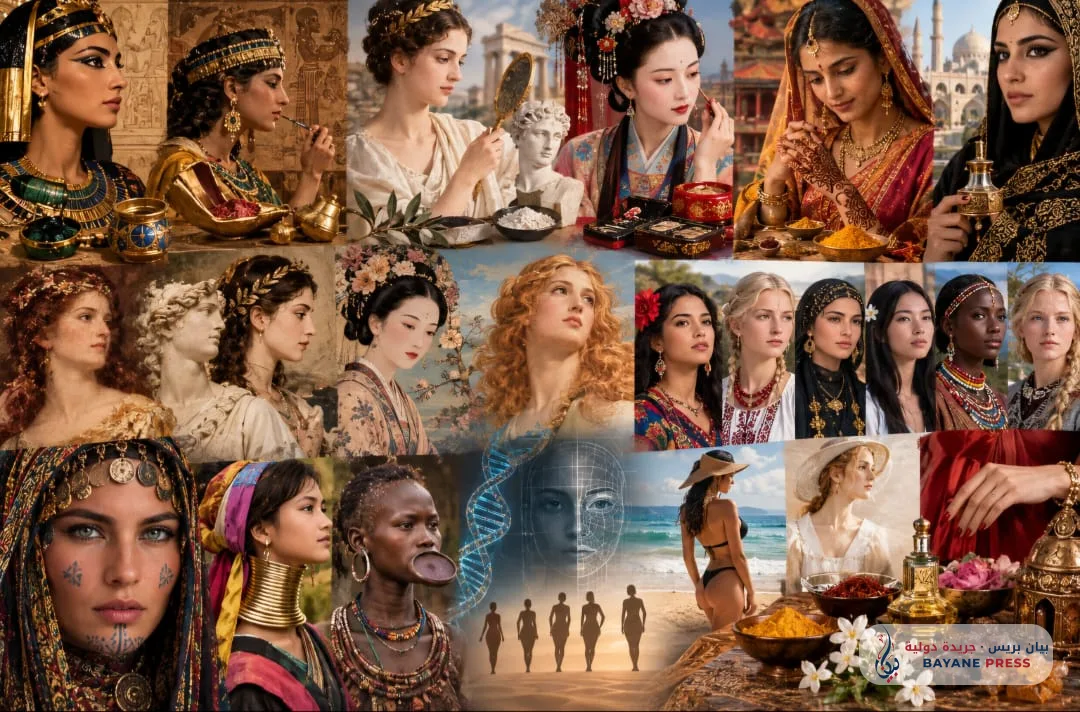
The earliest codified cosmetic practices originated in Mesopotamia; findings from the Royal Cemetery of Ur and the possessions of Queen Puabi revealed golden and silver shells to hold green kohl powders extracted from malachite, the oldest documented lipstick formula made from crushed mineral ingredients mixed with fats and beeswax, alongside golden crowns braided with lapis lazuli associated with the rituals of the temples of Ishtar. On the banks of the Nile, Egyptian cosmetics intertwined with medicine and funerary beliefs; women invented black "galena" kohl to outline eyes in the shape of the Eye of Horus to protect them from the desert sun and flood bacteria, also developing milk and honey masks, using henna for nails, and wigs saturated with aromatic fats to ward off the summer heat.
On the northern shores of the Mediterranean, the Greeks based their vision on strict mathematical proportion, demanding pale skin as a sign of chastity and nobility that distinguished a lady from field workers, even if it cost them coating their faces with toxic white lead, while highlighting the "unibrow" with soot as a symbol of wisdom and intelligence. The Romans soon inherited these foundations and transferred them to extravagant imperial consumption through public bath rituals and barley and fenugreek masks; with the northern conquests, Roman women developed a passion for blonde hair, resorting to lightening it with alkaline wood ash mixtures or wearing hair extensions taken from Germanic captives.
In the halls of the Chinese court, adornment was linked to imperial hierarchy; nail polish was invented from beeswax and plant gelatin, its gold and crimson colors restricted to the nobles, while faces were adorned with snow-white rice powder and eyebrows drawn with blue "dai" powder in the shape of willow leaves, culminating in the ritual of "lotus feet" which cemented the image of woman as a fragile aristocratic being. In contrast, the Indian subcontinent linked cosmetics to the energetic philosophy of "Ayurveda"; "kajal" kohl was used to soothe head heat and purify the eye, extremities were decorated with henna designs to bring balance, and skin was treated with turmeric and sandalwood to impart a golden glow, while "sindoor" and "bindi" powders marked centers of awareness and maturity. With the dawn of Islamic civilization, Arab cosmetic taste elevated the natural beauty of the eyes through stone "ithmid" kohl free of toxins, and the invention of the alembic device created a laboratory breakthrough in distilling Damask rose water and jasmine, blending them with compounds of musk, amber, and oud, making perfume an essential pillar of attire and purity.
Representations of Beauty in Literary Heritage
Literary chronicles documented standards of beauty across the ages with extreme precision; in pre-Islamic and Islamic poetry, flirtatious verse revolved around wide eyes and intense color contrast, known as "hawar" and "da'aj", mimicking the eyes of wild cows and desert antelopes. Bedouin taste celebrated the heaviness of physique and the poise of movement resulting from full hips and waists ("radah", "azizat al-mashi") as an environmental proof of leisure and seclusion, in contrast to a slender stomach and waist ("muhaffafa"), comparing the purity of skin to the hidden and protected ostrich eggs in nests.
In Greek and Roman epics, Homer and Virgil drew harmonious beauty based on the majesty of the gods; requiring the straightness of the Greek nose line connected to the forehead without a break, and facial symmetry. Poets sang of the bright golden braids of Helen of Troy and Venus like sunbeams and smooth ivory necks. This trend manifested differently in ancient Chinese court literature, where poems compared a woman's delicacy to round silkworm silk like the moon in the sky, and lips to cherry petals, in explicit praise of tranquility and seclusion. When the European Renaissance dawned, Petrarch's sonnets and Shakespeare's epics restored respect to the full-bodied, vibrant physique as a symbol of fertility and species continuity after plague disasters, celebrating broad shoulders, flushed cheeks, and flying copper hair.
Morphological Diversity and Contemporary Geography
Contemporary geography highlights morphological differentiation closely tied to migrations and genetic blending; Latin America (Venezuela, Colombia, Brazil) leads global beauty pageants due to historical "hybrid melting" between indigenous peoples, Africans, and European immigrants, generating diversity in olive skin tones, high skeletal symmetry, and a vital physical structure reinforced by a local culture that elevates physical care. In Eastern Europe and the Caucasus region, a sharp classical facial pattern prevails, resulting from the meeting of Slavic and ancient Eurasian lineages, characterized by prominent cheekbones, straight jaws, and colored almond-shaped eyes, cementing the region's women on high fashion platforms.
In the Middle East and North Africa, aesthetic identity is manifested through a warm color contrast combining Mediterranean traits with Arab and Amazigh origins; wide dark eyes surrounded by thick lash halos prevail alongside fresh wheat-colored skin. Women of South and Southeast Asia are distinguished by soft features, extreme symmetry, and thick, naturally healthy hair, while the Horn of Africa (Ethiopia and Somalia) features a morphological pattern characterized by pure lines: delicate high noses, graceful necks, and a homogeneous copper skin blending with a tall, slender physique. In contrast, Northern Europe (Sweden and Norway) consecrates the concept of cold freshness; features tend toward natural calmness, blonde hair, and light eyes consistent with a climate with low ultraviolet exposure, in harmony with a culture relying on simplicity and minimalism.
Anthropological and Biological Interpretation of Beauty
Studies in cultural and evolutionary anthropology show that standards of attractiveness are not arbitrary, but are linked to economic signals and survival functions:
The Signification of Skin Color and Social Class: In ancient feudal societies, skin paleness and whiteness were linked to social elevation, reflecting the affluent woman's stay in palaces away from the toil of sunny fields. With industrial revolution societies shifting to enclosed office work, the standard radically flipped, making a sun-acquired bronze tone a modern sign of wealth and the ability to travel and enjoy beach resorts.
Weight Between Food Abundance and Scarcity: In environments exposed to drought and historical famines, a full body and hip fatness were considered decisive proof of nutritional adequacy and biological capability to bear the hardships of pregnancy and lactation, giving rise to rituals of fattening girls. In contemporary consumer societies overflowing with cheap processed foods, the preference flipped toward fitness and thinness as a certificate of discipline and financial ability to acquire healthy food and exercise.
Bodily Modifications and Collective Identity: Physical interventions were not superficial adornment, but living identity cards; green tattoo inscriptions on the faces of Amazigh and Bedouin women were amulets to protect the body and a confirmation of reaching the threshold of social maturity and marriage. Neck-elongating rings among the Padaung tribes in Myanmar and clay lip plates among Mursi women in Ethiopia formed symbols of social status and preservation of tribal authenticity.
Facial Symmetry as a Health Indicator: Evolutionary biology confirms that human instinct biologically leans toward "bilateral symmetry" and balanced features, as they unconsciously reflect genetic soundness and the immune system's resistance to parasites and diseases during embryonic development. However, this silent innate code only acquires its human meaning when local cultures capture it, forging from it renewed shapes, arts, and civilizational values.



Comments (0)
No comments yet. Be the first to react!