


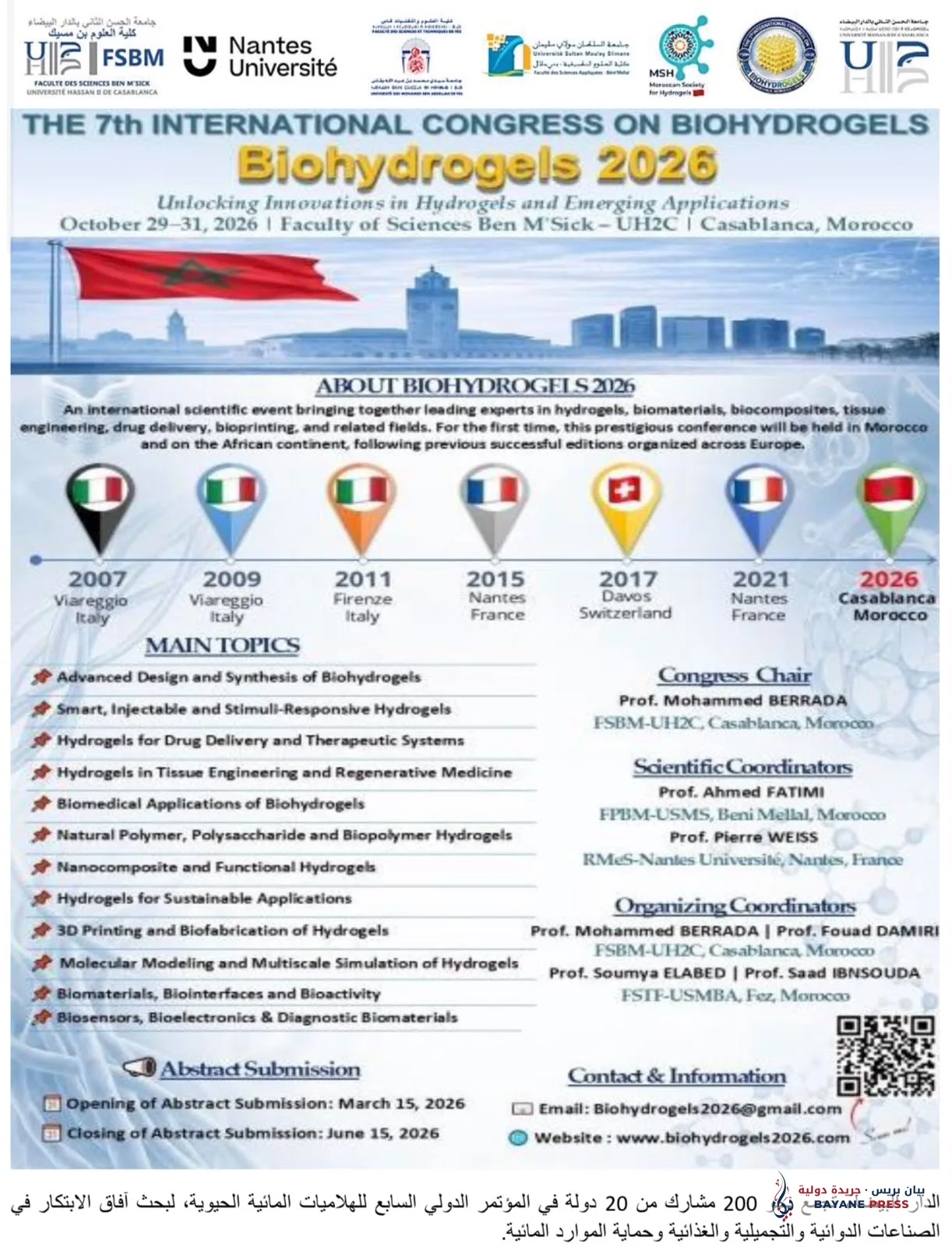
Casablanca is hosting «Biohydrogel 2026» with the participation of 200 researchers and experts to discuss the future of innovation in the pharmaceutical, cosmetic, and food industries and the protection of water resources
By D. Mohamed Saad
The Moroccan city of Casablanca is hosting, from 29 to 31 October, the activities of the 7th International Conference on Bioactive Hydrogels «Biohydrogel 2026», at the ICEC International Business Conference Center. This marks the first time this scientific event is being held in Morocco and across the African continent, with the participation of some 200 researchers, academics, experts, and industry representatives hailing from 20 countries.
The conference serves as an international platform for the exchange of experiences and discussions on the latest scientific and technological advancements in the field of hydrogels and advanced biomaterials. It also explores their applications in the pharmaceutical, medical, cosmetic, and food industries, alongside innovative solutions for water treatment and the valorization of biological resources, thereby strengthening the connection between scientific research and the needs of economic and industrial development.
Morocco's organization of this event takes place within a context of growing importance placed on acquiring knowledge and technology to consolidate health and industrial sovereignty, develop innovative solutions that respond to national and African needs, and foster cooperation among universities, research centers, and industrial institutions by transforming research results into practical applications with added value.
The congress is organized by the Faculty of Sciences Ben M'Sik at Hassan II University of Casablanca and the Moroccan Association of Hydrogels, with the participation of the Faculty of Applied Sciences of Beni Mellal (under Sultan Moulay Slimane University), the Faculty of Sciences and Techniques of Fez (under Sidi Mohamed Ben Abdellah University), the University of Nantes in France, and the Moroccan Association of Women Entrepreneurs in the International Sphere.
High-Level International Participation
The scientific program features an elite group of international researchers and experts from Morocco, the United Kingdom, Poland, Singapore, France, the United States, Canada, Jordan, and Denmark, including Professor Abdelkrim El Kadib (Morocco), Professor Vitaliy Khutoryanskiy (United Kingdom), Professor Beata Kaczmarek-Szczepańska (Poland), Professor Ali Asghar Bhagat (Singapore), Professor Sidi Ali Bencherif (France), and Professor Adel Akouch (United States).
The list of participants also includes Dr. Baptiste Charbonnier (France), Professor Sophie Lerouge (Canada), Professor Katish V. Katti (United States), Professor Ayat Bouziane (Jordan), Professor Khaled Draoui (Morocco), Professor Alireza Dolatshahi-Pirouz (Denmark), and Professor Pierre Weiss (France).
The program includes general scientific lectures, research presentations, scientific panel presentations, specialized workshops, and roundtables to discuss smart hydrogels, advanced biomaterials, nanotechnology, drug delivery systems, tissue engineering, regenerative medicine, wound healing, 3D bioprinting, and the development of sustainable materials.
This scientific diversity aims to promote the exchange of knowledge across different disciplines and open new horizons of cooperation among researchers, academic institutions, and industrial actors.
From Europe to Africa... Casablanca as a New Milestone
Holding the 7th edition of the conference in Morocco represents a significant milestone in its international trajectory, which began in the Italian city of Viareggio, host to the first and second editions in 2007 and 2009, followed by Florence in 2011, the French city of Nantes in 2015, and Davos (Switzerland) in 2017, before returning to Nantes in 2021 and arriving in Casablanca in 2026.
Hosting this conference grants Morocco a new African dimension for this scientific event, offering an opportunity to strengthen the presence of Moroccan and African researchers within international cooperation networks and highlighting their contributions in the field of biomaterials, which combines chemistry, polymers, biology, pharmacy, and engineering.
The organizers aspire for the conference outcomes to go beyond a mere scientific gathering by building sustainable partnerships, developing joint research projects, and fostering opportunities for training and experience exchange, thereby consolidating Morocco's position as a regional and international hub for scientific research and technological innovation.
Bioactive Hydrogels: Innovations for Health and Industry
Hydrogels are gaining increasing importance in scientific research and advanced industries due to their ability to retain large amounts of water and the possibility of tailoring their physical and chemical properties to suit multiple uses in medical, industrial, and environmental fields.
In the pharmaceutical and medical sector, their applications include the development of controlled drug delivery systems, advanced dressings, wound healing technologies, tissue engineering, regenerative medicine, and 3D bioprinting.
In the cosmetics industry, these materials enable the development of advanced formulations for skin hydration and care, in addition to improving methods for transporting, protecting, and gradually releasing active ingredients.
In the food industry, research is geared towards their use to protect sensitive ingredients and active compounds, improve product properties, and develop packaging materials that help preserve food quality.
Participants are expected to discuss the potential of employing these applications in productive sectors, the scientific and technical challenges associated with their development, and the requirements for their transfer from laboratories to industrial and commercial applications.
Water Security and Circular Economy Among Priorities
Environmental issues hold a prominent place among the conference themes, particularly research related to water treatment and the removal of certain pollutants, the development of more sustainable materials, and the valorization of biological resources and agricultural and food waste to transform them into functional materials with added value.
These topics gain significant relevance in light of challenges linked to water resources and the need to increase their usage efficiency, in addition to promoting the principles of the circular economy through the utilization of local resources and waste reduction.
Experts will discuss opportunities to develop these solutions and their degree of practical applicability, connecting scientific innovation with environmental and industrial needs and contributing to supporting sustainable development pathways.
Young Researchers in the Spotlight
The conference places special focus on PhD students and young researchers, offering them the opportunity to present their research results and discuss them with international experts, expand their scientific networking channels, and learn about cooperation and training opportunities.
This orientation reflects the importance of investing in young scientific skills, providing a conducive environment to develop their capabilities and reinforce their contribution to knowledge production and innovation, which helps prepare a new generation of researchers capable of tackling health, industrial, and environmental challenges.
Scientific Partnerships Connecting Research to Development
The organizers of «Biohydrogel 2026» are betting on the conference being held in Casablanca to help launch long-term partnerships between universities, research centers, the industrial sector, and relevant institutions, especially in the fields of pharmacy, cosmetics, the food industry, and environmental technologies.
This hosting reflects Morocco's orientation toward enhancing its openness to international scientific cooperation, valuing its research competencies, and expanding the contribution of universities to economic and industrial development.
The conference results are expected to constitute an opportunity to develop joint projects and stimulate innovation, reinforcing the role of scientific research in supporting health and industrial sovereignty, and contributing to finding solutions to challenges related to natural resources and the needs of future generations.



Comments (0)
No comments yet. Be the first to react!