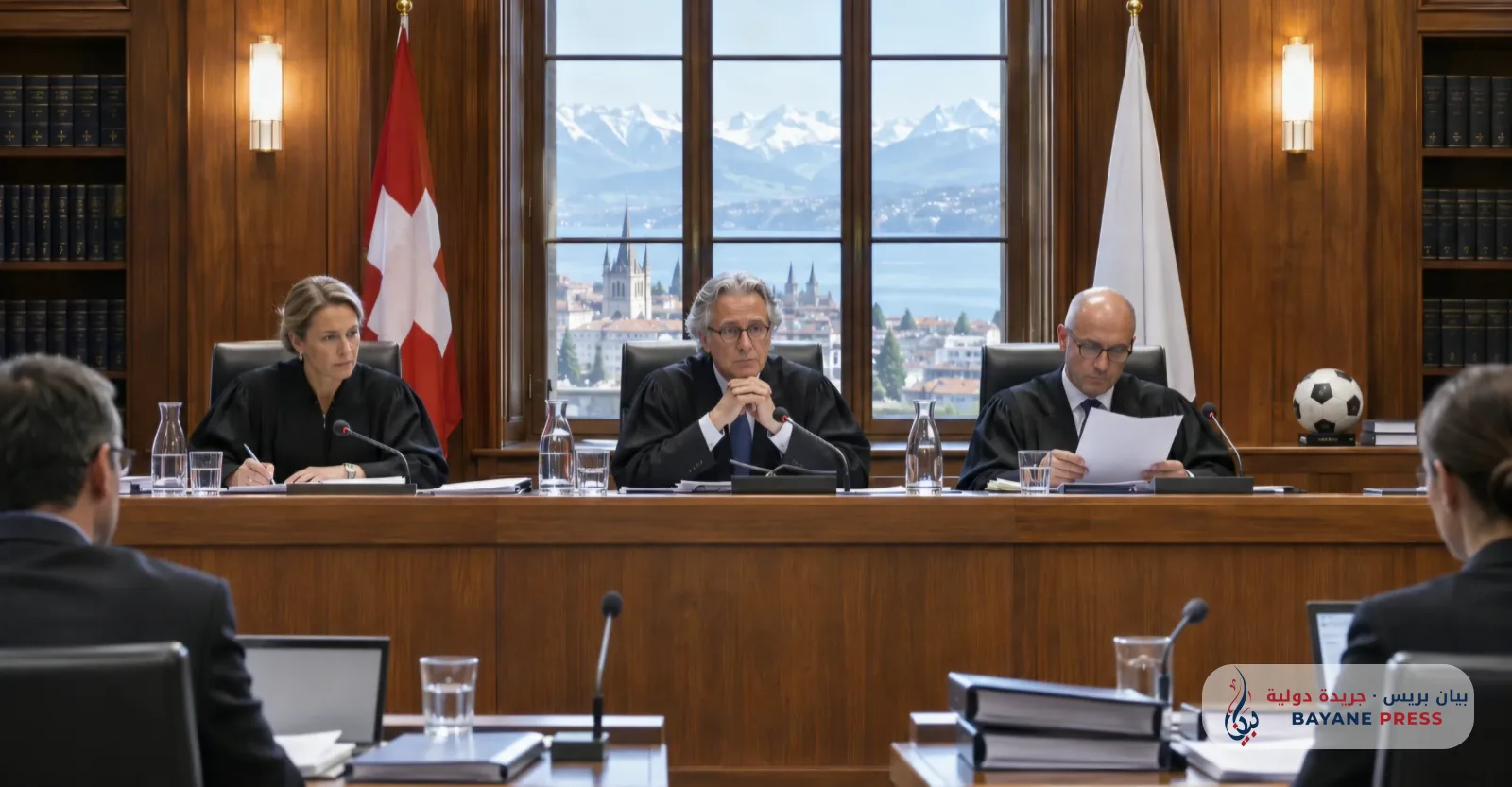
Between a referee's whistle ending a match on the pitch, an appeals committee decision changing the identity of the African champion, and an international arbitration ruling restoring the previous result, the chapters of one of the most complex cases in the history of African football are unfolding. However, what took place within the corridors of the Court of Arbitration for Sport (CAS) in Lausanne, Switzerland, appears far more complex than official statements and media headlines suggested. A review of the circulated version of the arbitration award, spanning 53 pages, reveals procedural and legal details that warrant close attention—from an external organization's attempt to intervene in the case, to the Confederation of African Football's (CAF) stance of neutrality, to the controversy over the admission of regulatory documents issued after the match, and finally, allegations concerning an alleged contact between the president of the Senegalese Football Federation and a member of the arbitration panel 48 hours before the ruling was issued.
On Tuesday, November 24, 2026, the Court of Arbitration for Sport (CAS) issued its ruling in case number 2026/A/12295, which accepted the appeal filed by the Senegalese Football Federation against CAF and the Royal Moroccan Football Federation (FRMF), overturned the CAF Appeals Committee's decision issued on March 17, and reinstated the Disciplinary Committee's decision dated February 11, officially restoring the 2025 Africa Cup of Nations title to Senegal. However, this ruling, which ended one phase of the sports dispute, has opened the door to a new legal battle that may move to the Swiss Federal Tribunal, as the FRMF has announced its intention to pursue all available legal avenues to challenge it.
The case dates back to the evening of January 18, 2026, when the Prince Moulay Abdellah Stadium in Rabat hosted the tournament final. As the match was heading toward a goalless draw, the final minutes saw developments that altered its course, after Congolese referee Jean-Jacques Ndala Ngambo disallowed a goal for the Senegalese team due to a foul committed before the goal, before consulting the Video Assistant Referee (VAR) to check a situation inside the Senegalese penalty area and deciding to award a penalty to the Moroccan team.
The decision sparked widespread protests within the Senegalese team, reaching the point where coach Pape Bouna Thiaw directed his players to leave the pitch, with most of them retreating to the dressing room, amid disturbances in the stands and tension between the technical staff members. The referee's report, dated January 19, also noted data regarding players and officials gathering around the VAR review area and the resulting difficulties in performing his duties.
According to the timeline provided in the circulated version of the ruling, the Senegalese team returned to the pitch with all its members in the nineteenth minute of stoppage time, before Brahim Diaz took the penalty in the twenty-third minute of the same period, which was saved by goalkeeper Edouard Mendy. The match moved into extra time, where Pape Gueye scored the winning goal for Senegal in the ninety-third minute, securing the title on the pitch.
The following day, CAF condemned the events that accompanied the final, before the Disciplinary Committee announced, on January 28, sanctions affecting both parties, including a five-match suspension for the Senegalese coach from official CAF matches, as well as sanctions against players and officials and financial fines. However, the committee did not consider the Senegalese team's departure from the pitch sufficient grounds to declare a forfeit loss, a position included in its decision dated February 11.
The Royal Moroccan Football Federation rejected this interpretation, relying on Articles 82 and 84 of the Africa Cup of Nations regulations. The importance of the first article lies in its definition of cases of loss and exclusion from the competition, including refusing to play or leaving the pitch before the legal end without the referee's permission, while the second article defines the consequences of a forfeit loss, primarily the awarding of a 3-0 result, with the possibility of additional measures.
Thus, the Moroccan objection was not directed at the validity of Senegal's goal or the decision to award the penalty, but at the legal consequence of the behavior of a team whose players left the pitch in protest against a refereeing decision. The Moroccan defense argued that the violation is realized as soon as the unauthorized departure occurs, regardless of the players' subsequent return to complete the match.
On March 17, 2026, the CAF Appeals Committee issued a decision responding to the Moroccan appeal, overturning the Disciplinary Committee's decision in file number DC23316, and declaring the Senegalese team to have lost by forfeit, with Morocco awarded a 3-0 victory.
However, one of the most important points that did not receive sufficient media coverage is that the Appeals Committee did not merely establish the violation of Articles 82 and 84, but also considered that the Royal Moroccan Football Federation's right to a fair hearing was not respected during the proceedings before the Disciplinary Committee. Thus, its decision was based on two aspects: one procedural, related to defense rights, and the other substantive, related to the application of the competition's regulations.
On March 24, the Senegalese Federation filed its appeal with the Court of Arbitration for Sport, which announced its registration the following day. From that moment, the dispute moved from African institutions to international arbitration, beginning a new phase that revealed complexities that were not apparent to the public.
The ruling document indicates that the Senegalese Federation chose the German arbitrator Ulrich Haas, a lawyer in Hamburg and professor of law in Zurich, while the Royal Moroccan Football Federation and CAF jointly chose the Italian arbitrator Luigi Fumagalli on April 16. On June 23, the formation of the arbitration panel was officially announced, chaired by French law professor Gérald Simon, assisted by panel clerk Stéphanie De Decker.
The parties' nomination of arbitrators does not represent an exceptional procedure or evidence of bias, as international arbitration is based on mechanisms that allow parties to participate in forming the panel that will decide the dispute, with all arbitrators bound by independence and impartiality. However, the name of the arbitrator chosen by Senegal would return to the forefront before the ruling was issued, under circumstances that sparked an official objection from the Moroccan side.
Before the panel's formation was completed, the file witnessed a notable development on April 7, when an organization named "Tikkun Olam Foundation" filed a request to intervene in the case as an "Amicus Curiae," a legal mechanism that allows an entity outside the dispute to provide observations or legal expertise that might assist the judicial panel in deciding it.
Paragraphs 28, 33, and 43, as well as paragraphs 58 through 61 of the circulated version of the ruling, reveal that all three parties opposed this organization's intervention, as CAF submitted its observations on April 13, followed by the Moroccan Federation on April 14, and then the Senegalese Federation on April 15.
On July 15, the arbitration panel rejected the request to intervene, after considering that the organization did not prove it possessed specific expertise or legal data that could provide a useful addition to the dispute, and that allowing it to file its brief might disrupt the balance between the parties, especially in light of the neutral position taken by the Confederation of African Football.
This development raises investigative questions regarding the organization's legal identity, its headquarters, the nature of its activity, its sources of funding, the reasons for its interest in an African football dispute, and the content of the brief it intended to submit. However, the available documents do not allow for determining its motives or confirming any link between it and any party in the case, especially since Morocco, Senegal, and CAF all opposed its intervention, and the court refused to accept its brief.
In parallel with the attempted external intervention, an institutional stance emerged that also deserves scrutiny. On April 13, the Confederation of African Football announced that it would take a neutral position during the arbitration proceedings and would commit to implementing the final ruling issued by the CAS. On May 13, it confirmed that it would not submit an answer brief addressing the subject of the appeal, limiting itself later to observations regarding procedural aspects, jurisdiction, and the admissibility of the appeal.
With this choice, the Royal Moroccan Football Federation bore the primary burden of defending the decision issued by the CAF Appeals Committee and the interpretation of regulations established by CAF itself. The irony is that the institution that granted Morocco the title by virtue of a decision from one of its judicial bodies chose not to present a detailed substantive defense of that decision before the CAS.
Although neutrality remains a permissible procedural choice, and there is no rule requiring CAF to defend every decision issued by its judicial bodies, this position raises questions regarding its institutional responsibility in clarifying the purpose of its regulations, the consistency of its disciplinary and judicial bodies, and its ability to ensure the stability of the rules governing continental competitions.
The Moroccan pleadings were not limited to the issue of the forfeit, but also included an objection to the jurisdiction of the CAS and the admissibility of the Senegalese appeal from a formal perspective. The Senegalese Federation filed its first appeal on March 24, based on the operative part of the Appeals Committee's decision, before being notified of its detailed reasons on April 3, then filed a subsidiary appeal on April 13 regarding the reasoned decision.
The Moroccan defense argued that the first appeal was premature and that the subsidiary appeal did not, according to its reading, meet all the required formal conditions. It also insisted on the provisions of the CAF Statutes regarding the exclusion of certain disputes related to the application of the Laws of the Game from the jurisdiction of the CAS.
However, the panel rejected these arguments, considering that the dispute relates to the application of the regulations governing the tournament, and that CAF's disciplinary rules do not make a request for reasoning a necessary condition for maintaining the right to appeal in the same way that some FIFA regulations provide, concluding that it had jurisdiction and that the Senegalese appeal was admissible.
On May 25, the file witnessed another legal development, after the Senegalese Federation requested the inclusion of two documents issued after the final match was played. The first relates to the FIFA Disciplinary Code in its version issued in May 2026, while the second relates to an official statement from the International Football Association Board (IFAB), dated April 28, 2026.
The Senegalese side argued that the two documents clarify the regulatory approach regarding cases of temporary departure from the pitch. On June 2, the Moroccan Federation objected to their admission, considering that they were issued after the event subject to the dispute and do not represent the rules governing the tournament at the time it was held, in addition to objecting to the timing of their submission.
However, the arbitration panel decided to accept them into the file on July 24, as they are related to the legal issue at hand, while providing the parties the opportunity to discuss them.
The sensitivity of this procedure lies in the principle of non-retroactivity of legal rules and legal certainty, as facts are supposed to be subject to the texts in force at the time they occur. However, accepting subsequent documents for reference differs legally from applying their provisions retroactively, and therefore the evaluation of this point depends on the nature of the use the panel made of the two documents in its reasoning, not solely on the date of their issuance.
On October 8, the hearing was held at the CAS headquarters in Lausanne, in the presence of representatives of the three parties, after no agreement was reached on adopting an expedited procedure. Paragraph 48 of the ruling reveals a highly significant fact: that the parties confirmed, at the end of the session, their satisfaction with the conduct of the procedure and the absence of any objection regarding the respect for their right to be heard.
This statement may constitute one of the arguments that the Senegalese Federation can use against a Moroccan challenge related to the proceedings prior to the hearing. However, it does not prevent the Moroccan Federation from raising new facts it claims to have learned about after the session, especially if they are related to the independence of one of the arbitrators.
On October 19, the CAS announced that deliberations would take several weeks, before setting November 24 as the date for announcing the ruling.
The core of the dispute revolved around the interpretation of Articles 82 and 84, as Morocco insisted on a literal reading of the text, considering that unauthorized departure requires a forfeit loss, and that the regulations do not explicitly require the departure to be final. The Moroccan defense also distinguished between the referee's authority to manage the match and the disciplinary bodies' authority to arrange the legal consequences resulting from the players' behavior.
As for the Senegalese defense, it considered that the purpose of the two articles is to address cases where it is impossible to complete the match and reach a sporting result, and that declaring a loss by forfeit assumes the match has stopped permanently, not just suspended temporarily. It relied on Law 5 of the Laws of the Game, Article 23.10 of the tournament regulations, and the principle of protecting referees' on-field decisions, known as the Field of Play Doctrine.
This principle is based on protecting the independence of referees and preventing sports judicial bodies from re-refereeing matches after they have ended, except in exceptional circumstances related, for example, to arbitrariness, bad faith, or a legal error that justifies intervention.
The CAS pointed to a precedent of the Swiss Federal Tribunal issued on January 23, 2026, under number 4A_494/2024, which reinforces the principle of not reviewing referees' on-field decisions outside of exceptional cases.
The panel chose to interpret Articles 82 and 84 according to the purpose it derived from their regulatory context, considering that the Congolese referee had the discretionary power to determine the possibility of resuming the match, and that his decision to allow play to continue was not arbitrary or tainted by a legal error.
However, this reasoning raises a fundamental issue regarding the dividing lines between interpreting a legal text and adding a new condition to the conditions for its application. If Article 82 includes, in its wording, leaving the pitch without the referee's permission, the requirement of a final stop that the CAS adopted is not explicitly stated therein, but was derived by the panel from its reading of the context and the regulatory purpose of the text.
Hence the legal paradox arises: does the referee's decision to resume the match prevent the imposition of a regulatory penalty for behavior that occurred before its resumption? Or does the referee's authority remain separate from the disciplinary bodies' authority in applying competition regulations?
The CAF Appeals Committee adopted the interpretation that gives priority to the legal effect of the departure, while the CAS adopted the interpretation that links the forfeit loss to the impossibility of completing the match. This difference does not necessarily prove the existence of a deliberate error by either body, but it reveals a weakness in the regulatory drafting that allowed for two contradictory results regarding the same event.
Paragraph 179 of the ruling shows another highly sensitive point, related to the panel's acknowledgment that the tense atmosphere that accompanied the Senegalese players' departure and the resumption of the match may have affected Brahim Diaz's psychological state when taking the penalty, before considering that the decision to resume play also served the interest of the Moroccan team, because it gave it the opportunity to open the scoring.
This reasoning calls for a discussion of the concept of equal opportunity, as it is not necessarily possible to equate the psychological and competitive conditions for taking a penalty kick normally with the conditions for taking it after a long stoppage, mass protest, and disturbances inside the stadium. Nevertheless, proving the possibility of psychological influence is not enough to prove that the kick would have been scored had it not been for those events, and it does not, by itself, constitute a legal reason to invalidate the arbitration ruling.
While the case was heading toward the announcement of its final result, the most dangerous development in the file emerged, after the Royal Moroccan Football Federation directed an objection to the CAS regarding a phone call that took place on Sunday, November 22, between the president of the Senegalese Football Federation, Abdoulaye Fall, and the German arbitrator Ulrich Haas.
French media outlets, including "RMC Sport" and the newspaper "Le Monde," covered the details of the accusation, while Reuters reported the data from a source familiar with the case, confirming its inability to independently verify that the call took place. Senegalese media also circulated statements by French journalist Romain Molina regarding the alleged call.
In contrast, the Senegalese Federation denied the accusations, and the German arbitrator also denied having any direct communication with the parties to the dispute. The CAS clarified that the official request for his recusal was received less than an hour before the ruling was announced, and that the elements provided were not sufficient to justify postponing its issuance.
A distinction must be made here between not postponing the announcement of the ruling and the final decision on all allegations related to the recusal request, as one cannot infer the content of the decision regarding the recusal or the extent of the investigation into the accusation from the mere fact that the court continued with the procedures for announcing the ruling.
Article R33 of the Code of Sports-related Arbitration stipulates the obligation of arbitrators to be independent and impartial and to disclose circumstances that might raise doubts about them, while Article R34 allows parties to submit a request to recuse an arbitrator within seven days from the date of becoming aware of the reasons justifying it.
Therefore, the fundamental issue is not the number of hours that separated the submission of the request and the announcement of the ruling, but the date the Moroccan Federation became aware of the alleged event, the nature of the evidence it obtained, the extent to which it respected the required deadlines and procedures, and the sufficiency of the examination to which those elements were subjected.
If the Moroccan defense succeeds in providing reliable evidence proving that a private contact related to the dispute occurred, outside the approved procedural channels, the file may move from a mere disagreement over the interpretation of sports regulations to a dispute affecting the integrity and independence of the arbitration panel. If it is impossible to prove that the contact occurred or its relationship to the case, the accusation will not be sufficient, in itself, to undermine the validity of the ruling.
There remains a fact that should not be ignored in evaluating this issue, which is the CAS's confirmation that the ruling was issued unanimously, including the Italian arbitrator Luigi Fumagalli, who was nominated by Morocco and CAF jointly. This fact weakens the hypothesis of reducing the result to the position of one arbitrator, but it does not legally prevent the possibility of challenging the integrity of the entire panel's formation if a legitimate reason for recusing one of its members is proven.
On November 24, the CAS settled the arbitration dispute through eight provisions contained in the operative part of the ruling, including confirming its jurisdiction, accepting the appeal in form and substance, overturning the CAF Appeals Committee's decision, confirming the Disciplinary Committee's decision, as well as charging the Royal Moroccan Football Federation with two-thirds of the arbitration costs and CAF with the remaining third, with each party bearing its own legal defense costs, and rejecting the rest of the requests.
The ruling did not specify the final value of the arbitration costs, which the court registry will determine and notify later.
Following the issuance of the ruling, the Confederation of African Football announced its respect for the decision and that it would take the necessary measures to implement it, while the Royal Moroccan Football Federation expressed its objection to the result and the way the accusations it raised regarding the German arbitrator's independence were handled, confirming its intention to continue the legal path.
Senegal's recovery of the title does not mean its team has received a disciplinary acquittal from all the events that accompanied the final, as the CAS did not consider leaving the pitch a legitimate behavior, and did not automatically cancel the sanctions issued in separate disciplinary proceedings, but rather refused to change the match result based on Articles 82 and 84 under the circumstances in which the match took place.
However, the ruling opens a discussion regarding the effectiveness of deterrence within sports competitions. If a forfeit loss becomes linked to the referee's decision to end the match permanently, this makes the behavior of teams that leave in protest and then return subject, in similar cases, to disciplinary responsibility different from a direct loss of the match. This calls for establishing more precise rules to avoid exploiting regulatory ambiguity in the future.
CAF President Patrice Motsepe had previously called for reviewing the regulations and strengthening disciplinary measures, in the context of the criticisms that followed the final's events. Football rules during the year 2026 also witnessed a trend toward stricter handling of protest-based departures from the pitch, without this meaning that the new amendments could be applied retroactively to the January match.
CAF's institutional responsibility goes beyond the issue of determining the champion, after the case showed a contradiction between the decisions of its judicial bodies, a weakness in the clarity of the texts regulating forfeits, and the resulting disruption in the legal status of the tournament. However, proving legal responsibility that requires compensation remains linked to identifying a proven violation, provable damage, and a causal link between them, and does not automatically result from overturning the Appeals Committee's decision.
At a time when sports institutions and the public were preoccupied with the content of the ruling, some media coverage, especially in Algeria and Egypt, took on dimensions that went beyond the limits of reporting the news.
In Algeria, the newspaper "El Khabar" published, at 12:53 on the day the ruling was issued, a piece that presented the recent Moroccan moves as maneuvers, before publishing another article at 15:14 that considered the Moroccan objection an attempt to delay the impact of the result. The newspaper went in its coverage to question the motives of the Royal Moroccan Football Federation, without providing independent evidence that settles the truth of the alleged contact.
As for the newspaper "Ennahar," it published at 15:28 a piece in which it used direct political rhetoric, presenting the ruling as a slap to Morocco, and speaking of alleged pressure on CAF officials. The published material did not contain independent evidence proving those accusations, which makes it closer to expressing an editorial position on the dispute than to providing investigative data proving Moroccan interference.
In contrast, other Algerian coverage, including material published by the newspaper "Echorouk," tended to address the sporting result and the possibility of the legal path continuing, confirming that the Algerian media discourse was not absolutely unified.
In Egypt, the website "Yalla Kora" focused on the legal merits of the ruling, through a report that reviewed twenty-one points of its justifications, while the newspaper "Al-Masry Al-Youm" addressed the match referee's powers and the provisions of the tournament regulations, and the newspaper "Youm7" devoted part of its coverage to monitoring the reactions of Moroccan media.
Comparing these materials reveals a disparity in treatment, between a polemical discourse with a political charge in some Algerian platforms, and a more present legal and sporting approach in a number of the Egyptian platforms monitored, with the presence of sensational headlines on both sides.
Diplomatically, the continuation of the dispute carries the risk of the sports tension spilling over into relations between Morocco and Senegal, despite the historical, religious, and economic ties that unite the two countries. Therefore, separating the legal dispute from bilateral relations remains necessary to avoid holding peoples and states responsible for a dispute between sports institutions.
Economically, changing the identity of the African champion raises questions about financial rewards, commercial rights, sponsorship contracts, and obligations related to the coronation, in addition to the costs borne by the parties in defense and arbitration proceedings. However, estimating the scale of these impacts requires access to contracts, executive decisions, and financial statements, and it is not possible to assume specific losses without documents proving them.
The future of the case remains linked to the possibility of the Royal Moroccan Football Federation resorting to the Swiss Federal Tribunal, in accordance with Article 190 of the Swiss Private International Law Act, which defines five basic grounds for challenging international arbitration awards, consisting of the unlawful formation of the arbitration panel, error in determining jurisdiction, exceeding the parties' requests or failing to decide on them, violation of equality and defense rights, and violation of public policy.
The deadline for filing the challenge is, in principle, thirty days from the date of notification of the ruling. However, the Federal Tribunal does not constitute a new appellate instance that re-evaluates the course of the match or weighs all possible interpretations of CAF regulations, but rather exercises limited legal oversight over the integrity of the ruling within the grounds defined by law.
From this perspective, the Moroccan defense may rely on objecting to the formation of the arbitration panel or the infringement of defense rights, if it succeeds in proving the existence of an actual breach of legal guarantees. It can also raise the issue of jurisdiction, within the conditions permitted by Swiss law. As for merely disagreeing with the CAS's interpretation of Articles 82 and 84, this is usually not enough to invalidate the ruling.
Swiss judicial precedents are of particular importance in this context, foremost among them the case of Chinese swimmer Sun Yang, against whom the CAS had previously issued an eight-year suspension ruling. On December 22, 2020, the Swiss Federal Tribunal overturned the ruling, in case number 4A_318/2020, after accepting a review request based on previous statements by the head of the arbitration panel, Franco Frattini, which raised justified doubts about his impartiality.
The file was reconsidered before a different panel, confirming with this precedent that the finality of arbitration awards does not prevent their invalidation when legal reasons exist that affect the independence of the arbitrators.
This precedent also established the importance of discovering the reasons for recusal in a timely manner, the necessity of expressing the objection without unjustified delay, and not keeping it until the result of the dispute is known. These are elements that could be of direct importance in evaluating the Moroccan position, depending on the time the Federation learned of the alleged contact and how it dealt with it.
In contrast, the Senegalese Federation possesses arguments it can use to defend the ruling, including its unanimous issuance, the lack of independent proof of the alleged contact, the denial by the concerned parties that it occurred, the confirmation by the parties of respect for their procedural rights at the end of the hearing, as well as the limited jurisdiction of the Federal Tribunal in reviewing the subject of the dispute. The strength of these arguments will depend on the nature of the new evidence and the extent of its legal admissibility.
The Royal Moroccan Football Federation can also submit a request to temporarily stay the execution of the ruling, in accordance with the conditions set out in Swiss law. However, filing the challenge does not automatically stay execution, and invalidating the ruling, if achieved, does not necessarily mean returning the title directly to Morocco, as it may lead to reconsidering the dispute before a new arbitration panel.
Therefore, the case still contains aspects that deserve an independent documentary investigation, foremost among them the evidence related to the phone call, the Royal Moroccan Football Federation's correspondence with the CAS, the timing of submitting the recusal request, the detailed reasoning for the position of the authority responsible for handling it, the statements related to the independence of the arbitrators, the documents revealing the identity of the external organization and the content of its intervention request, as well as the correspondence clarifying the reasons for CAF's choice of neutrality and not presenting a detailed substantive defense of the Appeals Committee's decision.
As of the available data, there is no independent evidence proving the involvement of Algerian or Egyptian political entities, or FIFA officials, in influencing the ruling. Nor are there sufficient documents to allow considering the external organization's attempted intervention as part of arrangements targeting Morocco or Senegal.
The most dangerous thing revealed by the Africa Cup of Nations final case is not just the transfer of the title between two teams by successive decisions, but the scale of the regulatory ambiguity that allowed for conflicting rulings, the tests facing the independence of sports justice, and the extent of its institutions' ability to provide guarantees that enhance the confidence of litigants and the public opinion.

Comments (0)
No comments yet. Be the first to react!