

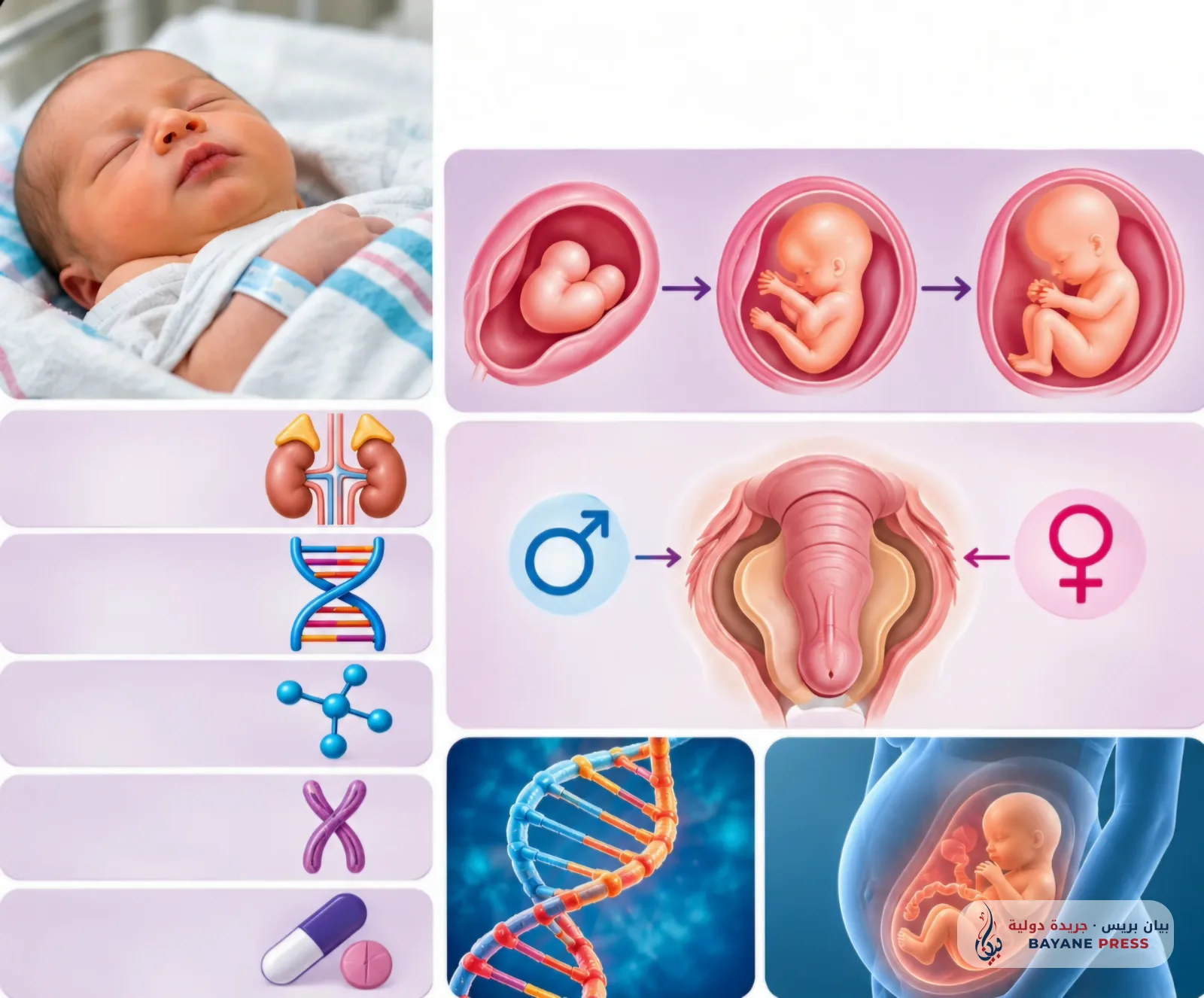
One of the phenomena that has most intrigued doctors and geneticists throughout history is the birth of children with genitalia that do not bear the typical appearance of males or females, cases historically known as "hermaphroditism," while modern medicine classifies them under what is called "Differences of Sex Development" (DSD). But what happens inside the mother's womb for the fetus to take this different path? Do male and female hormones actually mix? Can a child possess sexual characteristics of both sexes? And where does the defect begin: in the genes, the glands, or the hormones?
The answer begins from the very first moments of fetal formation, when the genetic material inherited from the parents determines the structure of the sex chromosomes. In most cases, females carry the XX structure and males carry the XY structure; however, determining sexual appearance does not stop at the chromosomes alone, but is subject to a complex series of genetic and hormonal signals that regulate the formation of glands and reproductive organs.
During the first weeks of pregnancy, the fetus possesses common primordial structures that can develop in different directions. By the sixth or seventh week approximately, the genetic processes responsible for the differentiation of the gonads begin, and the SRY gene, usually found on the Y chromosome, plays a fundamental role in initiating the formation of the testes through a network of genes that regulate sexual development.
When the fetal testes form, specialized cells begin producing testosterone, which helps develop certain internal male reproductive organs, while other cells secrete the Anti-Müllerian Hormone (AMH), which leads to the regression of the fetal structures that would have developed, in its absence, into the uterus, fallopian tubes, and parts of the female reproductive system.
As for the formation of external male genitalia, it depends to a large degree on the conversion of testosterone into a more potent hormone called dihydrotestosterone (DHT) by an enzyme known as "5-alpha-reductase." If this process is disrupted, or if the tissues do not respond to the hormone normally, a child may be born with XY chromosomes and testes, but their external genitalia do not take the typical male form.
Here, one of the most important scientific facts emerges: a difference in sex development does not necessarily mean that the fetus possesses equal or conflicting amounts of male and female hormones. The defect may occur in the production of a specific hormone, in its conversion to its active form, in the cells' reception of its signals, or in the genes that regulate the formation of the gonads themselves.
Among the most prominent medical causes for these cases is "Congenital Adrenal Hyperplasia," a genetic disorder that affects the ability of the adrenal glands, located above the kidneys, to produce certain hormones necessary for the body.
In the most common form of this disorder, there is a deficiency in the activity of an enzyme called "21-hydroxylase," which leads to a decrease in the production of cortisol, and sometimes aldosterone as well, with an increase in the production of androgenic hormones.
This increase during pregnancy may lead to the appearance of external genitalia with male characteristics in a fetus that carries XX chromosomes and has ovaries and a uterus. This can manifest as clitoral enlargement or partial fusion of the genital folds, to varying degrees, even though the internal female reproductive organs are usually present.
The danger of this disease is not limited to external appearance; the lack of aldosterone in some children may lead to severe loss of salts and fluids, low blood pressure, dehydration, and heart rhythm disturbances, and the condition may progress to a life-threatening adrenal crisis if not diagnosed and treated early.
In a completely different direction, there is a condition called "Androgen Insensitivity Syndrome," a genetic disorder that makes the body's cells unable to respond to male hormones fully or partially.
The fetus may possess XY chromosomes and develop testes that secrete testosterone, but the receptors responsible for receiving the hormone do not function as usual. In cases of complete insensitivity, the external genitalia may develop with a female appearance, while the uterus usually does not form due to the effect of the Anti-Müllerian Hormone.
In cases of partial insensitivity, the external organs may have an atypical appearance, with a significant difference in the degree of development from one child to another.
There is also 5-alpha-reductase deficiency, which prevents sufficient conversion of testosterone into the hormone most influential in the formation of external genitalia. Some children with this condition may be born with genitalia that appear female or ambiguous, before noticeable male changes occur during puberty as a result of rising testosterone levels.
The causes of differences in sex development are not limited to hormones alone; they may sometimes be linked to differences in the number or structure of sex chromosomes, or the presence of cell groups carrying different chromosomal structures within the same body, a phenomenon known as "chromosomal mosaicism."
In extremely rare cases, a person may possess both ovarian and testicular tissues, a condition medicine calls "ovotesticular difference of sex development." This does not necessarily mean possessing two complete reproductive systems capable of performing their functions, but rather the presence of two types of reproductive tissues with varying degrees of development.
Some factors related to pregnancy can also affect the hormonal path of the fetus, such as exposure to unusually high levels of androgens due to rare placental disorders, hormone-secreting tumors in the mother, or exposure to certain hormonal medications. However, most cases are not the result of an action taken by the mother during pregnancy, and many are linked to genetic or developmental factors that cannot be predicted in advance.
It is important to distinguish between differences in sexual organ formation and gender identity or sexual orientation; these are different concepts, and one cannot infer a person's future identity or inclinations from the appearance of their organs at birth.
Some differences in sex development may be discovered during fetal examinations, while other cases do not appear until birth, during puberty, or when seeking the causes of the absence of menstruation or fertility difficulties.
When a child is born with atypical genitalia, doctors begin a precise clinical examination, along with tests for chromosomes, genes, and hormones, measuring salts, sugar, and adrenal gland functions, and using ultrasound to identify internal organs. Examinations may include levels of testosterone, dihydrotestosterone, cortisol, and 17-hydroxyprogesterone, depending on the case.
Early diagnosis is of great importance, not just to explain the anatomical difference, but to discover any hormonal disorder that may threaten the child's life and to know their long-term health needs.
As for treatment, it does not rely on a single rule. Some children need hormone replacement to ensure their well-being, some need periodic monitoring without surgical intervention, while specific cases may require treatment for problems affecting urination or organ function.
Medically unnecessary genital surgeries have seen wide debate in recent years due to their potential effects on sensation, sexual function, fertility, and the person's right to participate in decisions regarding their own body. Therefore, medical and human rights trends call for caution regarding non-urgent cosmetic interventions and involving the person concerned in the decision whenever possible.
These conditions also do not necessarily mean infertility, as reproductive capacity varies depending on the genetic cause, the nature of the reproductive tissues and their function, and associated disorders.
This phenomenon reveals that human sexual development is more complex than it appears when looking at external organs alone. Between chromosomes, genes, glands, enzymes, and hormonal receptors, precise and interconnected processes take place during pregnancy, and a difference in one of their elements may lead to an unusual anatomical or hormonal path.
It is not simply a story of male and female hormones mixing inside the womb, but a potential result of differences in a highly complex biological system. Understanding these cases scientifically helps in diagnosing them early, protecting children's health, and treating them with respect, away from preconceived social judgments.
Comments (0)
No comments yet. Be the first to react!