


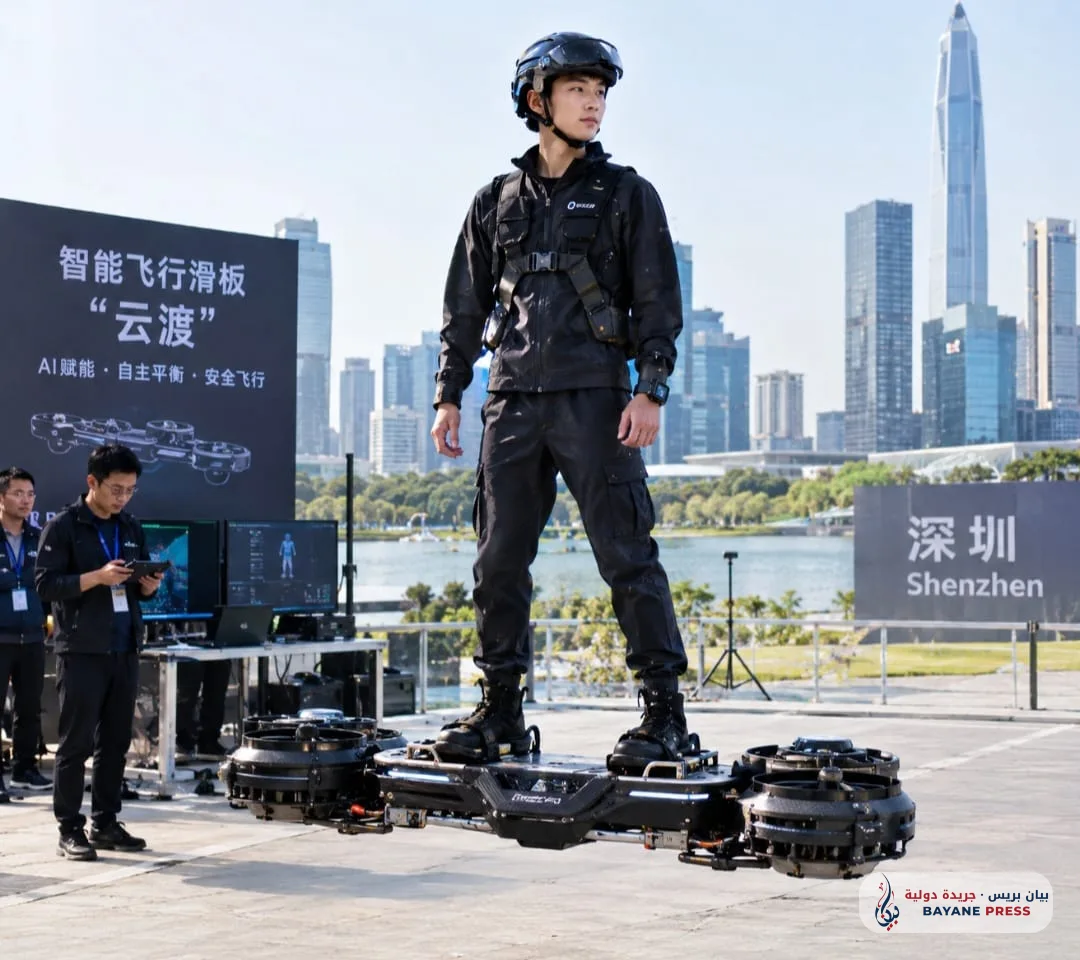
The dream of free individual flight has moved from the realms of science fiction and popular Asian folklore into tangible engineering reality in the heart of China's technological hubs in the cities of Dongguan and Shenzhen. There, young Chinese innovator Zhao Deli, alongside a new generation of young robotics engineers in Chinese laboratories, managed to develop an intelligent hoverboard whose foundational model was named "Jindouyun"—inspired by the flying cloud in Chinese heritage—before advanced technology incubators adopted it to integrate generative artificial intelligence and neural control systems, transforming it from a dangerous prototype requiring complex acrobatic skills into a stable and safe personal flight platform paving the way for a new era of low-altitude air mobility.
The structural design of this hoverboard is based on a compact base made of ultra-light, high-strength carbon fiber composite, which houses an array of interactive electric motors and small brushless ducted fans, powered by high-density lithium-polymer battery packs, giving the board vertical thrust capable of lifting an adult rider while maintaining a lightweight total device weight. However, the secret behind the success of this innovation lies not only in the power of the motors, but in the embedded electronic brain that manages the flight process moment by moment.
The operation of the hoverboard relies on integrating artificial intelligence and deep learning algorithms with a highly sensitive inertial measurement unit, supported by optical "LiDAR" sensors, millimeter-wave radars, and downward optical flow cameras; given that the major problem in traditional hoverboards was that any slight tilt in the rider's body led to the board tipping over and an immediate loss of control. Artificial intelligence has solved this by reading thousands of data points per second to predict the movement of the rider's body center of gravity before it is completed, then adjusting the rotational speed of each fan individually in fractions of a millisecond to resist tilting and counter sudden gusts of wind completely automatically.
The rider controls the path and altitude of the board through natural kinetic interaction without the need for complex steering handles, as the system's neural network translates the precise foot pressures and body tilt angles into smooth steering commands forward, outward, or for rotation, in conjunction with a smart wireless controller worn by the user on their wrist to adjust altitude and stabilize speed. In the same context, the computer vision system scans the surrounding environment at a 360-degree angle to map a three-dimensional layout of the space in real-time, allowing the board to autonomously avoid obstacles such as trees, buildings, and power lines. The system refuses to execute any movement that could lead to a collision even if the rider leans toward the obstacle by mistake.
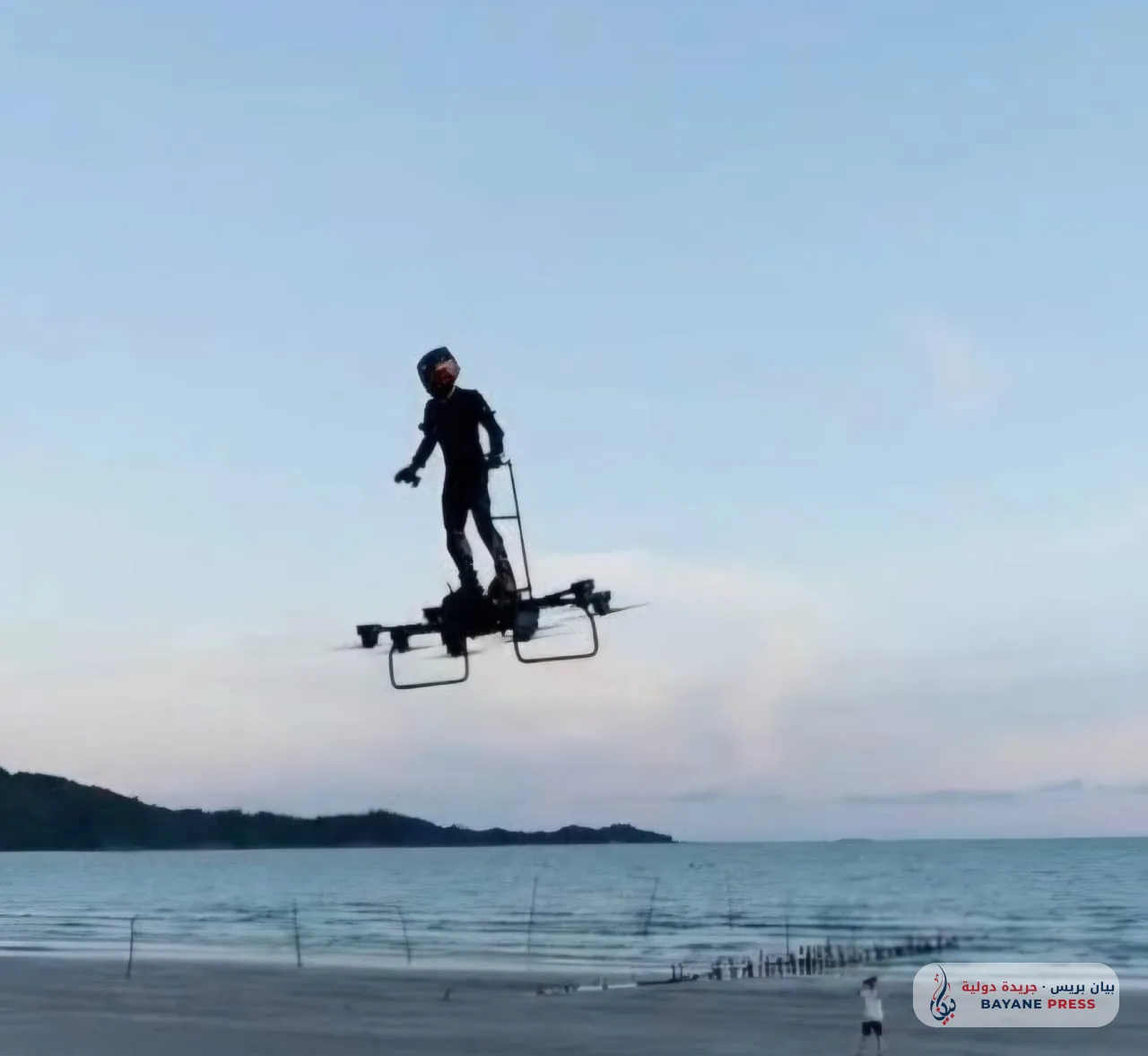
The experimental flight capabilities of this smart platform range between 15 and 25 minutes of continuous flight on a single charge, with the ability to reach speeds of up to 60 kilometers per hour at pre-programmed safe altitudes to ensure user safety. The board has been equipped with a smart safety protocol that intervenes immediately upon detecting a drop in battery level to a critical limit or a failure in one of the micro-motors, redistributing thrust among the healthy motors and executing a gradual, safe, and stable landing process. This Chinese innovation opens the door to wide practical applications beyond entertainment and aerial sports, to include rapid rescue operations in rugged terrain and immediate access to affected areas that traditional vehicles cannot reach.



Comments (0)
No comments yet. Be the first to react!