

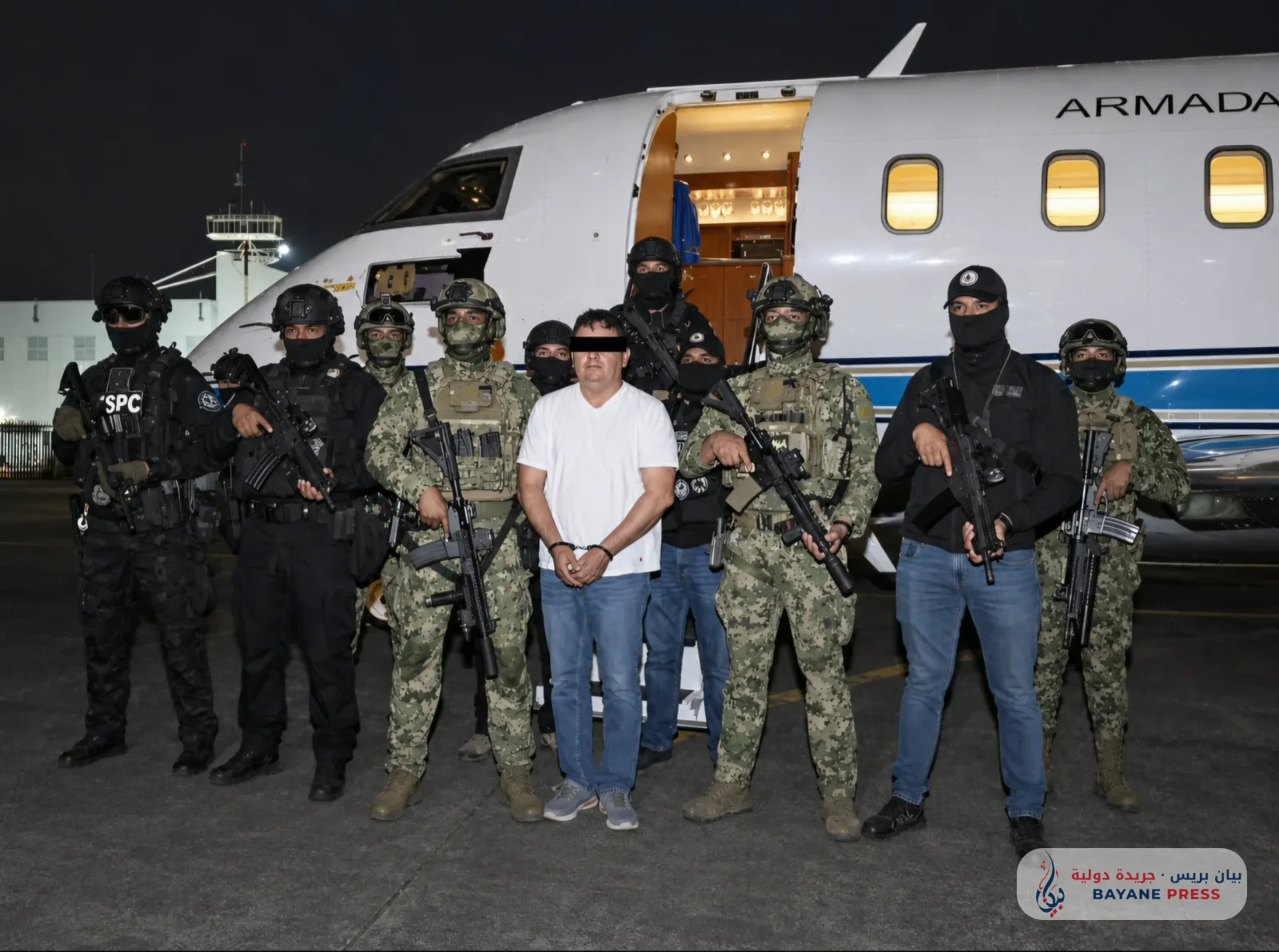
The Mexican capital saw a massive security deployment following the transfer of Fausto Isidro Meza Flores, known as 'El Chapo Isidro', one of the most wanted figures in international drug trafficking, to the headquarters of the specialized prosecutor's office for organized crime, amidst exceptional measures imposed by the Mexican Army and National Guard.
The suspect was brought before the prosecutor on the morning of Saturday, November 21, accompanied by two individuals suspected of belonging to his criminal network, after arriving in the capital on a military plane from the state of Sinaloa, where a large-scale arrest operation was carried out on Friday evening in the city of Guasave, following security investigations and intelligence coordination with U.S. authorities.
Mexican forces imposed a security cordon around the prosecutor's office, with armed units deployed to secure the arrival of the detainees and complete legal proceedings. The operation included the arrest of Germán, nicknamed 'Serafín', suspected of being the organization's second-in-command, as well as José, described by investigators as one of those responsible for managing its financial activities.
The arrest operation had triggered violent armed clashes between government forces and gunmen who attempted to prevent the capture of the organization's leader, resulting, according to the official toll, in the deaths of four Mexican soldiers and seven gunmen, in addition to the arrest of eight suspects. Areas of Sinaloa also saw road closures and vehicle burnings in an attempt to obstruct the movements of security forces.
'El Chapo Isidro' is considered one of the most prominent names linked to drug trafficking networks in Mexico, having previously been associated with the Beltrán Leyva organization before consolidating his influence in northern Sinaloa. U.S. authorities had placed him on the FBI's list of the top ten most wanted fugitives, offering a reward of up to five million dollars for information leading to his arrest.
The detainee faces charges related to organized crime and drug trafficking, while the United States seeks to hold him accountable before its courts for charges related to cross-border drug smuggling.
Bringing 'El Chapo Isidro' before the prosecutor does not mark the official start of his trial, but rather a preliminary procedure to determine his legal status before presenting him to the competent court, in a case whose developments are being closely watched by Mexican and American authorities, given the size of the criminal network he is suspected of leading.



Comments (0)
No comments yet. Be the first to react!