


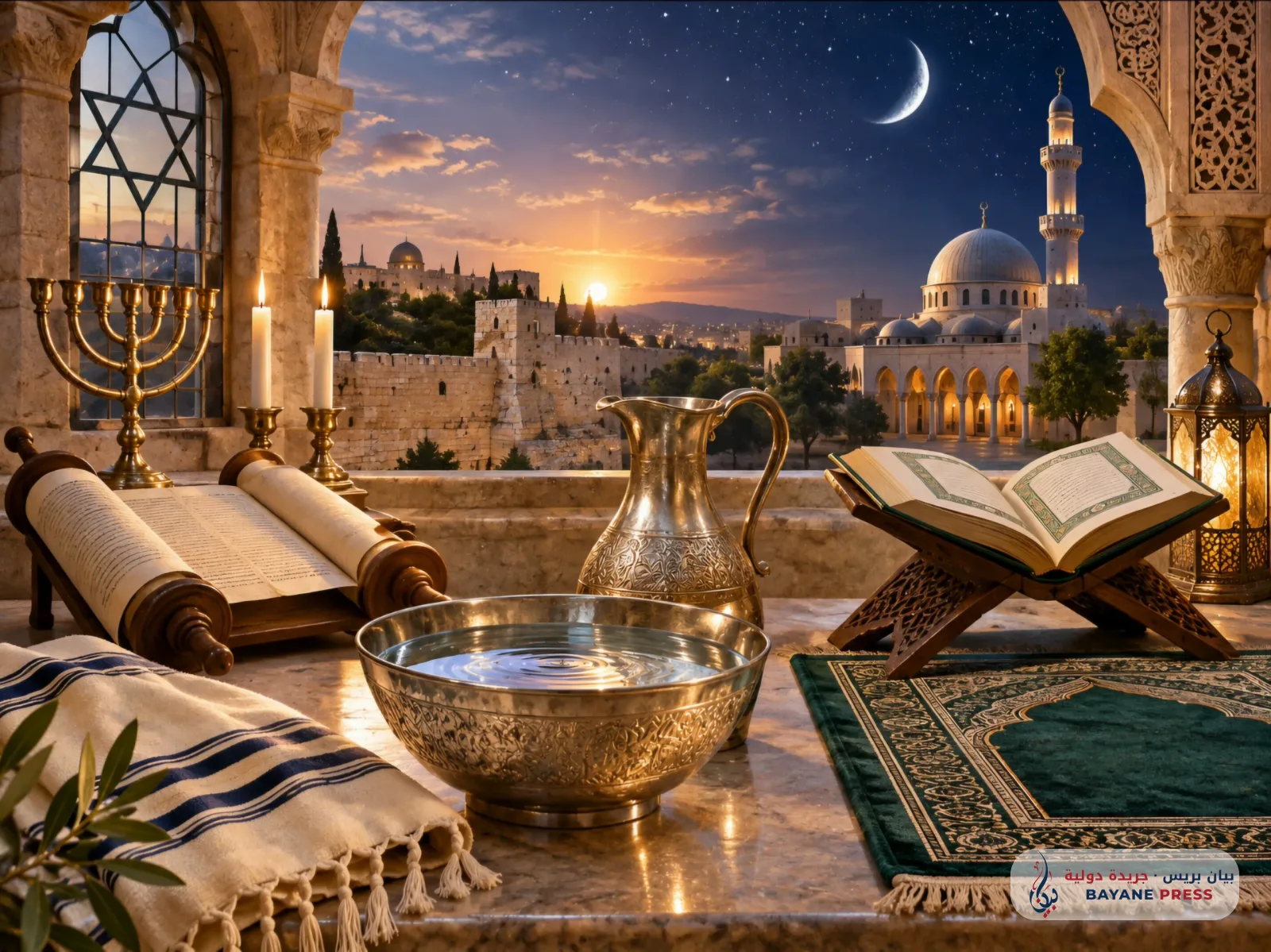
The laws of purity, worship, and sacred time constitute a crucial field in the study of legislative transitions between the Law of Moses and the Muhammadan Law, as they reveal the direct relationship between religious belief and human daily life. In these rulings, ritual cleanliness intersects with worship, sacred space with prayer, repentance with offerings, and religious time with labor and natural seasons. Through a comparison of biblical texts, rabbinic traditions, and Islamic legislation, differences in methods and regulations emerge, alongside shared religious values concerning sanctification, purification, and adherence to God's commands.
The Book of Leviticus, chapter 15, addresses the laws of purity regarding menstruation and bodily discharges, establishing the transmission of ritual impurity in certain cases through contact or the use of bedding and household items. In Jewish tradition, these rulings are linked to the concept of "Niddah," which concerns the ritual status of a woman during menstruation and the associated family and devotional laws.
It is essential here to distinguish between ritual impurity and moral or health-related accusations; ritual status in the Torah does not necessarily imply that a person is guilty or physically contaminated, but rather relates to a specific religious system for regulating purity and handling sacred matters. Therefore, portraying the menstruating woman in Judaism as a social outcast in all circumstances and eras is a generalization not supported by all texts and traditions.
As for the Quran, in Surah Al-Baqarah, verse 222, it stipulates avoiding sexual intercourse during menstruation, but it did not forbid eating, drinking, cohabiting, or normal family interaction. It is reported in Sahih Muslim on the authority of Anas bin Malik that the Prophet, peace be upon him, clarified the permissibility of social interaction with a menstruating woman, while avoiding intercourse, establishing a distinction between specific devotional prohibitions and the continuity of normal human relationships.
Regarding methods of purification, the Torah included rulings concerning vessels exposed to ritual impurity, including the breaking of certain earthenware vessels, as in the Book of Leviticus, chapter 11, verse 33. The Book of Numbers, chapter 19, also addressed procedures for purification from impurity related to death, using the ashes of the red heifer and water according to specific rituals.
These procedures were linked to an integrated religious system where some rulings were connected to the Temple, offerings, and the purity required for participating in rituals. In Islam, water is the primary means of purification, and Tayammum (dry ablution) is prescribed when water is unavailable or cannot be used due to illness or other valid excuses, as in Surah Al-Ma'idah, verse 6. This regulation demonstrates the principle of facilitation by providing a legal alternative when the primary means is unavailable, while maintaining the conditions and detailed rulings of purity.
Significant differences also emerge regarding the designated place of worship; the Book of Deuteronomy, chapter 12, regulated the offering of sacrifices in the place chosen by the Lord, and the Temple in Jerusalem became the center for sacrificial rites during periods of Jewish history. However, prayer, supplication, remembrance, and religious study were not all confined to the Temple, and the importance of synagogues and communal prayer increased after the destruction of the Second Temple in 70 AD.
As for Islam, it is stated in the authentic Hadith:
"The earth has been made for me a place of worship and a means of purification"
, which indicates the permissibility of praying in any suitable place on earth, without requiring a dedicated temple, while maintaining the rulings related to the purity of the place and the sanctity of mosques. This granted daily worship a wide spatial extension that fits the spread of Muslims across different geographical and cultural regions.
One of the most prominent issues for comparison is the system of atonement for sins; the Torah included rulings for offerings and sacrifices in the Book of Leviticus, chapters 1 to 7, with specific rituals for the Day of Atonement in chapter 16, in which priests played a central role. However, repentance in Judaism was not limited to offerings; the texts of the Prophets and the Psalms emphasized the importance of returning to God, reforming behavior, and redressing grievances, and later, rabbinic literature expanded on the conditions and acts of repentance.
The Torah also included accounts related to severe collective punishments in specific contexts, such as the events of the worship of the Golden Calf mentioned in the Book of Exodus, chapter 32, verses 27 and 28. The Quran mentions in Surah Al-Baqarah, verse 54, Moses' address to his people to repent for what they had done in worshipping the Calf. Muslim exegetes have addressed this incident within the specific rulings for the Children of Israel, and it is not correct to generalize it to all forms of repentance in Mosaic Law.
Islam, however, emphasized the possibility of direct repentance to God without requiring an animal sacrifice or the mediation of a priest, as in His saying:
"Say, 'O My servants who have transgressed against themselves [by sinning], do not despair of the mercy of Allah'" (Az-Zumar: 53)
. Islamic scholars have established conditions for repentance related to abandoning the sin, feeling remorse, and resolving not to return to it, while returning rights to their owners when the sin involves the grievances of others.
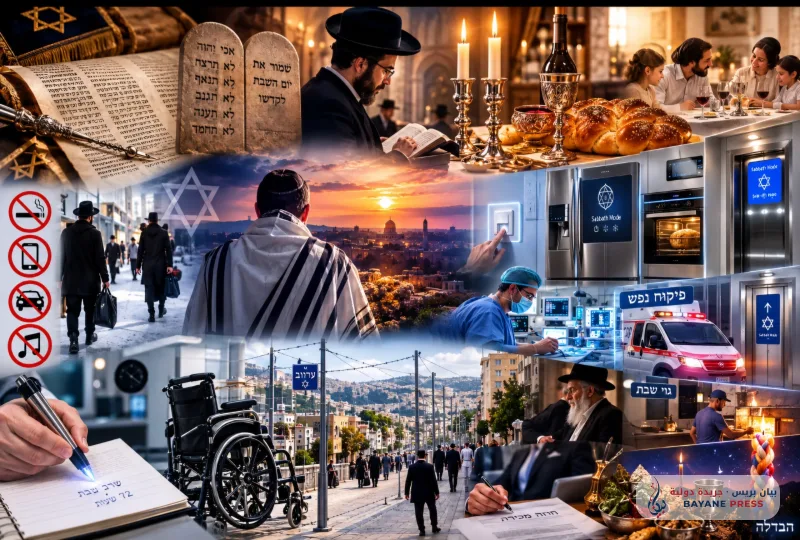
The legislative difference extends to the sacred weekly time; the Torah imposed the Sabbath as a day of rest and sanctification, and prohibited certain works, including kindling a fire, as in the Book of Exodus, chapter 35, verse 3. Other texts established severe penalties for certain forms of violating its sanctity, while rabbinic jurisprudence restricted the execution of criminal penalties with strict evidentiary conditions.
The Mishnah in "Shabbat," chapter 7, paragraph 2, detailed thirty-nine main categories of prohibited work on the Sabbath, including agricultural, industrial, construction, and writing activities, among others. These categories belong to the rabbinic classification of prohibited work, and it is not accurate to present them as a list stated in such detail in the Written Torah.
As for Friday in Islam, it is not a day where work is prohibited throughout the day as is the case with the Sabbath in traditional Jewish jurisprudence; the Quran obligated those for whom Friday prayer is mandatory to leave trade and hasten to the remembrance of God when the call is made, then permitted spreading out in the land and seeking provision after the prayer is concluded, as in Surah Al-Jumu'ah, verses 9 and 10. This reveals a difference in regulating the relationship between devotional time and economic activity.
The comparison deepens when moving to holidays and the calendar; biblical holidays were linked to agricultural seasons in the Levant, in addition to their religious and historical significance. Passover is linked to the spring month of Aviv, as in the Book of Deuteronomy, chapter 16, verse 1, and the Festival of Weeks, known as "Shavuot," is linked to the harvest season, while the Festival of Tabernacles, or "Sukkot," is associated with the ingathering of crops, as mentioned in the texts of the Book of Exodus, chapter 23.
To ensure these holidays occur in their seasons, the Jewish calendar adopted a lunisolar system that includes adding a month in certain years, and its mathematical calendar settled on a nineteen-year cycle that includes seven leap years, in which a month known as Adar II is added. Talmudic tradition addressed issues of adjusting months and years, including discussions in "Sanhedrin" regarding the factors affecting the intercalation of the year before the establishment of the known mathematical system.
Islam adopted the lunar year consisting of twelve months, as in His saying:
"Indeed, the number of months with Allah is twelve [lunar] months" (At-Tawbah: 36)
, followed by the condemnation of Nasi' (intercalation) in verse 37. Researchers have differed in identifying all forms of Nasi' known before Islam, but the Quranic text clearly condemns tampering with the sacred months. It is not correct to say that the two verses necessarily address the Jewish intercalation system, as determining the intended historical practice requires independent research.
As a result of adopting the lunar calendar, Ramadan and Hajj do not remain in one solar season, but their timing shifts across the seasons of the year during successive cycles. Fasting conditions also differ from one country to another depending on geographical location and the length of the day. The lack of connection between Islamic rituals and a specific agricultural season can be viewed as a manifestation of the independence of the devotional calendar, although considering this a deliberate legislation to achieve complete climatic equality among humans remains an interpretive effort, not an explicit text.
Thus, the laws of purity, space, and time reveal complex legislative differences between Judaism and Islam, concerning methods of purification, limits of work, devotional rituals, and religious seasons. In the Islamic conception, many of these rulings are linked to the principle of removing hardship and facilitation, without this implying the absence of wisdom, mercy, and repentance from previous religious traditions. This comparison opens the field for studying the impact of legislation on the details of family, dietary, and financial life, where the rulings of the permissible and the prohibited and the rights of family members appear more directly.

Comments (0)
No comments yet. Be the first to react!