


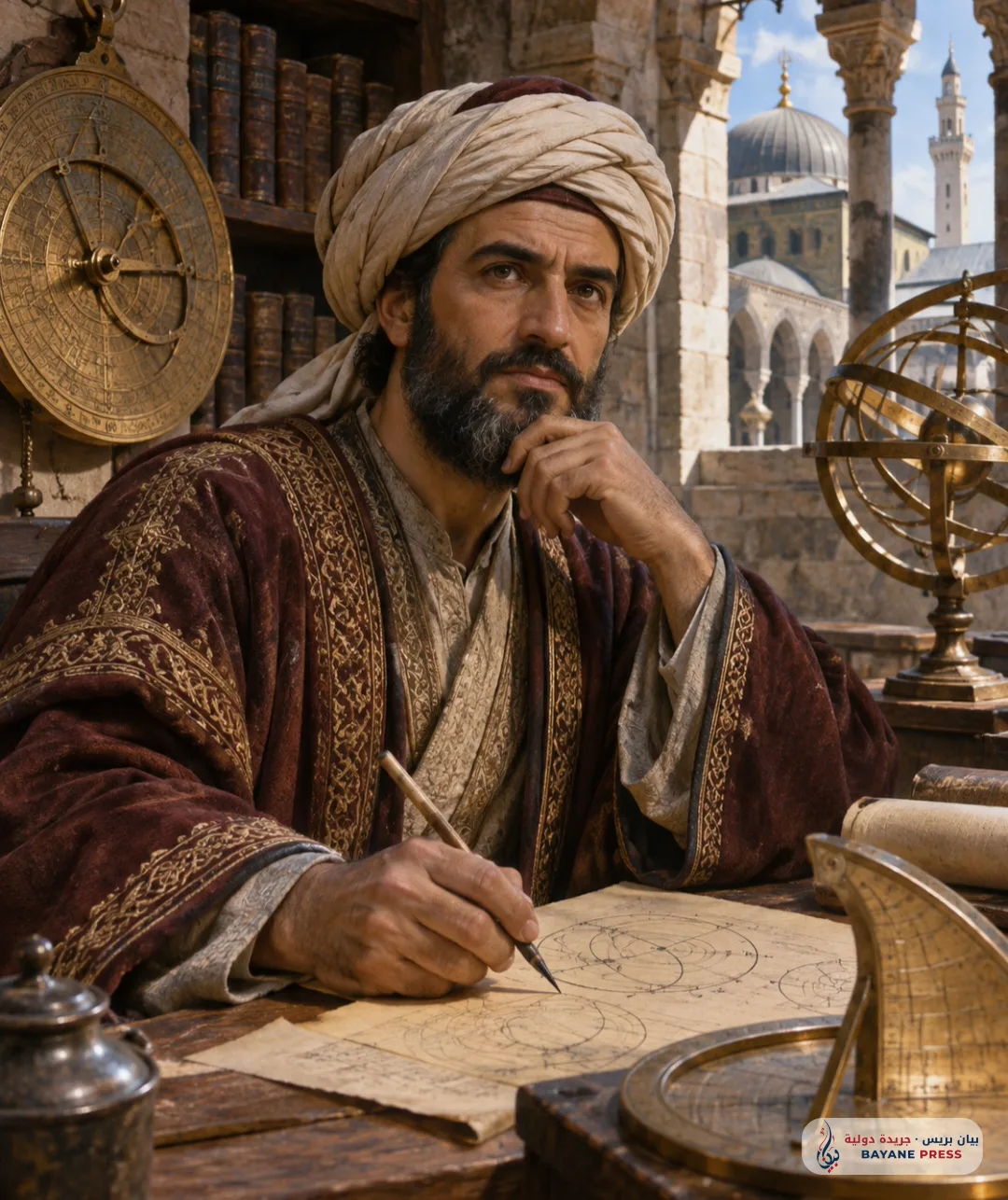
In the corners of ancient libraries, and among the pages of Arabic manuscripts that have remained far from the attention of historians for centuries, lies the story of a Damascene scholar who re-examined the geometry of the heavens long before Europe witnessed its great astronomical revolution. He is Ala' al-Din Ali ibn Ibrahim al-Ansari, known as Ibn al-Shatir, one of the most prominent astronomers of the 14th century AD, whose genius was not limited to observing stars and calculating time, but extended to inventing complex mathematical models for planetary motion, which modern studies have revealed to have a striking similarity to models used by Nicolaus Copernicus about two centuries later.
Ibn al-Shatir was born in Damascus around 1305 AD and grew up an orphan under the care of his relatives, before learning the craft of ivory inlay, which earned him the title "the Inlayer." This precise craft, based on measurement, engraving, and assembling small parts, was a practical school that honed his engineering skills and paved the way for his interest in making astronomical instruments. He was not content with what he learned in Damascus, but traveled to Cairo and Alexandria, where he delved into mathematics and astronomy, and examined the knowledge that occupied the scholars of his time, especially the problems associated with the astronomical system established by Ptolemy, which had dominated the interpretation of celestial motion for many centuries.
Ibn al-Shatir returned to Damascus and took over the position of chief timekeeper at the Umayyad Mosque, a job that requires advanced knowledge of astronomy, arithmetic, and geometry to determine prayer times and phenomena related to the sun's movement. However, the Damascene scholar went beyond the limits of traditional work, transforming timekeeping into a field of innovation, combining mathematical theory and mechanical application in instruments that impressed his contemporaries.
Among his most notable achievements is a massive marble sundial he erected on the Bride Minaret of the Umayyad Mosque in the year 773 AH, corresponding to the years 1371 and 1372 AD. It measured two meters in length and one meter in width, and contained a precise system of geometric lines and curves that allowed for the calculation of hours and prayer times. It was distinguished by the use of a gnomon directed toward the celestial pole, a significant development in the history of sundial making, especially since this type of design was later associated in historical writings with European astronomical developments.
However, the surprise revealed by specialized studies is that the sundial currently on the minaret is not the original one crafted by Ibn al-Shatir's own hands, but a copy made in the late 19th century, while parts of his original instrument were preserved in the National Museum of Damascus, according to the documentation of historian David A. King. Thus, the instrument did not disappear completely, even if its image today does not reflect its original state in the 14th century.
Ibn al-Shatir also made a small instrument known as the "Jewel Box," which measured about 12 centimeters in length and width, and three centimeters in height. It included a sundial and geometric calculations that helped determine the times of Dhuhr and Asr, the meridian line, and the direction of the Qibla. The importance of this tool lies in combining multiple astronomical functions within a small box, reflecting his interest in turning complex calculations into practical tools. He also developed other astronomical instruments, including the astrolabe and the "Universal Instrument," and left behind works that dealt with the construction and use of astronomical quadrants.
One of the rare testimonies to his mechanical skill is the account of the historian Salah al-Din al-Safadi, who visited him in 1343 AD and saw an astronomical instrument mounted on a wall, one of whose parts moved a full cycle in twenty-four hours, displaying different systems for calculating hours. The historical description does not allow for a certain reconstruction of its operating mechanism, but it reveals that Ibn al-Shatir was preoccupied with devices with regular motion, in addition to his interest in mathematical models of the movement of the heavens.
However, the greatest thing he left behind was not a physical machine, but a scientific project to reconstruct astronomical theory. In his book "Nihayat al-Sul fi Tashih al-Usul" (The Final Quest in Correcting the Principles), he presented new models for the sun, moon, and planets, surpassing some of the mathematical complexities in Ptolemy's system, especially the reliance on the "equant" point, which had sparked objections from previous astronomers due to its conflict with the concept of uniform circular motion.
Ibn al-Shatir did not start his revolution from a vacuum; he benefited from the works of the Maragha school scholars, led by Nasir al-Din al-Tusi and Mu'ayyad al-Din al-'Urdi, and then re-developed the geometric tools they used, relying on additional epicycles and precise mathematical structures. His goal was to formulate models that matched observed movements without resorting to some assumptions he believed weakened the geometric consistency of the Ptolemaic theory.
The importance of his achievement was manifested in addressing the motion of the moon; Ptolemy's model led to an exaggerated change in the distance between the Earth and the moon, which required a large change in its apparent size. Ibn al-Shatir addressed this problem by using a geometric structure based on two epicycles, reducing the variation in distances produced by the old model, while maintaining a concept that made the Earth the center of motion. He also provided a distinct treatment for the motion of Mercury, one of the most difficult problems that faced ancient astronomers due to the complexity of its apparent motion.
A study published by researcher Victor Roberts in 1957 in the journal "Isis" reveals the importance of a manuscript copy of "Nihayat al-Sul fi Tashih al-Usul," preserved in the Bodleian Library at the University of Oxford under the number "Marsh 139," which was copied in the year 768 AH, corresponding to the years 1366 and 1367 AD, during Ibn al-Shatir's lifetime. This copy helped reconstruct his lunar model and compare it with later European models, starting a new phase of research into the Damascene scholar's position in the history of global astronomy.
Among the less circulated details is that Ibn al-Shatir's works are not limited to the books that have reached us. Sources have pointed to a book titled "Ta'liq al-Arsad" (Commentary on Observations), in which he discussed his astronomical observations and the procedures he relied on in deriving the mathematical coefficients for his models, but no surviving copy is known. The absence of this work constitutes a significant gap in the study of his methodology, as it could have helped historians understand the precise relationship between his actual observations and his theoretical innovations.
The story becomes even more intriguing with the appearance of a trace of another lost work titled "Nihayat al-Ghayat fi al-A'mal al-Falakiyat" (The Final Limits in Astronomical Works), linked to the name of Prince Saif al-Din Tankiz, the Mamluk Sultanate's deputy in the Levant. An academic study published by researcher Fien De Block in 2021 revealed a manuscript note referring to this book, transmitted by the astronomer Abd al-Aziz al-Wafa'i from a text by the astronomer Shams al-Din Muhammad ibn Abi al-Fath al-Sufi, who mentioned seeing an earlier Zij (astronomical table) by Ibn al-Shatir bearing this title. No surviving copy is known to exist yet, which opens the possibility that a portion of the Damascene scholar's production is still missing.
The "Al-Zij al-Jadid" (The New Astronomical Tables) manuscript, preserved in the Bodleian Library in Oxford under the number "Arch. Seld. A.30," carries another piece of evidence for the continued circulation of Ibn al-Shatir's works after his death. It included marginal notes indicating that Abd al-Aziz al-Wafa'i, one of the timekeeping scholars in Cairo during the 15th century, owned the copy and used it, and recorded a note about it being copied from a draft attributed to Ala' al-Din Ibn al-Shatir. These notes gain special value because they reveal the movement of scientific texts between Damascus and Cairo, and clarify that the manuscript was not just a preserved book, but a practical tool for education, calculation, and gaining scientific status.
Remarkably, some tables in "Al-Zij al-Jadid" adopted the latitude of Damascus, which is about 33.5 degrees, despite being circulated in Cairo. De Block's study suggests that using tables calculated for another city may have played an educational role, as it allowed students to practice recalculating according to different geographical locations. The Zij included trigonometry calculations, calendars, and the positions of celestial bodies, in addition to topics belonging to astrological concepts that were historically intertwined with some branches of mathematical astronomy, without this meaning that Ibn al-Shatir practiced fortune-telling.
His scientific influence did not cease with his passing; rather, the knowledge associated with the Damascus astronomical school continued to move to the scholars of Cairo. Among them was Jamal al-Din al-Maridini, who studied under Ibn al-Shatir, then passed on part of the science of timekeeping to Ibn al-Majdi, one of the leading Egyptian astronomers of the 15th century, who in turn was a teacher to Abd al-Aziz al-Wafa'i. These connections reveal a continuous scientific network, in which knowledge was transferred through direct teaching, books, tables, and instruments, despite the differences in the interests of later scholars compared to Ibn al-Shatir's theoretical interests.
Other manuscript evidence confirms the continued use of his works into later times; the University of Michigan collections hold Arabic texts from his Zij, copied around 1662 AD, and include discussions related to the sighting of the crescent moon. This temporal extension reveals that Ibn al-Shatir's influence did not end with his death in the 14th century, but some of his works continued to be circulated and used for nearly three centuries thereafter.
As for the most controversial chapter, it concerns Copernicus, the Polish scientist who became famous in the 16th century for his heliocentric theory. Academic comparisons have shown that some of his mathematical models, especially those related to the moon and Mercury, are exceptionally similar to Ibn al-Shatir's models, despite the difference in the general cosmic conception of the two scientists. Ibn al-Shatir kept the Earth at the center of his system, while Copernicus made the sun the center of planetary movements in his model.
In a scientific study published by researchers Sajjad Nikfahm-Khubravan and Jamil Ragep in 2019 in the journal "Arabic Sciences and Philosophy" issued by Cambridge University Press, a detailed comparison showed that the Mercury model in Copernicus's book "De revolutionibus orbium coelestium" is almost geometrically identical to Ibn al-Shatir's model. The researchers leaned toward the likelihood that Copernicus had access to the Damascene scholar's models, based on the mathematical similarity and the nature of the adjustments he made to his model at different stages of his work.
The issue goes beyond a mere similarity between geometric drawings; it relates to complex mathematical solutions for specific problems in planetary motion, which makes the hypothesis of knowledge transfer worthy of serious research. Other studies have addressed the roles of scientific intermediaries between the East and Europe, including the Jewish scholar Moses Galeano, whose name has been linked to the transfer of Islamic astronomical knowledge to Italy during the period when Copernicus studied there. However, these clues, while important, do not conclusively prove that Copernicus directly saw a specific manuscript by Ibn al-Shatir, nor are they sufficient to make a historical judgment that he appropriated his works.
The importance of this issue lies in the fact that it reveals that the shift toward modern European astronomy was not an isolated event from previous centuries, but came in a long context of scientific accumulation and knowledge exchange. Copernicus brought about a major shift by reorganizing the cosmic system around the sun, while Ibn al-Shatir, before him, contributed to developing the mathematical tools that could be used to understand celestial movements in new ways. Each has his historical place that should be evaluated according to the nature of his achievement, far from exaggerations or reducing one to the other.
Ibn al-Shatir died in Damascus around 1375 AD, leaving behind a scientific legacy whose evidence is distributed among manuscripts, instruments, and historical references. However, what has reached us may not represent all his works, given the loss of works directly related to his observational methodology and the development of his theories. Hence, the study of Arabic manuscripts preserved in the world's libraries remains a key to a deeper understanding of his status, and perhaps to uncovering new details of his scientific project.
Perhaps the greatest thing revealed by Ibn al-Shatir's biography is not just that he preceded Copernicus in some mathematical solutions, but that he represented an advanced stage of critical scientific thinking within Islamic civilization; a stage that did not just translate and preserve Greek knowledge, but tested its hypotheses, rebuilt its models, and produced original innovations. Thus, his manuscripts were not just papers that survived time, but testimonies to a scientific history whose some links still need investigation, and to a Damascene scholar who was able to leave his mark on the geometry of the heavens centuries before the formation of modern astronomy.


Comments (0)
No comments yet. Be the first to react!