


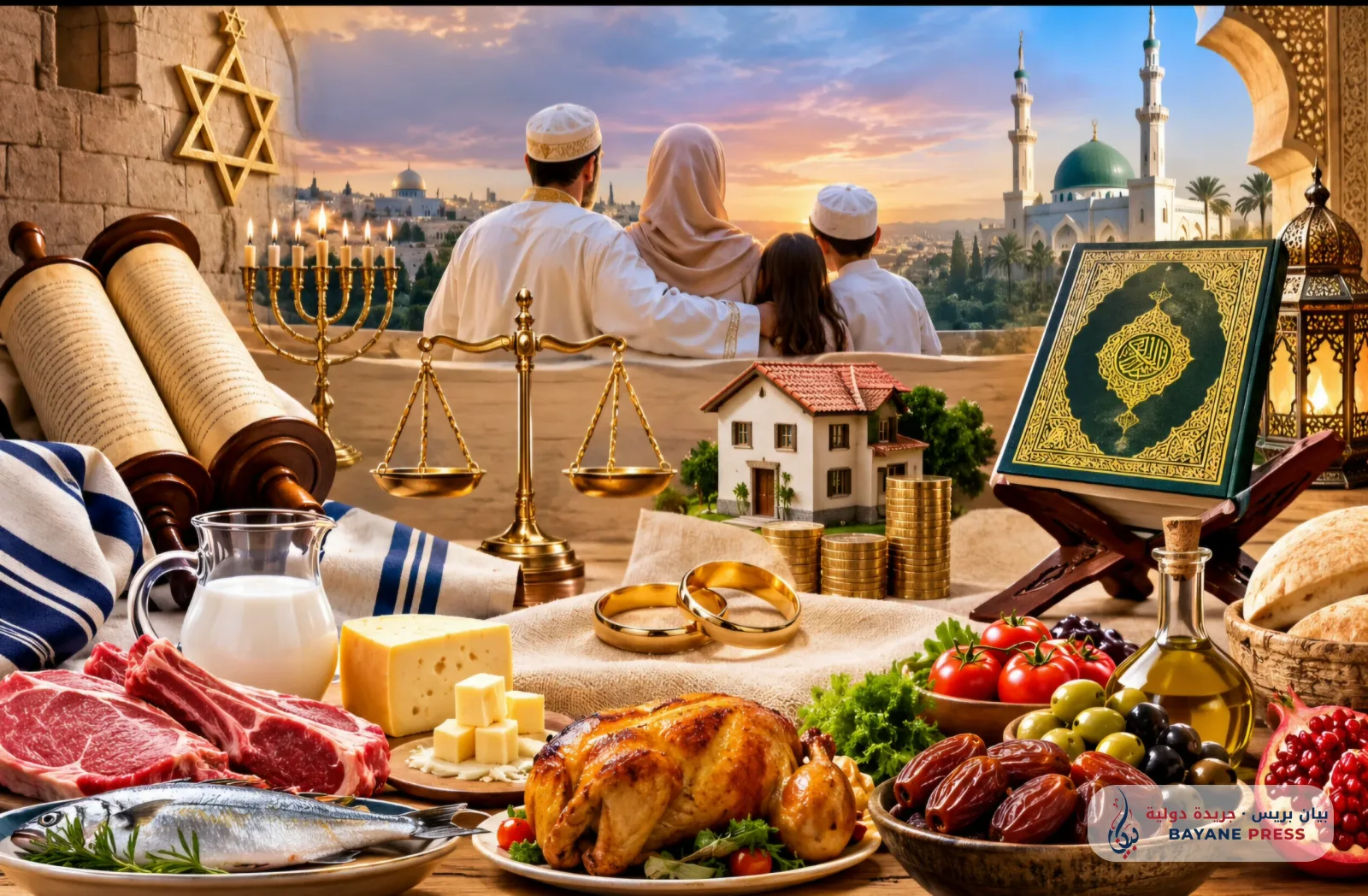
Dietary, marriage, inheritance, and divorce laws reveal the aspects most connected to daily life in religious legislation, as they address what humans eat, how they establish their families, and the rights and obligations resulting from kinship and marriage. Through a comparison between Mosaic Law and Islamic legislation, differences emerge in defining the permissible and the forbidden, and in regulating family relations and financial rights, with a necessary distinction between biblical texts and rabbinic jurisprudence, and between Quranic rulings and Islamic interpretations that addressed the details of their application.
Regarding dietary laws, the Book of Leviticus, chapter eleven, and the Book of Deuteronomy, chapter fourteen, established detailed criteria for permitting the meat of wild animals, most notably the requirement that the animal must both chew the cud and have a split hoof. Based on these conditions, certain types of animals were forbidden in biblical legislation, including camels and rabbits, with other provisions specified for birds and aquatic creatures.
The Torah also included the prohibition of blood and certain types of fat, as in the Book of Leviticus, chapter three, verse seventeen, as well as provisions related to the sciatic nerve linked to the story of Jacob in the Book of Genesis, chapter thirty-two. Rabbinic jurisprudence expanded on explaining these restrictions and defining their limits, until a comprehensive religious dietary system known as the laws of "Kashrut" was formed.
One of the most prominent rules of this system is the separation of meat and dairy, based on the repeated biblical prohibition against boiling a young goat in its mother's milk, as in the Book of Exodus, chapter twenty-three, verse nineteen. Rabbinic traditions interpreted this prohibition in a broader direction that included rules related to cooking meat and dairy, eating them, and benefiting from certain forms of combining them, with details appearing in the Babylonian Talmud, including the "Chullin" tractates.
As for the Holy Quran, it stated that some dietary prohibitions were imposed on the Children of Israel specifically, as in Surah Al-An'am, verse one hundred and forty-six, which addresses the prohibition of every animal with claws and some fats, linking this to their transgression in the Quranic conception. In contrast, Islamic legislation permitted types of food not allowed by traditional Jewish jurisprudence, including camel meat, and did not establish a general prohibition against combining meat and dairy.
The Quran stipulated basic dietary prohibitions, including carrion, blood, swine flesh, and what has been dedicated to other than Allah, as in Surah Al-An'am, verse one hundred and forty-five, with other details in Surah Al-Ma'idah, verse three. The Prophetic Sunnah provided additional rulings, including the prohibition of eating every beast of prey with fangs and every bird with talons, which clarifies that dietary prohibitions in Islamic jurisprudence are not limited to the four categories mentioned in some verses as an exhaustive list.
The Quran also permitted the food of the People of the Book in Surah Al-Ma'idah, verse five, a ruling for which jurists discussed the conditions and applications, especially regarding slaughtered animals, methods of ritual slaughter, and types of food. This reveals the connection of dietary laws to social and religious relations between groups, with continued disagreement among jurists on some details.
From food, the comparison moves to family and inheritance laws, where biblical legislation organized the transfer of wealth within the family according to specific rules. The Book of Numbers, chapter twenty-seven, stipulated the transfer of inheritance to daughters in the absence of male children, and the Book of Deuteronomy, chapter twenty-one, verse seventeen, established a double portion for the firstborn son.
Jewish jurisprudence developed additional rules related to the husband's financial obligations, the wife's rights, daughters' maintenance, marriage contracts, wills, and gifts. One of the most prominent tools for protecting the wife's financial rights is the marriage contract known as the "Ketubah," which regulates specific obligations resulting from marriage and its termination, according to the conditions approved in Jewish jurisprudence.
As for the Quran, it established a detailed system for inheritance and granted women specific shares according to kinship and family structure, as in Surah An-Nisa, verses seven, eleven, and twelve. Verse one hundred and seventy-six set out provisions related to the inheritance of the Kalalah (those who leave no direct descendants or ascendants), especially brothers and sisters covered by that verse, with the necessity of distinguishing between them and the maternal siblings mentioned in verse twelve.
The wife, mother, daughter, and sister have become entitled to a share in the inheritance once the conditions for entitlement are met and its impediments are absent, while observing the rules of exclusion and the order of heirs. It is not permissible to reduce the Islamic inheritance system to the rule that a man inherits twice as much as a woman in all cases; the man's share may increase in some cases, they may be equal in others, and a woman may inherit more than some men depending on the degree of kinship and the heirs present.
Islam also granted women independent financial capacity to own and dispose of property within the provisions of Sharia, while regulating the dowry (Mahr), maintenance, and other financial marital rights. These provisions do not mean that women did not have financial rights in all previous Jewish societies, but rather that the difference relates to the nature of these rights, the rules of wealth transfer, and the sources of legal obligation.
Among the family laws of historical significance is the "Yibbum" system, mentioned in the Book of Deuteronomy, chapter twenty-five, verses five through ten, which relates to the marriage of a deceased man's brother to his brother's widow if he died without offspring, according to specific conditions, with the aim of continuing the deceased's name and lineage within the biblical conception. The same book stipulated an alternative procedure when the marriage is not completed, known as "Halitzah," which involves the removal of a shoe within a specific legal ritual.
It is not lawful for you to inherit women by compulsion.
(An-Nisa: 19)
Islam did not mandate a similar compulsory marriage for the deceased's widow to his brother, but rather subjected marriage to its own independent conditions and rulings, and forbade the compulsion of women and inheriting them in the manner that was known in some social practices, as in the Almighty's saying: (An-Nisa: 19).
Regarding polygamy, the Torah and ancient Jewish jurisprudence recognized the permissibility of polygamy within various restrictions, without a general numerical limit similar to the Islamic limit. Restrictions evolved in some Jewish communities, most notably the ban attributed to Rabbi Gershom ben Judah, which spread among Ashkenazi Jews since about the eleventh century AD, with continued historical debate over the attribution of the decision to him personally.
As for Islam, it restricted polygamy to four wives and linked it to the condition of justice in rights that a human can achieve, as stated in Surah An-Nisa, verse three, which included the command to suffice with one when fearing the inability to be just. Verse one hundred and twenty-nine of the same Surah also indicates the impossibility of complete equality in emotional inclination, while forbidding the inclination that leads to leaving one of the wives suspended without her rights.
Another difference is evident in the regulation of ending the marital relationship; divorce in traditional Jewish jurisprudence was linked to a document known as a "Get," based on the provisions of the Book of Deuteronomy, chapter twenty-four, verse one, and multiple jurisprudential and judicial procedures evolved for it. The husband's refusal to grant this document in some cases formed a legal and social problem that rabbinic authorities addressed throughout the ages.
As for Islamic jurisprudence, it regulated divorce (Talaq), Khul' (divorce initiated by the wife), and judicial separation, with differences among schools of thought regarding the conditions of some of these procedures. Jurists based the rulings of Khul' on Surah Al-Baqarah, verse two hundred and twenty-nine, and on the Prophetic Sunnah, and they also regulated the causes of judicial separation in cases of harm or the impossibility of continuing marital life according to specific conditions.
This comparison indicates that family legislation did not evolve in a single simple path, but rather formed within different religious and social systems, each of which sought to regulate rights and duties according to its conception of marriage, kinship, and financial responsibility. It is not correct to portray women in the Jewish tradition as deprived of all rights, just as it is not permissible to overlook the jurisprudential differences and historical applications known in Islamic societies.
In the Islamic conception, the importance of Quranic rulings appears in determining inheritance shares and regulating polygamy and marital rights, with the continued role of jurisprudence and interpretation in explaining their details. Thus, family, food, and money constitute one of the clearest fields of comparison between religions, before moving to the criminal field, which raises more complex questions about retribution (Qisas), pardon, blood money (Diyah), and the conditions of judicial proof.


Comments (0)
No comments yet. Be the first to react!