

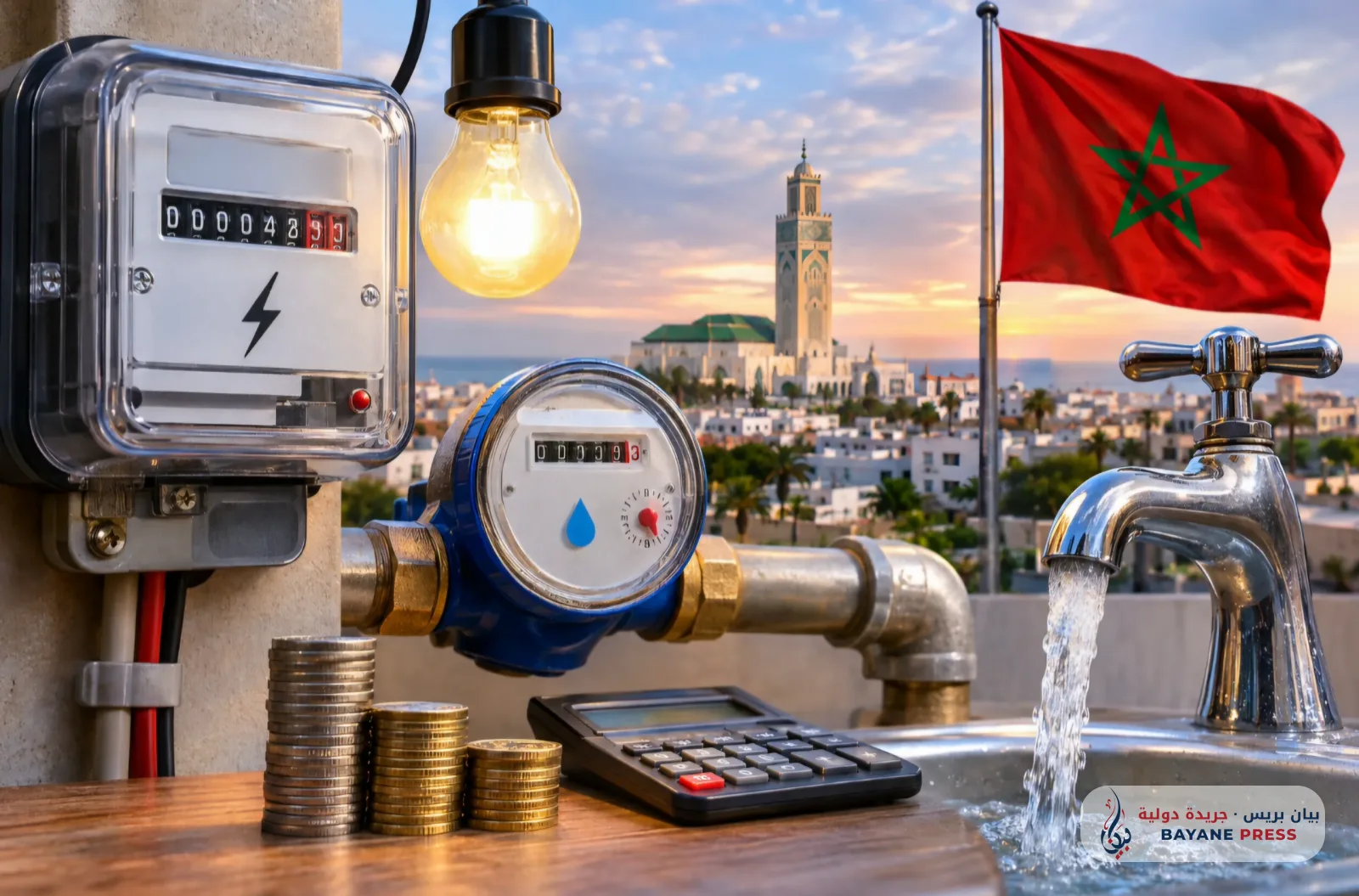
The Moroccan government, led by Fatima Zahra Mansouri of the Authenticity and Modernity Party (PAM), is entering a social and economic test with its announcement to cover household electricity bills that do not exceed one hundred dirhams per month, starting from January 1, 2027. This move aims to strengthen purchasing power and alleviate living burdens for eligible families. However, this measure, which appears on the surface to be a direct social gain, opens a deeper debate regarding the fairness of subsidy distribution, the impact of tax policy on bills, funding sources, and the state's ability to ensure its sustainability, as well as questions regarding the exclusion of drinking water and liquid sanitation from bill coverage, despite these services being linked to the essential expenses of Moroccan households.
The initiative gains its significance from its transition from the electoral pledges of the Authenticity and Modernity Party to the Finance Bill No. 60.26 for the 2027 fiscal year, which was approved by the House of Representatives in a first reading on the evening of Saturday, November 14, 2026, by a majority of 179 deputies against 126 opposing, with no abstentions. Despite the importance of this approval, the measure has not yet entered into force, as it remains linked to completing the legislative procedure and adopting the necessary regulatory and technical arrangements for its implementation.
Government documents indicate the mobilization of a financial envelope of approximately 2.8 billion dirhams, while the Minister of Economy, Finance, and Public Administration, Fouzi Lekjaa, estimated the annual cost at about 2.83 billion dirhams. During the discussion of the Finance Bill before the Finance and Economic Development Committee, he explained that about six million electricity subscriptions record monthly bills not exceeding one hundred dirhams, with an actual average of 56 dirhams. However, government estimates revealed that nearly 29 percent of these subscriptions are linked to vacant or secondary residences, which necessitates their exclusion from eligibility.
Based on these data, the theoretical number of eligible subscriptions drops to about 4.26 million. Multiplying this number by the average bill of 56 dirhams, then by twelve months, yields an approximate cost of about 2.86 billion dirhams, a result close to the government estimate. However, this calculation assumes that the average consumption itself applies to the remaining subscriptions after exclusion and does not represent a final census of the number of beneficiary families or the actual cost of the program.
The announced mechanism is based on the state covering the full value of the monthly electricity bill that does not exceed one hundred dirhams for the primary residences of eligible families, without the need to submit paper applications or travel between administrations. The measure also includes prepaid meters by providing monthly credits to beneficiaries, an aspect of particular importance in rural areas. However, defining social eligibility conditions, how to prove primary residence, and handling exceptional cases remains essential to ensure fair implementation.
The first economic problem arises in the nature of the benefit ceiling; the project does not propose deducting one hundred dirhams from all electricity bills, but rather covering the value of bills that do not exceed that amount. Based on the announced formula, a family whose bill is 99 dirhams could benefit from the state covering its full value, while a family whose bill rises to 101 dirhams might have to pay the entire amount if the implementing rules do not include a transitional system or partial support for bills that exceed the threshold by a limited margin.
This paradox reveals what is economically known as the sharp threshold effect, where a slight change in consumption leads to the loss of a significant financial benefit. Moving from 99 to 101 dirhams could mean the family goes from paying nothing to bearing a full bill, even though the increase in consumption value does not exceed two dirhams. This design could become a source of social disparity between families with similar incomes and basic needs, which calls for studying more flexible mechanisms to determine eligibility.
The sensitivity of this issue increases when the tax system is factored into the calculations. The Value Added Tax (VAT) applied to electricity has seen a gradual increase under the 2024 Finance Act, from 14 percent in 2023, to 16 percent in 2024, then 18 percent in 2025, reaching 20 percent starting January 1, 2026. The tax on electricity meter rental also rose from 7 percent to 11 percent in 2024, then 15 percent in 2025, reaching 20 percent during the current year.
However, it is necessary to distinguish between the increase in the tax rate and the actual increase in the final price of electricity. Circular No. 735 issued by the General Directorate of Taxes, regarding the fiscal provisions of the 2024 Finance Act, stated that the change in tax rates does not, under the adopted transitional measure, affect the electricity sales tariffs regulated by Decree No. 2451.14 issued on July 21, 2014. Therefore, the tax reaching 20 percent does not in itself represent evidence of an automatic increase in the domestic consumption tariff, although it is necessary to monitor other fees and charges included in the bill.
Families whose bills are close to one hundred dirhams remain the most sensitive to any change in consumption or billing elements. If the ceiling remains at its current value in the future, without taking into account changes in electricity costs, a limited increase in some bills could lead to their owners falling out of the eligibility circle. This result does not necessarily mean the cancellation of the program, but rather the possibility of its social coverage gradually declining if the support mechanism is not accompanied by a periodic review of eligibility criteria.
In a legislative development worth following, press reports on November 13, 2026, stated that the Finance and Economic Development Committee of the House of Representatives approved an amendment submitted by the Justice and Development group, which provides for exempting electricity sales intended for domestic use from VAT, without the right to deduct, within the limit of the first 150 kilowatt-hours of monthly consumption per meter. This proposal differs from the state covering electricity bills that do not exceed one hundred dirhams; the former relates to the quantity of energy consumed and its tax system, while the latter relates to the monetary value of the bill. Determining the final impact of this amendment remains contingent on the text adopted after completing the legislative procedure and its official publication, and it cannot be considered an effective exemption before that.
Economically, adopting the proposed tax exemption could reduce the value of some household bills, allowing additional subscriptions to fall below the eligibility threshold, depending on how tariffs and taxes are applied. However, this could expand the base of subsidy beneficiaries, coinciding with a decrease in part of the tax revenues, which requires calculating the net financial impact of both measures together, rather than evaluating each in isolation.
However, the debate is not limited to electricity, but extends to the exclusion of drinking water and liquid sanitation from covering small bills. Government documents related to the 2027 Finance Bill speak explicitly about electricity bills, without approving a similar measure for water. Thus, the beneficiary family remains required to pay the dues for water consumption, liquid sanitation, and the fees associated with them, according to the applicable tariffs.
Here, an important tax detail emerges; the 2024 Finance Act approved the exemption of water distribution operations intended for domestic consumption from VAT, with the right to deduct, starting from January 1 of the same year. The exemption also included liquid sanitation services and water meter rental related to domestic use, according to the specified legal conditions. However, tax exemption does not mean the service is free, as families remain required to pay the value of consumption and the due fees. Thus, a fundamental difference appears between electricity, the tax on whose consumption reached 20 percent in 2026, with the state proposing to cover its small bills starting from 2027, and domestic water, which has been tax-exempt since 2024, without being included in the new measure for covering bills.
The importance of this distinction is evident in that some citizens deal with a single distributor for water, electricity, and liquid sanitation services, and may receive payment demands that include more than one service. However, the unity of the distributor or the means of payment does not mean that all services are covered by the subsidy. If the electricity bill for an eligible family reaches 80 dirhams, and the water and sanitation dues reach 60 dirhams, the state may cover the value of electricity alone, while the sixty dirhams remain due from the family. Also, the total dues reaching 140 dirhams does not constitute, according to the announced ceiling, a reason in itself for exclusion, because the eligibility criterion relates to electricity alone, pending regulatory controls to confirm the practical details of billing.
From the perspective of welfare economics, measuring the social impact of the subsidy should not be limited to the value of the electricity bill covered by the state, but must include the amount of real savings in the family budget after calculating other necessary expenses. A family might achieve monthly savings of 80 dirhams thanks to electricity support, but it remains required to cover the costs of water, housing, food, and transportation. Therefore, the actual economic benefit of the program varies according to income, the number of family members, and the nature of its basic expenses.
Also, a low electricity bill does not always reflect limited financial resources. A well-off person living alone might consume electricity worth less than one hundred dirhams, while the bill of a low-income family with a large number of members exceeds this ceiling due to its daily needs. Low consumption may also be linked to the inability to purchase necessary electrical equipment or use heating and cooling means. Hence, relying on the cash amount alone, without complementary social criteria, could lead to disparity in benefits between the most and least needy families.
Data from the High Commission for Planning reinforces the importance of this analysis; the national survey on household living standards for 2022 and 2023 showed that the share of housing and energy expenses combined in the household budget rose from 23 percent in 2014 to 25.4 percent in 2022. These figures do not represent electricity expenses alone, but they reflect the increasing weight of burdens related to housing and energy within family spending, and highlight the importance of directing support to the groups most affected by the costs of basic services.
As for public finance, allocating 2.83 billion dirhams annually represents a commitment that can be included in the budget, but it is not isolated from the state's other social and investment expenditures. The 2027 Finance Bill is based on a hypothesis of economic growth of 3.7 percent, which are government expectations and not achieved results, at a time when the requirements for funding health, education, social protection, and infrastructure continue.
The financial sensitivity of the program can be tested by adopting hypothetical scenarios. If the average value of subsidized bills increases by 10 percent, with the number of beneficiaries remaining constant and all their bills continuing to fall within the ceiling, the annual cost could theoretically rise from 2.83 to about 3.11 billion dirhams. If the increase reaches 20 percent, it could reach nearly 3.40 billion dirhams. However, these calculations are not government forecasts, and they are also conditional on the continued eligibility of all beneficiaries; as some bills exceeding the one-hundred-dirham threshold could lead to a decrease in the program's cost to the state, as a result of their owners leaving the support circle.
The importance of financial sustainability increases given Morocco's exposure to the prices of imported energy sources and the costs of electricity production, transmission, and distribution, in addition to the necessary investments to modernize networks and expand renewable energies. Free bills do not mean the economic cost of electricity disappears, but rather the transfer of the payment burden from the eligible family to the general budget, which makes the program one of the tools for redistributing public resources.
The Authenticity and Modernity Party had proposed in its electoral program a marginal solidarity contribution of 12 percent on the portion of electricity consumption exceeding 200 kilowatt-hours per month, to help fund the free small bills. However, the inclusion of this measure in the party program does not mean it has entered into force, and it should not be confused with the applicable VAT. Also, adopting such a contribution, if decided legislatively, requires taking into account the situations of large families and cases where consumption rises for necessary reasons not related to luxury.
The implementation mechanism poses administrative and technical challenges related to identifying primary residences and excluding secondary and vacant residences, and ensuring the benefit of families whose names of occupants do not match the owners of the meters, in addition to addressing bills based on estimated readings or shared between more than one family. It is also necessary to clarify how to deal with consumption fluctuations between seasons, and whether the benefit returns automatically when the bill drops again to one hundred dirhams or less, while providing a clear mechanism for objecting to billing or exclusion errors.
In light of these challenges, graduated support emerges as one of the possible economic alternatives, whereby the state covers the full value of small bills, then the amount of support decreases gradually when exceeding the ceiling, instead of losing it all at once. It is also possible to study adopting a basic subsidized quantity of electricity measured in kilowatt-hours, and linking part of the eligibility to the number of family members and their social status. However, these alternatives need accurate data and financial simulation before adoption, because they could expand the base of beneficiaries and raise the total cost.
As for the possibility of the free small electricity bills turning into a temporary measure after which families return to paying, there is no announced government plan in the available documents that provides for its cancellation after one year. Conversely, there is no legal guarantee yet for funding it indefinitely or automatically reviewing the benefit ceiling when prices change. Therefore, its continuation will remain linked to the final legislative framework and future financial allocations and government choices, without this possibility constituting evidence of a prior intention to backtrack on it.
Hence, the real test of the program will not be in the number of bills the state covers during the first months of 2027 alone, but in its ability to maintain the scope of benefit and fairness of distribution during the following years. This requires publishing periodic data on the number of families actually benefiting, the average value of the support, cases of exclusion due to exceeding the ceiling, and the geographical and social distribution of beneficiaries, in addition to measuring the impact on purchasing power and the total basic expenses of families.
Therefore, the project of the state covering the value of small electricity bills represents a social measure that is applicable in principle, and is supported by official financial estimates, but it faces challenges related to the sensitivity of the monetary ceiling, the fairness of targeting, the overlap of tax policy with direct support, and the sustainability of funding. Also, limiting it to electricity without water remains a subject worthy of economic and social debate, especially since both services represent basic needs, even if their costs, pricing mechanisms, and considerations related to rationalizing their consumption differ.
The real stake is not only in the state covering the value of the electricity bill that does not exceed one hundred dirhams per month starting from January 2027, but in ensuring that its rise to 101 dirhams does not become a potential reason for losing the entire support, and that changes in prices in the future do not lead to a shrinking number of beneficiaries without taking an explicit decision to cancel the program. Between the existing tax, proposed exemptions, and support funded from the general budget, the fundamental economic question remains the extent of the government's ability to transform free small bills from a measure linked to a fixed financial ceiling into a fair and sustainable social protection mechanism that preserves the purchasing power of families without disrupting financial balances or the requirements for rationalizing energy and water consumption.

Comments (0)
No comments yet. Be the first to react!