


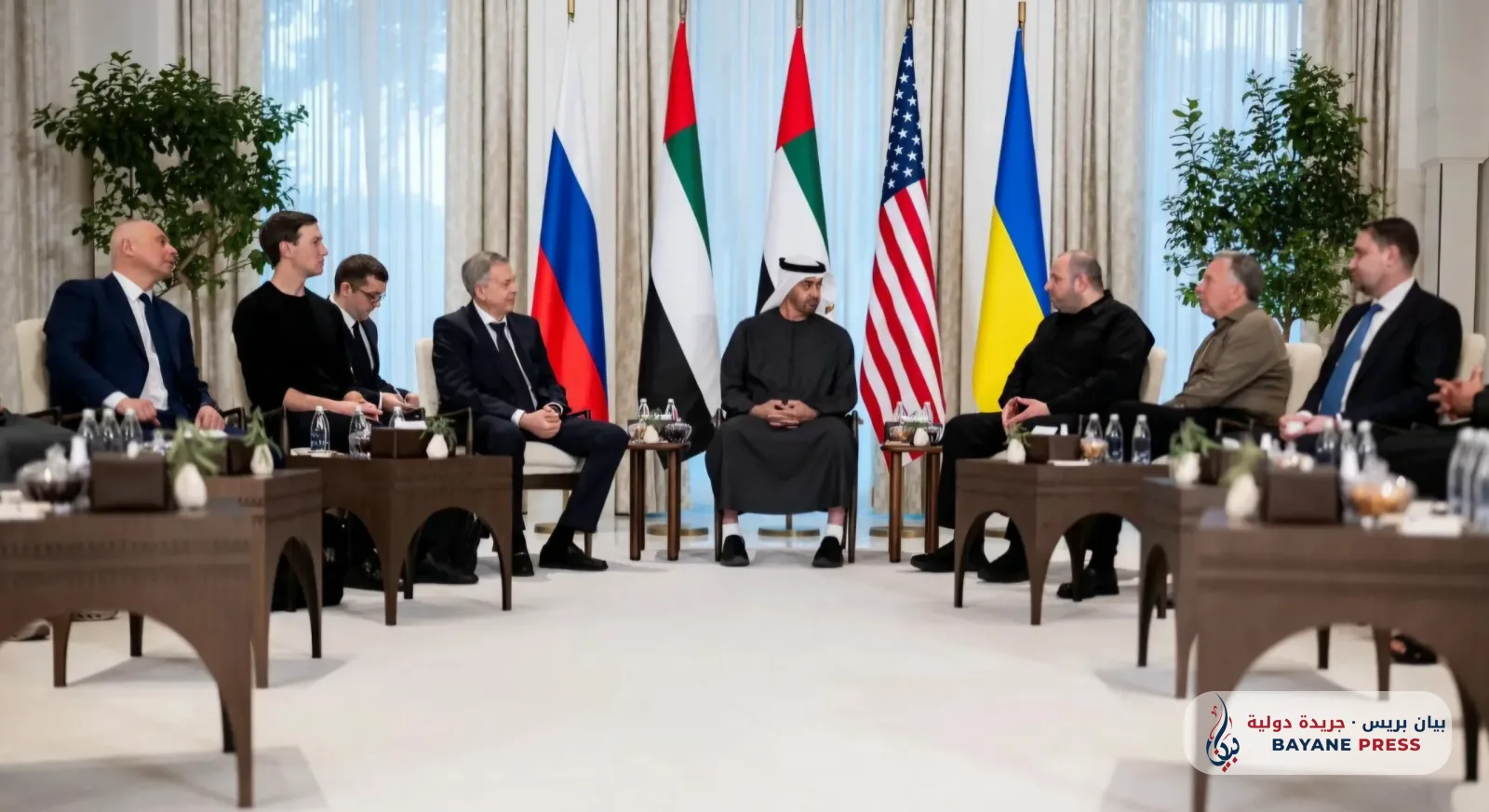
The Emirati capital, Abu Dhabi, became a pivotal diplomatic hub on Tuesday, November 10, 2026, in the search for a settlement to the Russia-Ukraine war. The city hosted high-level delegations from the United States, Russia, and Ukraine for a new round of negotiations, during which Washington seeks to bridge the gap between Moscow and Kyiv and pave the way for understandings that could end a conflict that has drained resources and lives, while casting its repercussions on international security and the global economy.
This two-day round comes after the suspension of trilateral negotiations since last February, amid persistent disagreements over occupied territories, security guarantees, and the future of relations between Russia, Ukraine, and the West. The US delegation is led by envoy Steve Witkoff and Jared Kushner, while the Russian side is represented by a delegation headed by Vladimir Medinsky, and the Ukrainian delegation is led by Rustem Umerov, in an attempt to reshape a common negotiating ground despite the significant distance between the parties' positions.
The negotiations place the issue of security guarantees at the forefront of the agenda, alongside de-escalation measures, humanitarian arrangements, and the possibility of expanding prisoner exchange operations. Ukraine insists on the necessity of a ceasefire and obtaining guarantees to prevent the renewal of Russian attacks, while Moscow insists on addressing regional and security issues according to its own terms, making the achievement of a comprehensive agreement a complex task that requires concessions whose outlines have yet to emerge.
The meetings are taking place at a time when military operations have not ceased, as Russian and Ukrainian forces continue to exchange drone and missile attacks, reflecting the gap between political efforts and the reality on the ground. European countries are also following these talks with interest, fearing that any new arrangements might lead to broad changes in the European security architecture without sufficient consensus.
For the UAE, hosting these negotiations reflects the growing role of Abu Dhabi as a space for dialogue between parties divided by deep international disputes. However, the political significance of this round will remain linked to the actual progress it can achieve, as bringing adversaries to the same table represents the beginning of a diplomatic path, but does not in itself constitute a guarantee for the end of the war.



Comments (0)
No comments yet. Be the first to react!