


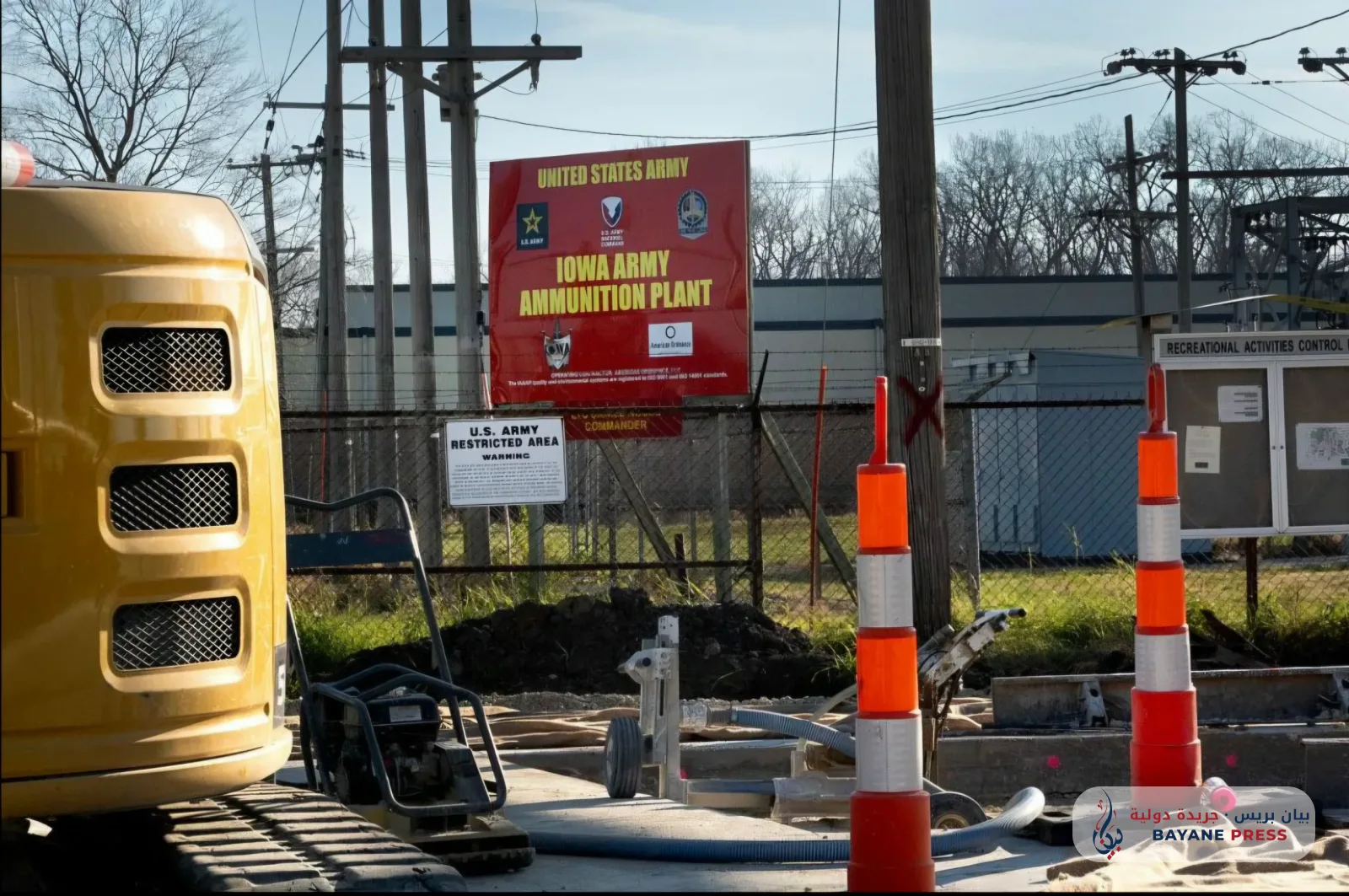
The United States is facing an unprecedented environmental and legal crisis in the state of Iowa, following the U.S. Army's announcement of its intention to detonate approximately four and a half tons of a highly explosive chemical containing toxic lead, despite a federal appeals court ruling freezing the operation's environmental permit, amid warnings of potential polluted dust spreading over wide residential and agricultural areas, and mounting questions regarding how an aging military stockpile transformed into a threat to residents and the environment.
Court documents and reports published by Reuters and Iowa Public Radio revealed that the operation aims to dispose of 68 barrels containing a chemical substance known scientifically as Lead Azide, stored inside two fortified, earth-covered structures at the U.S. Army ammunition plant in Middletown, southeastern Iowa, near the city of Burlington.
The quantity specified in the litigation documents is 9,773.5 pounds, equivalent to about 4.43 metric tons, or roughly five tons according to the American system of measurement, making the anticipated operation one of the most environmentally controversial explosive disposal operations in the region in recent times.
This is not a matter of a normal stockpile of conventional ammunition, but rather a highly sensitive chemical compound used in the manufacturing of military detonators and explosives, characterized by its ability to detonate when exposed to shock or friction. The danger of the substance increases when its chemical properties deteriorate due to prolonged storage, particularly with the formation of crystals that can become more vulnerable to external factors.
The origins of the current crisis trace back to March 2026, when plant management discovered that the barrels stored for more than twenty years had suffered severe deterioration after the substance inside began to recrystallize, a transformation explosive experts considered a potential threat to the safety of the facility and surrounding areas.
Inspections conducted by Army teams during April showed that the majority of the barrels exhibited signs of crystallization, with military statements indicating this phenomenon affected 58 out of 68 barrels, heightening fears over the danger of moving the containers, opening them, or transferring their contents to another location.
According to the military assessment, low temperatures could increase risks, after meteorological services forecasted temperatures dropping below 30 degrees Fahrenheit, or about one degree Celsius below zero, in the coming days. The military fears that thermal changes could cause the crystals formed inside the containers to crack, potentially leading to an uncontrolled explosion.
Preparations for the detonation further complicated the situation after a filing submitted by the Department of Justice to the court revealed that the protective doors of some bunkers were removed in preparation for the operation, and that reinstalling them has become impossible under current circumstances, leaving the materials more exposed to temperature fluctuations, according to the military assessment.
Faced with these facts, the Army decided to dispose of the stockpile via two controlled detonations at the storage site itself, to avoid risks associated with transporting the material or removing it from its containers. The first date was set for Friday, November 20, before being postponed to Monday, November 23, as a result of objections from local residents and officials, followed by the Department of Justice announcing that the Army intends to carry out the operation no later than Tuesday, November 24.
However, the decision triggered a legal confrontation after the organizations "Iowa Environmental Council" and the state's "Sierra Club" filed a challenge against the exceptional permit granted by the U.S. Environmental Protection Agency to the Army on November 13.
The two organizations argued that the authorities did not provide sufficient guarantees to protect the population from potential pollution, that the assessment of less dangerous alternatives was not as comprehensive as required, and pointed to delays in notifying communities that could be affected by the dust cloud resulting from the detonation.
On November 20, the U.S. Court of Appeals for the Eighth Circuit decided to temporarily suspend the environmental permit pending consideration of the legal motion regarding the operation. The decision was not a final ruling on the legality of the detonation, but rather a temporary judicial measure that halted the effect of the permit authorities intended to rely upon.
However, the most dramatic development occurred when the U.S. Department of Justice informed the court, in a memo dated November 21, that the Army intends to use a legal exemption specific to emergency situations involving ammunition and explosives, which allows, according to the government's interpretation, handling the risk of an imminent explosion without the need for the environmental permit that had been suspended.
The ministry relied on the provisions of the Resource Conservation and Recovery Act, commonly known as RCRA, arguing that the direct danger to lives, property, and the environment justifies urgent action, and that suspending the permit does not legally prevent the military response to the emergency.
Authorities emphasize that the planned detonation, despite its potential environmental risks, remains less hazardous than an accidental explosion that could scatter unexploded ordnance into surrounding areas, making rescue and cleanup operations much more complex.
Conversely, environmental organizations believe that resorting to the emergency exemption raises serious legal issues, especially since the Army had known about the material's deterioration for months and had time to study alternative methods for its disposal.
An investigation covered by Iowa Public Radio and originating from The New York Times revealed that the U.S. Army had signed a contract last March with "MuniRem Environmental," a company specializing in the chemical treatment of hazardous materials, aimed at neutralizing the contents of the barrels without the need to detonate them.
However, the contract was canceled about two months later, even though the company had presented its technology to a panel of military experts. Correspondence reviewed by the newspaper showed that the cancellation was not related to any technical shortcomings in the company's proposal.
This revelation raised questions about the real reasons that prompted authorities to abandon the chemical treatment option, before later announcing that detonation had become the safest solution.
Official bodies responded that chemical treatment would have required direct handling of the barrels, opening them, and conducting operations lasting between seven days and 22 days, which could expose workers to the risk of accidental explosion, especially given the unstable state the material had reached.
The EPA emphasized, in a letter sent by its Region 7 Administrator Jim Macy to Iowa Governor Kim Reynolds, that experts from the Army, the FBI, and the ATF concluded that merely moving the barrels or removing their lids could be dangerous.
Authorities also studied other alternatives, including moving the materials to an explosives disposal site within the facility, building protective structures around the storage location, or continuing to keep them under surveillance, but deemed these options unacceptable from a safety standpoint.
The primary environmental concerns lie in the fact that the detonation of lead azide may release microparticles containing lead, which is a toxic metal capable of accumulating in the environment and the human body.
The danger of exposure to these particles is heightened in children and pregnant women, as lead can affect nervous system development and cognitive abilities in children, and high exposure to it is linked to serious health complications.
Environmental organizations warned of the potential for polluted dust to travel a distance of up to 100 miles, or about 160 kilometers, according to certain meteorological scenarios relied upon in their legal challenge. However, this distance represents an estimation of potential spread, rather than proof that actual pollution occurred or that particles reached all areas within this range.
The nature of the risk depends on the amount of material that may be released during the detonation, wind direction and speed, weather conditions, and the effectiveness of dust containment measures.
Independent experts also raised concerns about the potential emission of other toxic chemical compounds, including hydrazoic acid, demanding a broader assessment of all potential explosion byproducts rather than limiting measurements to lead particles alone.
Concern also spread to Iowa City, after City Manager Jeff Fruin warned that a lack of information regarding the potential dust trajectory could complicate preparations to protect water sources, including the Iowa River, upon which the city relies for a large portion of its water supply.
Objections were not limited to environmental groups, but extended to officials and elected representatives in Iowa and Illinois, where lawmakers and senators demanded the operation be delayed and additional guarantees provided regarding its health and environmental impacts.
The Governor of Iowa announced the activation of the state's Emergency Operations Center to coordinate preparations, while health authorities issued guidelines to residents regarding minimizing exposure to outdoor air in areas that might be affected by dust, closing windows and doors, and following official maps and directives.
Initial protection plans included the precautionary evacuation of some areas near the plant, alongside monitoring air, soil, and water before and after the detonation to detect any rise in pollution levels.
For its part, the Army clarified that it intends to erect sand-filled barriers approximately two stories high around the storage sites, use water sprays to reduce dust dispersion, and choose weather conditions as favorable as possible to minimize the spread of particles.
Military authorities also pledged to conduct environmental measurements and collect samples before, during, and after the operation, carrying out cleanup and remediation work if results reveal pollution requiring intervention.
However, these guarantees failed to dispel the concerns of residents and environmental organizations, particularly with ongoing questions regarding the delay in announcing the details of the operation, and the failure to fully explain the reasons that led to the accumulation of these hazardous materials over the years without disposing of them before they reached their current state of deterioration.
The case reveals a problem that goes beyond the borders of a single military plant, concerning how legacy explosive materials are managed within defense facilities, and the limits of extraordinary authorities military institutions can use when urgent intervention requirements conflict with environmental and judicial oversight procedures.
As of the latest information available when preparing this report, the detonation had not been proven to have taken place, while the Army remained committed to completing the operation by November 24, 2026, relying on its assessment that the risk of an uncontrolled explosion increases as the cold wave approaches.
Between the military institution's assertion of the necessity of urgent intervention, and environmental organizations' insistence on ensuring transparency and accountability, the most sensitive questions remain hanging: Why was a highly dangerous stockpile left to deteriorate all these years? Why was the chemical treatment contract canceled? And will containment measures be sufficient to protect residents from pollution?
These are questions tied not only to the fate of 68 barrels of explosives, but to the level of institutional responsibility in handling military risks when they turn into a potential threat to public health and the environment.



Comments (0)
No comments yet. Be the first to react!