

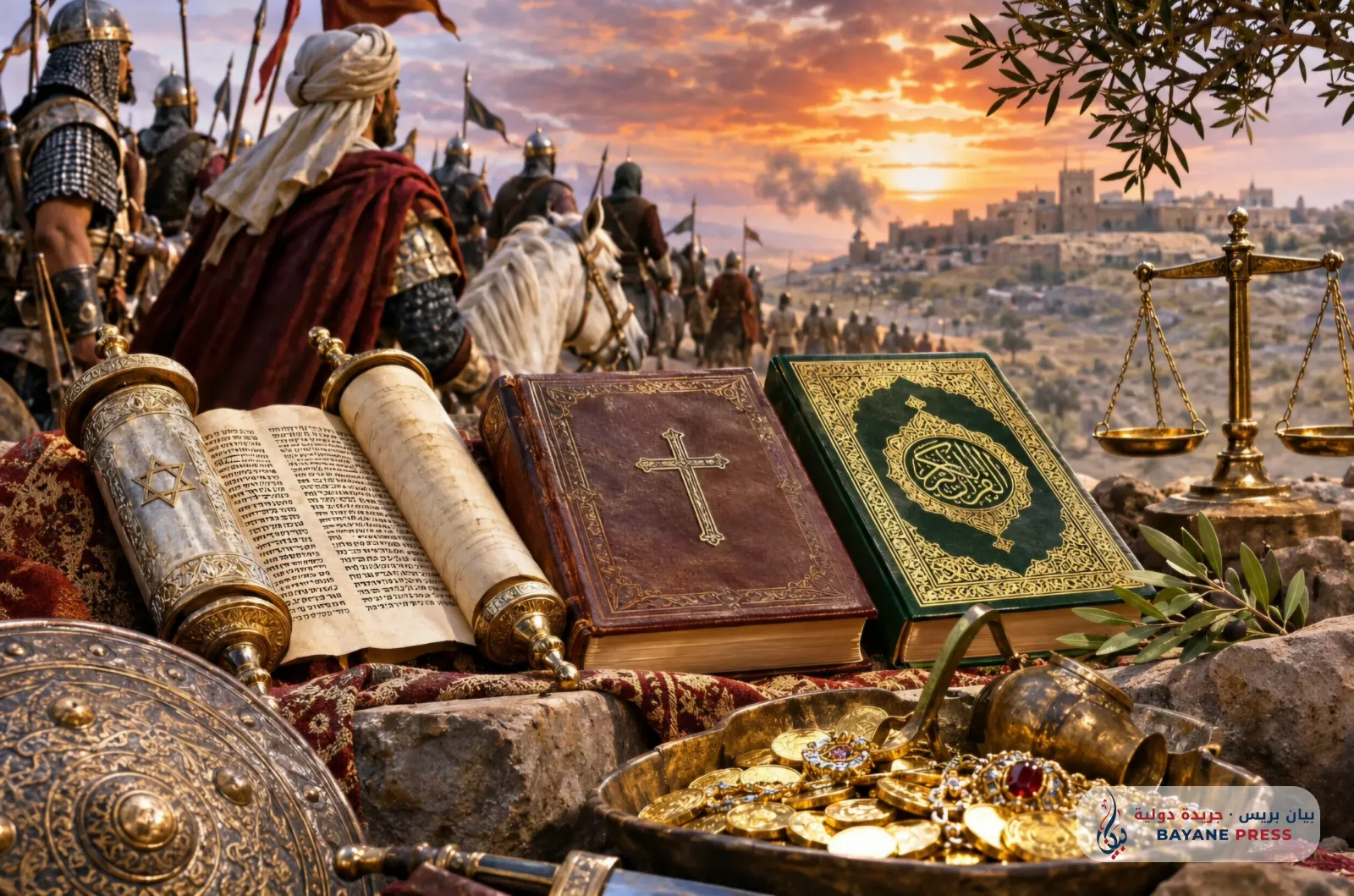
The comparison between Mosaic law and Muhammadan law reaches one of its most sensitive stages when addressing the rules of war, peace, and spoils, as religious texts in this field relate to issues that transcend the individual to the community and the state. These include the legitimacy of using force, the protection of non-combatants, the treatment of prisoners, the regulation of property and spoils, and the limits of pardon and reconciliation. Through the study of biblical texts, rabbinic interpretations, the Quran, the Sunnah, and Islamic jurisprudence, significant legislative and historical differences become clear, while emphasizing the need to avoid confusing rules specific to ancient events with the general principles developed by jurists throughout the ages.
The Book of Deuteronomy, chapter twenty, addressed the rules of war in various contexts, distinguishing between distant cities that are offered terms of peace before fighting, and specific rules for the peoples mentioned in the texts within the land of Canaan. Some of these texts included severe commands for destruction in specific military and religious contexts, as in the Book of Joshua, chapter six, concerning the city of Jericho, and the First Book of Samuel, chapter fifteen, concerning the war against the Amalekites.
Associated with these rules is the concept of "Herem," a Hebrew term related to religious ban or dedication, which in some contexts may include the destruction of persons or objects or the prohibition of using certain properties. However, the meaning of Herem and its applications are not identical in all biblical texts; therefore, it is not correct to consider it a single rule applicable to every war or spoil in the history of the Children of Israel.
Later Jewish jurisprudence distinguished between types of wars, including what is known as "Milhemet Mitzvah," meaning a mandatory war, and "Milhemet Reshut," meaning an optional or authorized war according to its conditions. Jewish jurists addressed these classifications in light of Torah texts and traditions of interpretation, with differences in defining the cases that fall under each type.
Among the most important jurisprudential texts in this field is what Maimonides stated in the "Mishneh Torah," within the "Laws of Kings and Wars," chapter six, where he established the necessity of offering peace before war, whether it is mandatory or optional. However, this peace, according to his conception, is conditional upon accepting specific obligations, including political submission, payment of imposed taxes, and acceptance of the seven commandments attributed to the sons of Noah.
This requires distinguishing between the concept of offering peace in Maimonides' jurisprudence and the modern conception of peace based on legal equality between states. The peace he regulated was part of a historical political and military system, linked to conditions of sovereignty and obligations imposed on the other party, and does not mean mere mutual abstention from fighting without conditions.
The Torah also included rules related to limiting destruction during war, including the prohibition against cutting down fruit-bearing trees when besieging cities, as in the Book of Deuteronomy, chapter twenty, verses nineteen and twenty. This rule evolved in Jewish jurisprudence within broader discussions regarding the prevention of unjustified destruction, which indicates that biblical war texts cannot be reduced to the orders of destruction mentioned in certain events.
Nevertheless, the texts related to the wars of Canaan and Amalek remain among the topics that have raised ethical and historical questions among researchers and commentators, especially regarding the nature of the rules contained therein and the limits of their application. Different Jewish schools have dealt with them as being linked to specific historical contexts or conditions that do not exist in later reality, while some jurists discussed their theoretical implications within the traditional classification of wars.
As for the Holy Quran, it addressed fighting in various contexts and established rules for it related to its causes, limits, covenants, and safety. Among the foundational texts in this field is the Almighty's saying:
﴿Fight in the way of Allah those who fight you but do not transgress. Indeed. Allah does not like transgressors.﴾ (Al-Baqarah: 190).
Muslim scholars have used this verse as evidence for the prohibition of aggression in fighting, while differing in the interpretation of some of its rules and its relationship to other verses that addressed war and peace. Therefore, it is not correct to consider this verse alone as a text encompassing all war rules in Islamic jurisprudence, but rather it should be read within the collection of Quranic texts, the Prophetic Sunnah, and the ijtihad (legal reasoning) of scholars.
It is stated in Sahih al-Bukhari the Prophetic prohibition against killing women and children in war. The Sunnah also included texts related to safety, fulfilling covenants, the prohibition of treachery, and rules for treating prisoners and protecting those who do not participate in fighting. Jurists also addressed the rules for the elderly, monks, laborers, and others, while differing on some forms of protection depending on participation in fighting or direct military contribution.
Among the rules that Islamic jurisprudence also discussed is the protection of property and natural resources during war. There are directives in the Islamic tradition that prohibit corruption and the destruction of crops, fruits, and animals without a valid justification, with jurisprudential disagreement on some forms of destruction required by military necessity. Jurists also discussed issues of siege, cutting down trees, and destroying property, and their positions did not coincide in all circumstances.
Therefore, talking about environmental protection in Islamic legislation should distinguish between the moral principle that rejects corruption and the detailed jurisprudential rules that may permit some actions when a valid necessity is met. It is also necessary to avoid projecting modern legal concepts onto all forms of historical fighting without considering the differences in institutions, circumstances, and military tools.
Regarding spoils, legislative differences appear related to the nature of benefiting from property that falls into the hands of the victors after the war. Some biblical events included special rules prohibiting the use of certain spoils or destroying them, as in the story of Jericho mentioned in the Book of Joshua, chapter six, and some rules related to the war against Amalek in the First Book of Samuel, chapter fifteen.
However, these rules do not mean that all spoils were forbidden to the Children of Israel in all wars; the Torah included other texts that regulate the acquisition and division of spoils. Therefore, it is more accurate to distinguish between the events linked to Herem and other rules related to money and property in biblical wars.
As for Islam, it permitted benefiting from spoils according to specific rules and regulated the distribution of one-fifth of them and its expenditures in Surah Al-Anfal, verse forty-one, which included categories of those entitled to it according to the interpretation of jurists. It is stated in the authentic Hadith that spoils were made lawful for the Prophet Muhammad, peace be upon him, and his nation, in the context of talking about the characteristics of his message.
Islamic jurisprudence discussed the details of spoils, fay' (booty acquired without fighting), expenditures of funds, and the rights attached to them, while distinguishing between types of property and their rules. It is not correct to overlook this detail or consider every asset obtained by the army during war as a legitimate spoil absolutely, because the rules differ according to the source of the money, the method of obtaining it, and the existing covenants.
In addition to spoils, Islamic jurisprudence regulated issues of safety, truce, reconciliation, and covenants, and discussed the rules of the Dhimmi (protected non-Muslims) and the Musta'min (those granted safety) and others within the political and legal systems known to Islamic states historically. The details of these rules differed according to the schools of thought and circumstances, and they cannot be automatically equated with the concepts of citizenship, sovereignty, and international law in the modern era.
This comparison reveals that the rules of war in the Abrahamic religions cannot be understood by cutting out severe texts or selecting tolerant rules in isolation from their contexts. The Torah includes harsh war rules in certain events, but it also includes restrictions related to peace and the prevention of some forms of destruction. The Quran also establishes the prohibition of aggression, and the Sunnah contains rules for protecting non-combatants and fulfilling covenants, while Islamic jurisprudence includes various details on issues of war, peace, captivity, and spoils.
Hence, the importance of separating the foundational text, jurisprudential interpretation, and historical application emerges, because the existence of a rule in an ancient code does not necessarily mean that it remained applied in every era, just as the occurrence of a military practice in the name of religion does not necessarily make it consistent with all its rules.
If the comparison expands to include the philosophy of legislation and its objectives, the concept of mercy emerges as one of the major principles in the Holy Quran, where the Almighty says:
﴿And We have not sent you, [O Muhammad], except as a mercy to the worlds.﴾ (Al-Anbiya: 107), and He decides the removal of hardship by saying: ﴿and has not placed upon you in the religion any difficulty.﴾ (Al-Hajj: 78), as He confirms the desire for ease by saying: ﴿Allah intends for you ease and does not intend for you hardship.﴾ (Al-Baqarah: 185).
Scholars of the objectives of Sharia (Maqasid) have relied on these texts and others in building an integrated vision for protecting the basic interests of man, foremost among them the preservation of religion, life, intellect, lineage, and property. Al-Shatibi contributed in "Al-Muwafaqat" to the development of objective research, while contemporary studies addressed issues of human dignity, freedom, justice, and public interest in light of the development of methods of ijtihad.
Nevertheless, mercy, justice, and benevolence are not values absent from Judaism or Christianity; the Torah and the texts of the prophets included calls to protect the poor, the stranger, and the weak, just as love and forgiveness occupy a central place in Christian teachings. The difference between the laws appears in the regulation of rules, their sources, the limits of their application, and the relationship between religious authority and human responsibility.
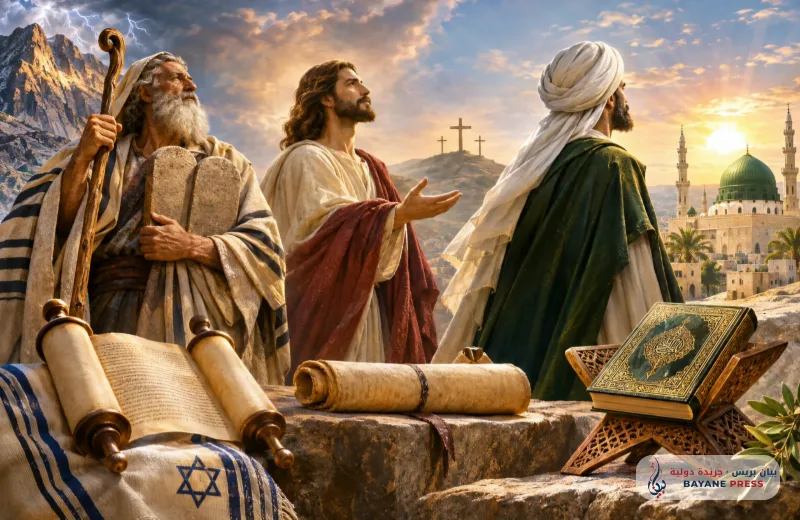
Through the topics covered in this series, it becomes clear that the history of legislation between Moses and Muhammad, peace be upon them, does not represent a mere transition from one set of commands to another, but reveals a profound difference in the concept of the continuity of divine rule, the limits of the authority of interpretation, the relationship of the text to reality, and the status of man in the religious system.
In Rabbinic Judaism, the doctrinal structure is based on the permanence of the law of Moses with a wide development in the interpretation of its rules and applications. In Christianity, multiple theological conceptions developed regarding the relationship of Christ to the Mosaic Law and the extent to which believers are bound by its rules. As for Islam, it affirms the unity of the divine origin of the messages, with the possibility of differences in laws and the abrogation of some of their rules, and sees in the Muhammadan message the conclusion of prophetic legislation.
In the Islamic conception, the difference in laws does not indicate a contradiction in divine knowledge or a change in wisdom, but is linked to the revelation of rules to nations and times according to what is determined by revelation. Also, the completion of legislation does not mean the cessation of human ijtihad in understanding and applying texts, but rather means the end of prophetic legislative revelation, with the continuation of jurisprudential research into renewed events according to its principles and controls.
The Holy Quran established this meaning in the Almighty's saying:
﴿This day I have perfected for you your religion and completed My favor upon you and have approved for you Islam as religion.﴾ (Al-Ma'idah: 3), which is a verse that occupies a central place in the Islamic conception of the completion of religion.
Thus, the research into the transformations of divine legislation goes beyond mere comparison between prohibitions, permissions, punishments, and acts of worship, to reach a broader question related to how the unity of divine guidance and the diversity of rules across messages meet. In Islamic doctrine, the answer lies in the fact that the unity of the source does not require the identity of every practical rule between nations, and that the difference in laws does not negate the unity of the principles of monotheism, justice, and moral responsibility.
Hence, the true value of studying legislation between Moses and Muhammad, peace be upon them, becomes clear; it is a study of the relationship between revelation and man, between text and history, between justice and mercy, and between the stability of doctrine and the diversity of rules, with the realization that understanding these transformations requires fairness in presenting the beliefs of different religions, accuracy in citing their sources, and continuous distinction between textual truth, jurisprudential interpretation, and the doctrinal vision from which each religious tradition proceeds.

Comments (0)
No comments yet. Be the first to react!