

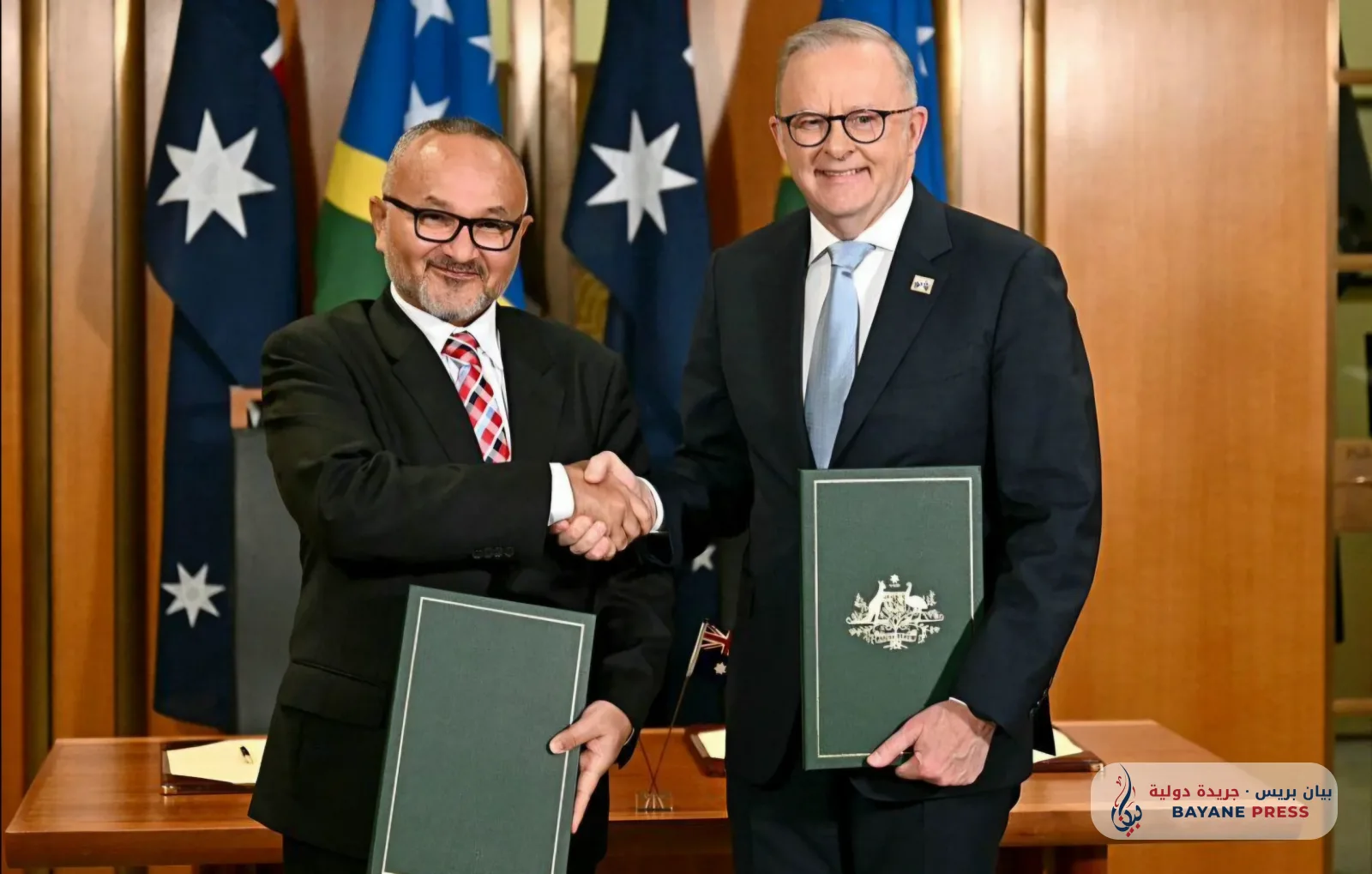
The South Pacific has witnessed a new strategic shift after Australia and the Solomon Islands signed a comprehensive treaty for security, economic, and development cooperation on Wednesday, November 25, 2026, which is set to strengthen Canberra's position in the region and limit opportunities for Chinese military expansion in this vital part of the world.
The treaty was signed in the Australian capital, Canberra, by Australian Prime Minister Anthony Albanese and his Solomon Islands counterpart, Matthew Wale, in the presence of government officials from both countries, marking the culmination of negotiations that began following Wale's visit to Australia last June.
The treaty establishes Australia as the primary security partner for the Solomon Islands, with the South Pacific nation committing not to allow the establishment of any foreign military or security base on its territory, in addition to protecting its sensitive facilities from military use, external interference, and unauthorized access.
It also includes commitments to prior consultation with Australia regarding critical infrastructure projects and security cooperation with countries that are not members of the Pacific Islands Forum, while affirming the sovereignty of the Solomon Islands and its right to determine its needs and choose its partners.
Under the agreement, Canberra pledges to continue supporting the development of the Royal Solomon Islands Police Force, enhancing its operational capabilities, and improving border management systems, thereby increasing the archipelago's ability to face security challenges.
The treaty is not limited to security aspects but includes a package of economic and social commitments related to supporting the Solomon Islands' general budget, funding free education policies, developing sustainable roads and infrastructure, and investing in renewable energy projects.
It also includes expanding employment opportunities for Solomon Islanders in Australia, particularly in the childcare and aged care sectors, alongside developing vocational training programs and facilitating visa access, extending their validity and permitted stay durations.
However, the geopolitical dimension of the treaty remains the most significant, given the security agreement signed by the Solomon Islands with China in 2022, under former Prime Minister Manasseh Sogavare, which at the time raised concerns in Australia and the United States regarding the potential for a Chinese military facility in the region.
The Solomon Islands are located approximately two thousand kilometers northeast of Australia, a location that grants them strategic importance in security calculations related to the South Pacific.
The Australian Broadcasting Corporation revealed that the Solomon Islands government has unofficially informed Beijing of its intention not to renew the Chinese security agreement when it expires in April 2027.
But Prime Minister Matthew Wale refrained, during the joint press conference, from confirming this information, citing a confidentiality clause in the agreement with China and noting that discussions with Chinese authorities are ongoing.
Wale also announced his government's intention to present legislation to Parliament during the coming January or February, with the aim of enshrining the commitments contained in the new treaty within the domestic legal framework.
The agreement comes as part of broader Australian moves to strengthen security partnerships with Pacific nations, after Canberra concluded agreements with Papua New Guinea, Vanuatu, and Fiji, in the context of growing competition with China for regional influence.
Although the new treaty does not absolutely prohibit the establishment of security relations with countries outside the region, it sets clear controls for these partnerships and prioritizes cooperation with Pacific nations, led by Australia.
These developments constitute a test of the nature of Chinese influence in the region, as the Solomon Islands seek to balance their development needs, security commitments, and relations with competing international powers, without the fate of their security agreement with Beijing having been officially settled in public statements thus far.
Comments (0)
No comments yet. Be the first to react!