

Monday, November 23, 2026
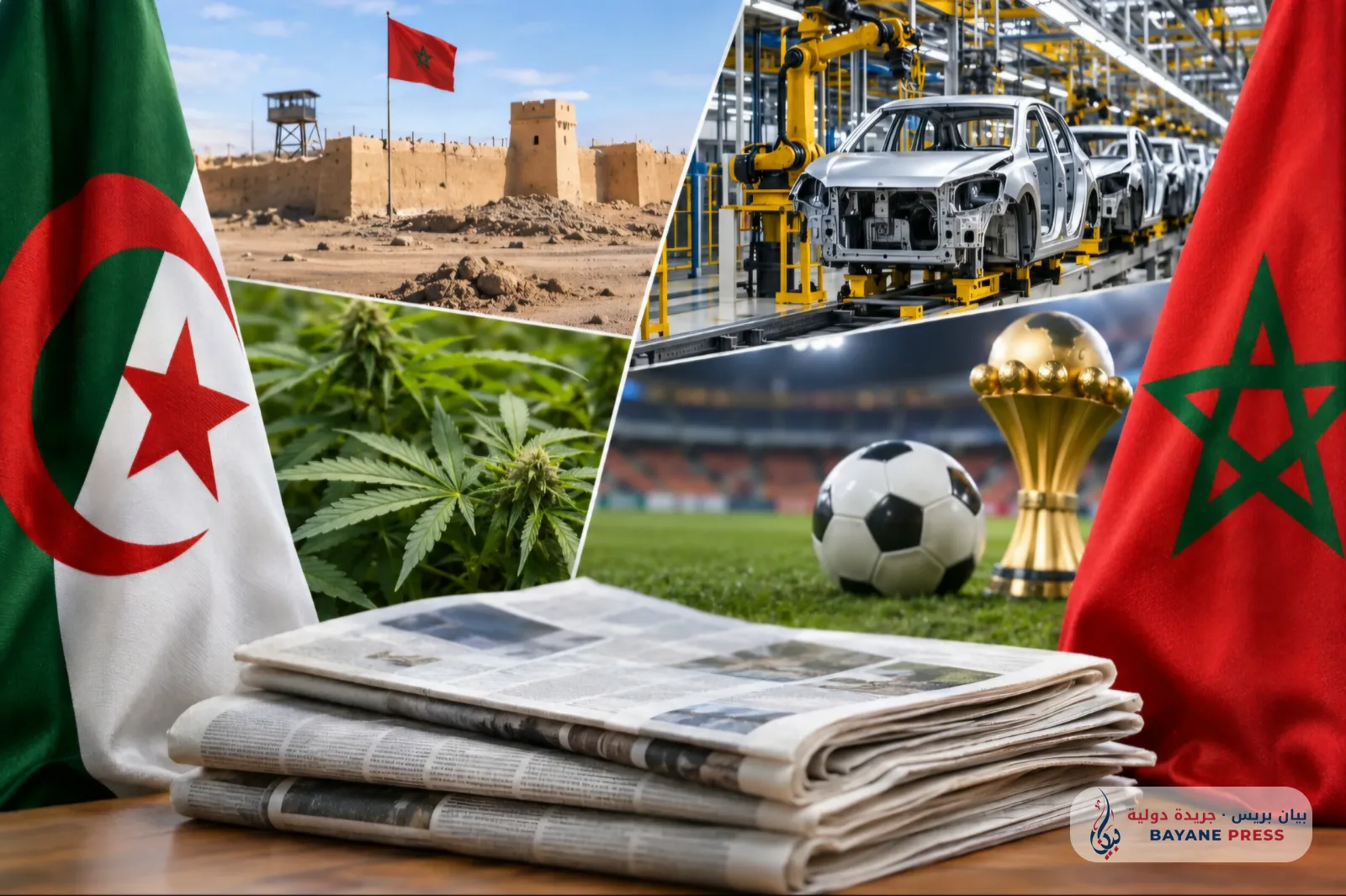
Morocco returned to the forefront of several Algerian news outlets on Monday, November 23, 2026, in coverage that blended military warnings, economic criticism, and drug-related accusations, alongside sports developments. While these reports cover various files, a reading of their content reveals a striking presence of Morocco in the Algerian media discourse, raising questions about the boundaries between reporting facts, political analysis, and the use of contentious issues to shape an image of the Kingdom.
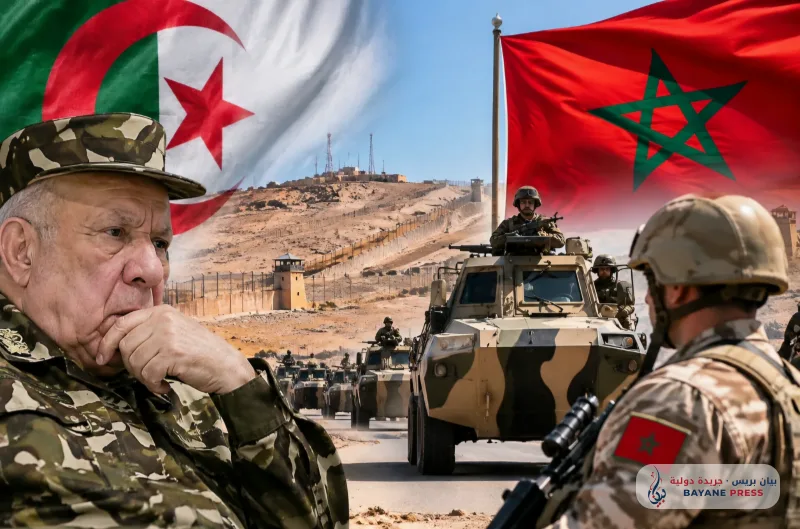
In an article titled "Polisario Redeployment: Dangerous Repercussions for the Region!", the Algerian newspaper "Echorouk", written by Hamdi Yahdih, discussed potential scenarios for field developments in the Moroccan Sahara following the end of the UN mission "MINURSO" on October 31, after the Security Council failed to renew its mandate.
The author speculated on the possibility of Morocco taking military steps to expand its field control, citing a number of factors, including military cooperation with Israel, American support, and relations with the UAE and Mauritania. He also warned of the possibility of the Polisario resorting to drones and long-range missiles, speaking of repercussions that could exceed the region's borders and the possibility of regional and international parties intervening if the confrontation widens.
However, these perceptions, despite their gravity, remain conclusions drawn by the article's author, and not proven information regarding the existence of a Moroccan military decision or international arrangements to implement it. Furthermore, talk of potential military movements by Algeria or Russia is not based in the published material on any official announcement confirming these hypotheses.
Conversely, Morocco had confirmed, following the end of the MINURSO mission, its continued commitment to the ceasefire, as announced after a working session chaired by King Mohammed VI on November 4. This is a fundamental factor in reading the security situation, because the end of a UN mission does not automatically mean the collapse of ceasefire commitments, nor does it prove the existence of preparations for a new war.
In a different vein, the newspaper "Tout sur l'Algérie", known as "TSA", chose to address the future of the Moroccan automotive industry through an article by journalist Riad Hamadi titled "Automotive Industry: The Limits of the Moroccan Model". The report focused on the potential repercussions of the European industrial trend known as "Made in Europe", which aims to strengthen production within the European Union and grant privileges to products meeting European origin requirements.
The newspaper considered that Morocco's reliance on foreign investment and European markets might make it vulnerable to economic challenges, especially for export-oriented factories, led by Renault and Stellantis facilities in Tangier and Kenitra. It cited statements by the Moroccan Minister of Industry and Trade, Ryad Mezzour, regarding the Kingdom's concerns about its products being excluded from certain European support and demand mechanisms, and the redirection of industrial investments that were expected in Morocco toward European sites.
However, this economic discussion, despite its importance, does not mean that the Moroccan automotive industry has become threatened with collapse. The European trend is still linked to a legislative and regulatory path, and depriving Moroccan products of some potential privileges is not equivalent to banning their exports to European markets. The strength of the Moroccan industrial base, the volume of existing investments, and the Kingdom's ability to diversify partnerships and markets remain key factors in assessing the actual impact of these shifts.
As for the newspaper "L’Expression", it dedicated a prominent piece to Morocco titled "A Kingdom Flooded with Hashish", written by Said Bousta, which addressed cannabis cultivation and drug trafficking, and leveled accusations against Moroccan institutions of being lenient with these activities.
The article relied on varying numerical data, including an estimate of cannabis cultivation areas reaching 400,000 hectares, attributed to expert Hassan Kacimi, in addition to the figure of 134,000 hectares linked to estimates by the United Nations Office on Drugs and Crime.
However, scrutiny reveals that the latter UN figure dates back to a survey conducted for the year 2003 and cannot be adopted as a description of the current situation, while the 400,000-hectare estimate remains in need of independent field data to confirm its validity rather than relying on fortune-telling. Furthermore, accusations regarding the protection of Moroccan official institutions for drug trafficking do not become proven facts simply by being published in a newspaper article.
Addressing this file requires recalling the transformations Morocco has undergone since the adoption of Law No. 13.21 regulating the legitimate uses of cannabis in medical, pharmaceutical, and industrial fields, and the establishment of a national agency tasked with regulating related activities. Despite the persistence of challenges related to illegal cultivation and smuggling, ignoring this regulatory framework leads to presenting an incomplete picture of the reality of the sector.
In the security context, the newspaper "Ennahar" published a report on an operation carried out by the judicial police in the city of Cherchell, in Tipaza province, during which it announced the arrest of a suspect and the seizure of three kilograms and 780 grams of processed cannabis, along with a sum of money that authorities said was from the proceeds of trafficking.
The newspaper quoted the Algerian General Directorate of National Security as saying that the drugs were smuggled across the western border from Morocco, noting that they were found wrapped in pages of Moroccan newspapers. While the announcement of the seizure and arrest is based on an official security statement, determining the actual source of the drugs and their smuggling route remains subject to the results of the investigation and evidence related to the network. Packaging materials, regardless of their origin, are not enough on their own to prove the smuggling route or hold a specific state responsible for a criminal activity.
Algerian coverage was not limited to political, economic, and security files, as the website "Algerie360" addressed developments in the sports dispute related to the 2025 Africa Cup of Nations final between Morocco and Senegal, noting that a decision by the Court of Arbitration for Sport (CAS) is imminent.
An official statement issued by the court in Lausanne today, Monday, confirmed that the decision regarding the appeal of the Senegalese Football Federation against the Confederation of African Football and the Royal Moroccan Football Federation will be issued on Tuesday afternoon, November 24, 2026, emphasizing that any official announcement regarding the case will be issued exclusively through the court's channels.
Comparing these materials reveals that Algerian newspapers did not address Morocco from a single angle, but rather distributed their interests between anticipating military developments, discussing industrial challenges, raising drug issues, and following a sports dispute of a legal nature. However, the difference in the nature of these topics requires a clear distinction between confirmed news, political opinion, and unproven accusations.
It is noticeable that some coverage moved from presenting data to building broad conclusions about the future of Morocco and its international relations, without always having sufficient evidence to support them. This opens a wider discussion about the role of the media in Moroccan-Algerian relations, especially when disputed security and political files become recurring material for headlines and analyses.
Economic or security criticism of Morocco remains a legitimate journalistic practice when based on facts, just as discussing the repercussions of the end of the MINURSO mission or the challenges of Moroccan industry falls within the core of media work. But credibility requires that possibilities do not turn into facts, that old statistics are not used to measure a new reality, and that political accusations are not presented as final judgments.
The presence of Morocco in the headlines of the Algerian press on November 23 is not limited to the multiplicity of news published, but also reflects the continued influence of political and regional disputes on the way some platforms handle the Kingdom's affairs. Between what documents prove and what analyses suggest, the real challenge for the press remains to present the full truth, far from selectivity and exaggeration, because the strength of an article is not measured by the sharpness of the accusation, but by the solidity and accuracy of the information.
Comments (0)
No comments yet. Be the first to react!