


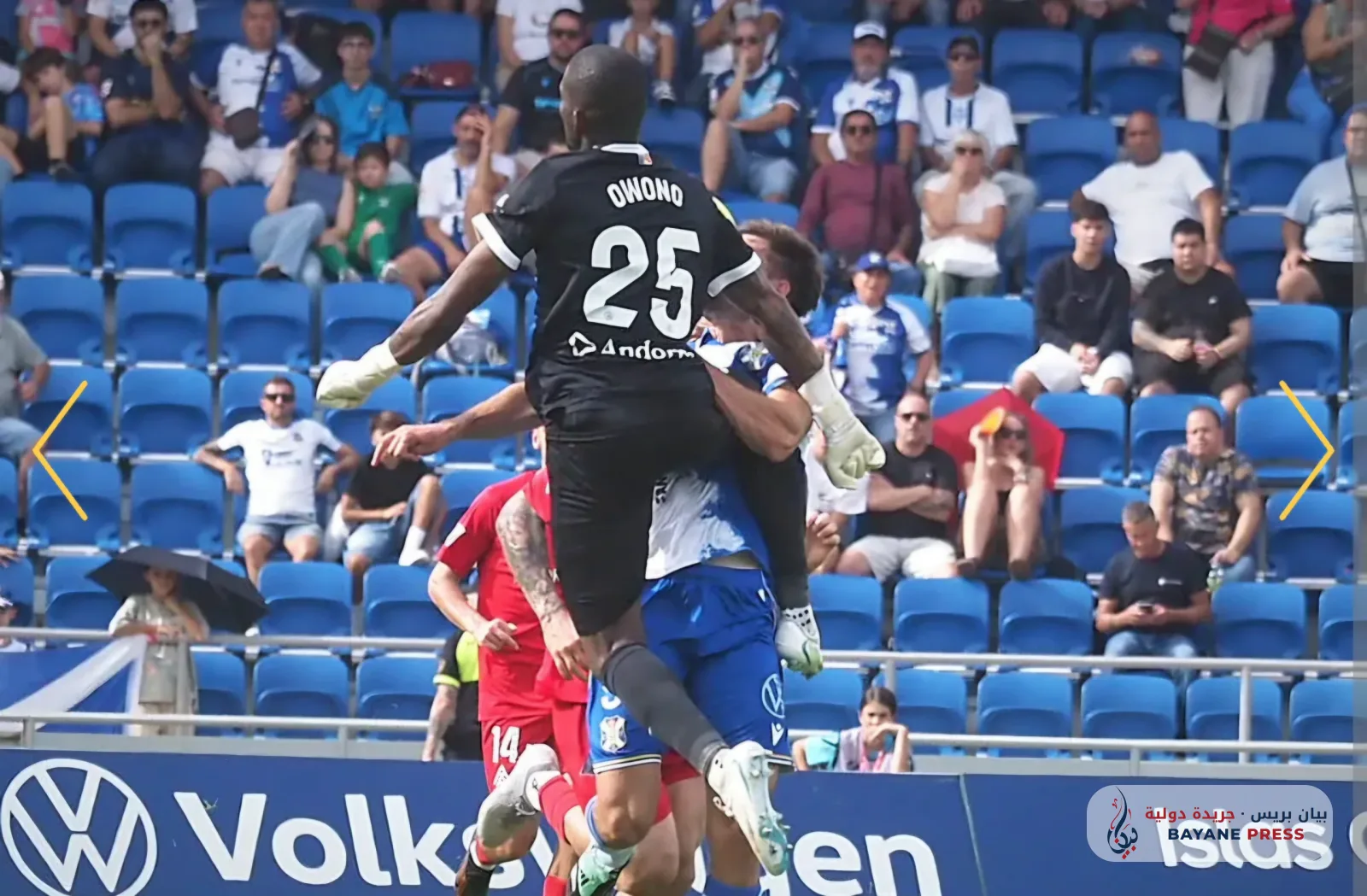
A Spanish league football match turned into a human tragedy that shook the sporting world, following the passing of player Jesús de Miguel Alameda, the striker for Tenerife, at the age of 30, as a result of a violent collision with Andorra goalkeeper Jesús Owono. The incident prompted the Spanish National Police to launch a judicial investigation to determine the circumstances of the death, amid a widespread wave of grief and solidarity extending far beyond Spanish stadiums.
The details of the incident trace back to the evening of Monday, November 2, 2026, during the clash hosted at the Heliodoro Rodríguez López Stadium in Santa Cruz de Tenerife, as part of the Spanish Second Division. Goalkeeper Jesús Owono rushed out of his penalty area to intercept a long ball, simultaneously as striker de Miguel advanced toward it. The challenge ended in a powerful collision where the player received a blow to the chest area before falling to the ground and entering a critical condition.
The scene caused panic inside the stadium after it became apparent that the player had suffered a cardiorespiratory arrest, prompting urgent medical intervention to perform resuscitation efforts. Although the medical staff managed to restore his pulse inside the ambulance and transferred him to the Nuestra Señora de la Candelaria Hospital, his health condition deteriorated critically, particularly neurologically, before his death was announced on the morning of Tuesday, November 3, 2026, at eight o'clock local time.
The match referee had shown a direct red card to the Andorra goalkeeper for his violent challenge, before suspending the match—which was tied at two goals apiece—in a decision imposed by the severity of the striker's health condition and the impossibility of continuing play under the tragic circumstances witnessed on the pitch.
On the security front, the Homicide Group of the Spanish National Police initiated investigation procedures under the supervision of the competent judicial authorities, while the public prosecutor's office began following the case to ascertain the nature of the collision and determine whether there is potential criminal liability beyond the scope of a sporting foul.
Spanish judicial sources explained that opening an investigation in such cases represents a legal procedure mandated by the nature of an unnatural death, whether caused by an accidental event or an act that could potentially constitute a crime. This makes investigating the possibility of manslaughter a procedural step to verify the facts, rather than a fixed accusation against the goalkeeper.
In this context, the Public Prosecutor in Santa Cruz de Tenerife, José Luis Sánchez Jáuregui, pointed out that the likelihood of pursuing criminal prosecution seems low, given that the collision occurred during a contest for the ball, while the determination of legal responsibilities remains tied to the investigation results and available evidence.
The case opens a legal and sports debate regarding the dividing line between permitted physical challenges on the pitch and interventions that may entail serious consequences, especially when a sporting foul turns into an accident resulting in the loss of a player's life. It also highlights the importance of distinguishing between disciplinary sanctions decided by football bodies and criminal responsibility that requires proving independent legal elements.
Amid these developments, Tenerife announced six days of mourning and the suspension of its teams' activities, while the Royal Spanish Football Federation decided to postpone the Copa del Rey and Copa de la Reina matches scheduled for November 3, 4, and 5, as an expression of solidarity with the player's family and the stricken club.
The wave of condolences extended to a number of international football stars and European clubs, while grief enveloped Tenerife fans who received the news of the death with profound shock, at a time when the Andorra goalkeeper found himself amidst psychological pressure and widespread criticism, despite no criminal liability being proven against him.
While Spanish authorities continue their procedures to uncover the exact circumstances of the incident, the death of Jesús de Miguel remains one of the most painful accidents in Spanish stadiums in recent years, after a moment of sporting competition ended in a human tragedy, leaving behind a heartbroken family, shocked teammates, and legal and medical questions still awaiting definitive answers.

Comments (0)
No comments yet. Be the first to react!