

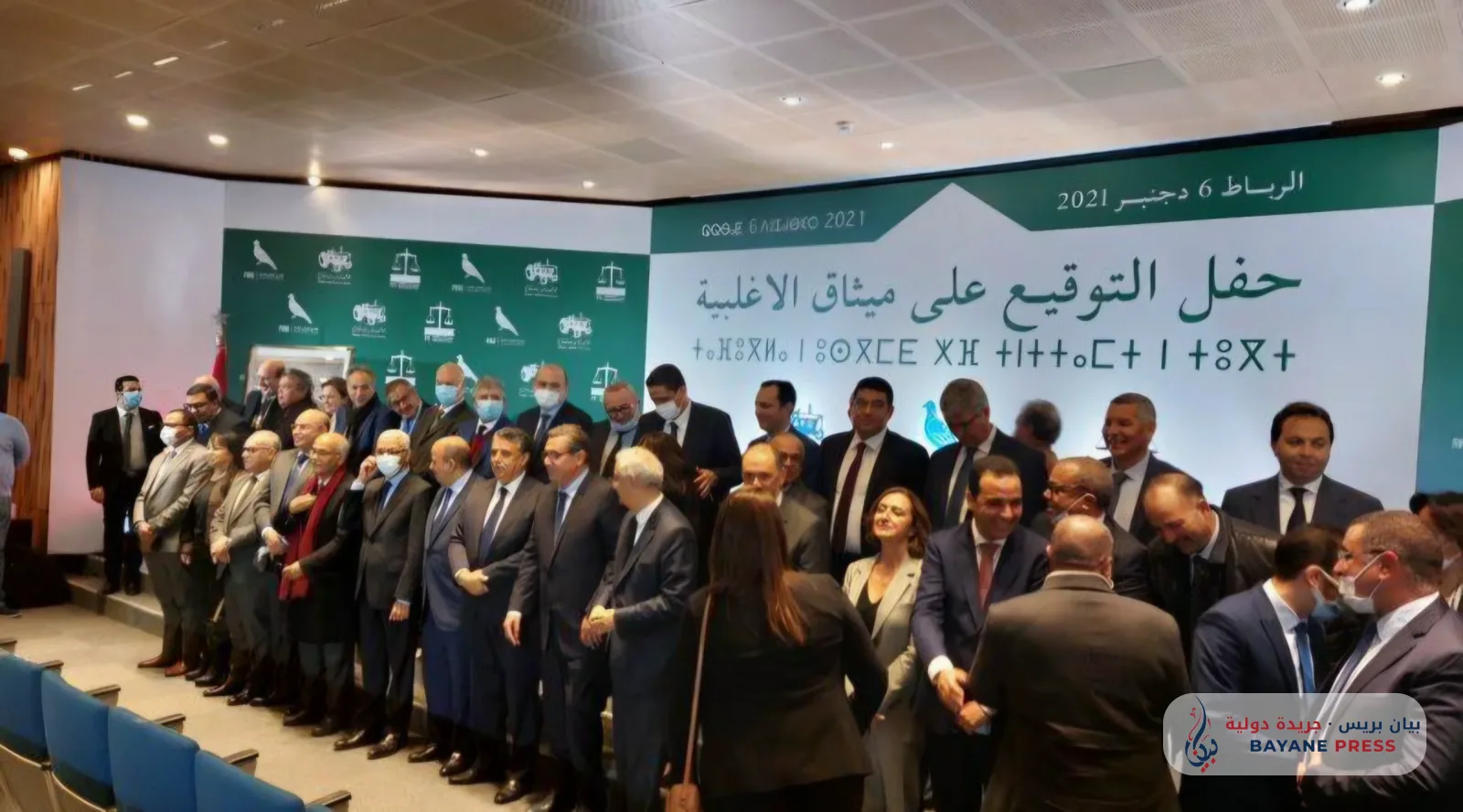
The government majority in Morocco has entered a new phase of organizing its political and parliamentary relations, following the signing of a joint charter by its six constituent parties on Tuesday evening, November 24, 2026, in Rabat, to frame their commitments during the legislative term spanning from 2026 to 2031.
The charter was signed by Fatima Zahra Mansouri for the Authenticity and Modernity Party (PAM), Nizar Baraka for the Istiqlal Party, Driss Lachgar for the Socialist Union of Popular Forces (USFP), Mohamed Nabil Benabdallah for the Party of Progress and Socialism (PPS), Mohamed Joudar for the Constitutional Union, and Abdessamad Archane for the Social Democratic Movement.
The charter establishes a political, ethical, and contractual framework to organize joint work among the majority components by setting up mechanisms to coordinate positions, monitor the implementation of the government program, and evaluate its results, in addition to organizing legislative and oversight initiatives within both houses of Parliament.
The document includes the creation of four coordination bodies, including the Majority Presidency, which brings together the leaders of the six parties under the chairmanship of Head of Government Fatima Zahra Mansouri, alongside bodies dedicated to coordinating parliamentary work within the House of Representatives and the House of Councilors.
However, the most notable political consensus revealed during the meeting was Nizar Baraka's announcement that the majority components have agreed to support a joint candidate from the Istiqlal Party for the presidency of the House of Councilors, ahead of the upcoming elections in 2027.
This consensus constitutes a political commitment between the coalition members, rather than a final decision to assign the presidency of the upper house, the election of which remains subject to established legal procedures.
The meeting also addressed several priorities related to combating corruption and conflicts of interest, improving citizens' purchasing power, strengthening governance, developing public services, and continuing reforms in the education, health, water, energy, and industrial sectors.
The charter thus draws new rules for managing the relationship between the majority components, while the implementation of the announced commitments and their impact on economic and social conditions will remain the benchmark for evaluating the effectiveness of this political contract.

Comments (0)
No comments yet. Be the first to react!